
Train Conductor — solve it right on the sheet.
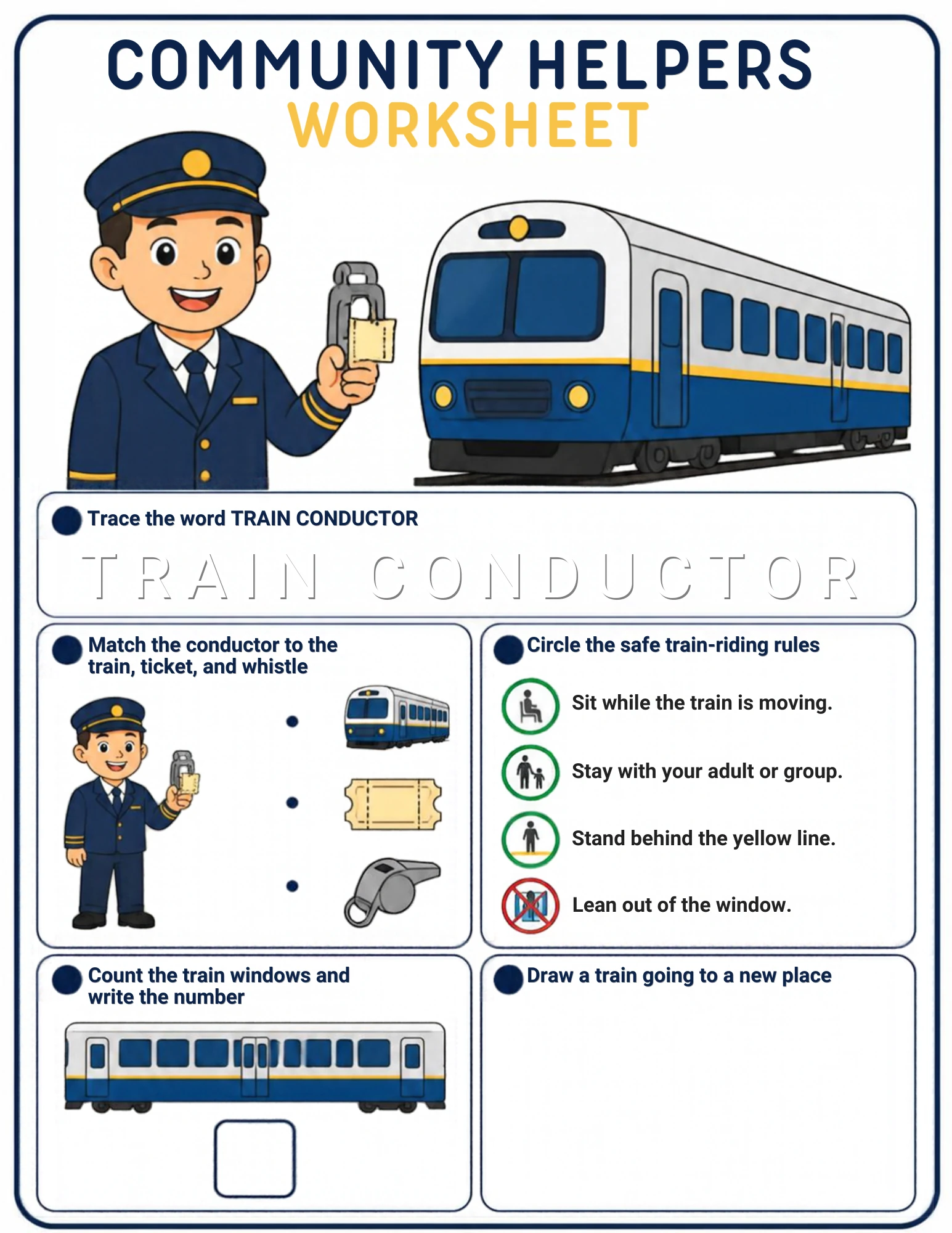
Trace TRAIN CONDUCTOR, match the conductor to the train, the ticket and the whistle, circle the safe train-riding rules, count the train windows and draw a train going somewhere new.
Your sheet is ready.
Pick a color or the eraser, then trace, match, circle, count and draw straight on the sheet with your finger, a stylus or the mouse. Press Save my work when you are proud — that is what marks this activity cleared for your child.
What this worksheet teaches.
What the child is learning: What a train conductor does aboard the cars, the four rules of riding trains safely, and which rules are safe and which are not — plus how to write the words TRAIN CONDUCTOR.
Knowledge to have ready: The conductor checks tickets, calls the stations and keeps every rider on course: the ticket is your pass to ride, the whistle wakes the train, and the yellow line on the platform is the place where waiting feet stop. Windows are for looking — never for leaning!
Why this activity matters: Trains are magical AND heavy, which is exactly why the yellow line matters. Sorting safe from unsafe rules gives your child the platform talk before the platform does — and the somewhere-new draw box turns rail safety into adventure planning.
- Train vocabulary
- Tool matching
- Platform safety
- Safe-versus-unsafe sorting
- Word tracing
- Journey drawing
What to say before you start: "This is the train conductor — the captain of the whole train. Trace the two words, then connect the train, the ticket and the whistle. Now the four rules: which are safe? Count the windows on the long train, and then draw where YOUR train would go — somewhere brand new!"
What to look for on the sheet: Find the engine at the front of the long train and count the cars it pulls. In the grid, read each rule aloud — sitting bottoms, staying close to your adult, waiting feet behind the yellow line — and let your child veto the window-lean with a strong NO.
Questions to ask along the way: "What does the conductor do with the ticket?" "Which three train rules are safe?" "Why do we stand behind the yellow line?" "Where would YOUR train go first?"
Helpful hints without giving it away: Three rules keep every rider on track and one tips people out the window — the wobbly one is about leaning. Read all four with wide-open ears; the safe ones stand still and the unsafe one stretches.
Parent tips: On a real platform, the ritual is: hand in hand, back from the yellow line, and never near the edge while the train arrives. Say it the same way every time — sameness is what makes the rule stick when the whistle blows.
Understanding check: Ask: "Who is the captain of the train? Name two safe train rules. Where do waiting feet stop?" The conductor, two rules, the yellow line = the sheet landed.
Real-life practice: Ride a real train, a tram or the airport shuttle this month and rehearse the sheet: ticket checked, yellow line respected, window admired with eyes only. The somewhere-new box comes true the moment the wheels start.
This activity belongs to Class 33 — Community Helpers & Our Neighborhood on the Learning Path. Progress is saved on this device for the child chosen in My Classroom — and only a real save of finished work marks it cleared, never just opening the page.
How did it go?
One tap, no writing, no name. Pick the face that matches how it went — reactions are counted instantly and stay anonymous.
Parent reviews.
A different thing from the quick faces above: a star rating for the grown-ups, plus an optional line about how it went. Every review is read by the school office before it appears.
No parent reviews yet — yours could be the first.
Parent comments.
How did you use this page Share the game, the moment or the trick that worked in your house. Comments are read by the school office before they appear, and they are about your ideas — never about your child.
No parent comments yet — yours could be the first.