
Florist — solve it right on the sheet.
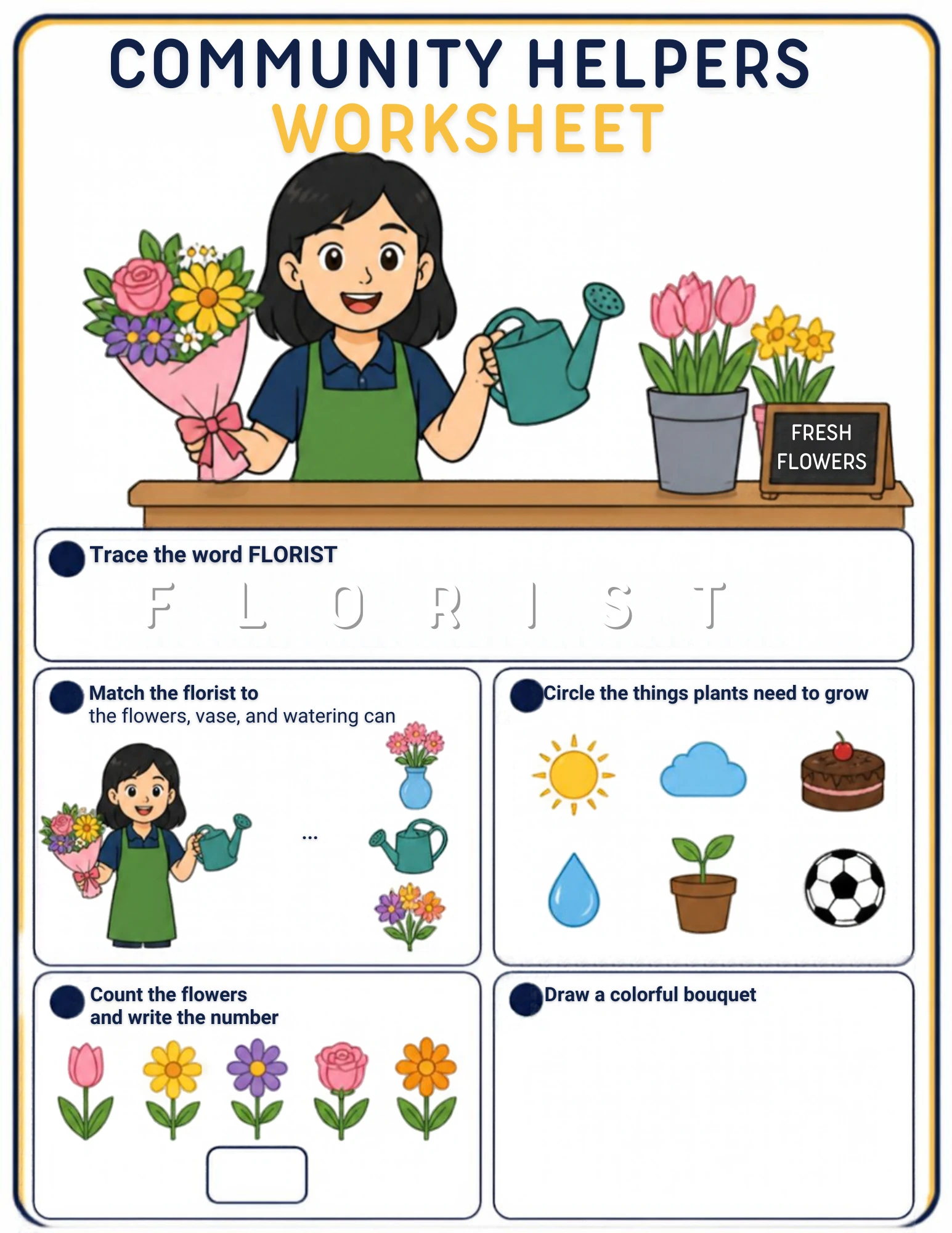
Trace FLORIST, match the florist to the flowers, the vase and the watering can, circle the things plants need to grow, count the flowers and draw a colorful bouquet.
Your sheet is ready.
Pick a color or the eraser, then trace, match, circle, count and draw straight on the sheet with your finger, a stylus or the mouse. Press Save my work when you are proud — that is what marks this activity cleared for your child.
What this worksheet teaches.
What the child is learning: What a florist arranges and sells, what every plant needs to grow — sun, water and care — and how to tell plant-helpers from party guests — plus how to write the word FLORIST.
Knowledge to have ready: A florist works with flowers: the vase holds the bouquet, the watering can gives each stem a drink, and every flower in the shop was once a seed that needed sun, rain and soil. Chocolate cake is wonderful — but no plant ever grew from cake!
Why this activity matters: This sheet hides a science lesson inside a flower shop: what a living thing truly needs. The plant-needs grid builds the earliest biology sorting there is, and the bouquet draw box ends the sheet with generosity — flowers are how people say kind things.
- Plant vocabulary
- Tool matching
- Plant-needs sorting
- Word tracing
- Counting practice
- Bouquet drawing
What to say before you start: "This is a florist — the helper who makes bouquets out of flowers. Trace the name, then connect the flowers, the vase and the watering can. Now the six pictures: which ones help plants grow? Count the flowers petal by petal, and then draw a bouquet — who should we pretend to give it to?"
What to look for on the sheet: Find the watering can and ask what it gives the flowers — a drink, just like you! In the grid, ask of each tile: sun, water, or something a plant cannot eat? In the draw box, ask for at least three colors; florists are not shy with color.
Questions to ask along the way: "What does a florist sell?" "What three things does every plant need to grow?" "Which grid tiles are party guests instead?" "Who would you give a real bouquet to, and why?"
Helpful hints without giving it away: Two tiles in the grid are visitors from a birthday — one is sweet and one bounces. Ask of each: does a seed drink this, grow toward this — or would this just sit there? The little seedling in its pot is a big clue.
Parent tips: Grow something this week — a bean in a wet cotton ball counts completely. Let your child water it with a real can and watch for the first sprout: the grid’s sun, water and seedling, alive on a windowsill.
Understanding check: Ask: "Who arranges flowers for a living? Name two things plants need to grow. How many flowers?" The florist, two needs, the count = the sheet landed.
Real-life practice: Buy or pick three stems this week and let your child arrange, water and display them — then deliver one flower to a neighbor. Flowers are kindness with stems; the sheet just says it in pencil.
This activity belongs to Class 33 — Community Helpers & Our Neighborhood on the Learning Path. Progress is saved on this device for the child chosen in My Classroom — and only a real save of finished work marks it cleared, never just opening the page.
How did it go?
One tap, no writing, no name. Pick the face that matches how it went — reactions are counted instantly and stay anonymous.
Parent reviews.
A different thing from the quick faces above: a star rating for the grown-ups, plus an optional line about how it went. Every review is read by the school office before it appears.
No parent reviews yet — yours could be the first.
Parent comments.
How did you use this page Share the game, the moment or the trick that worked in your house. Comments are read by the school office before they appear, and they are about your ideas — never about your child.
No parent comments yet — yours could be the first.