
Mechanic — solve it right on the sheet.
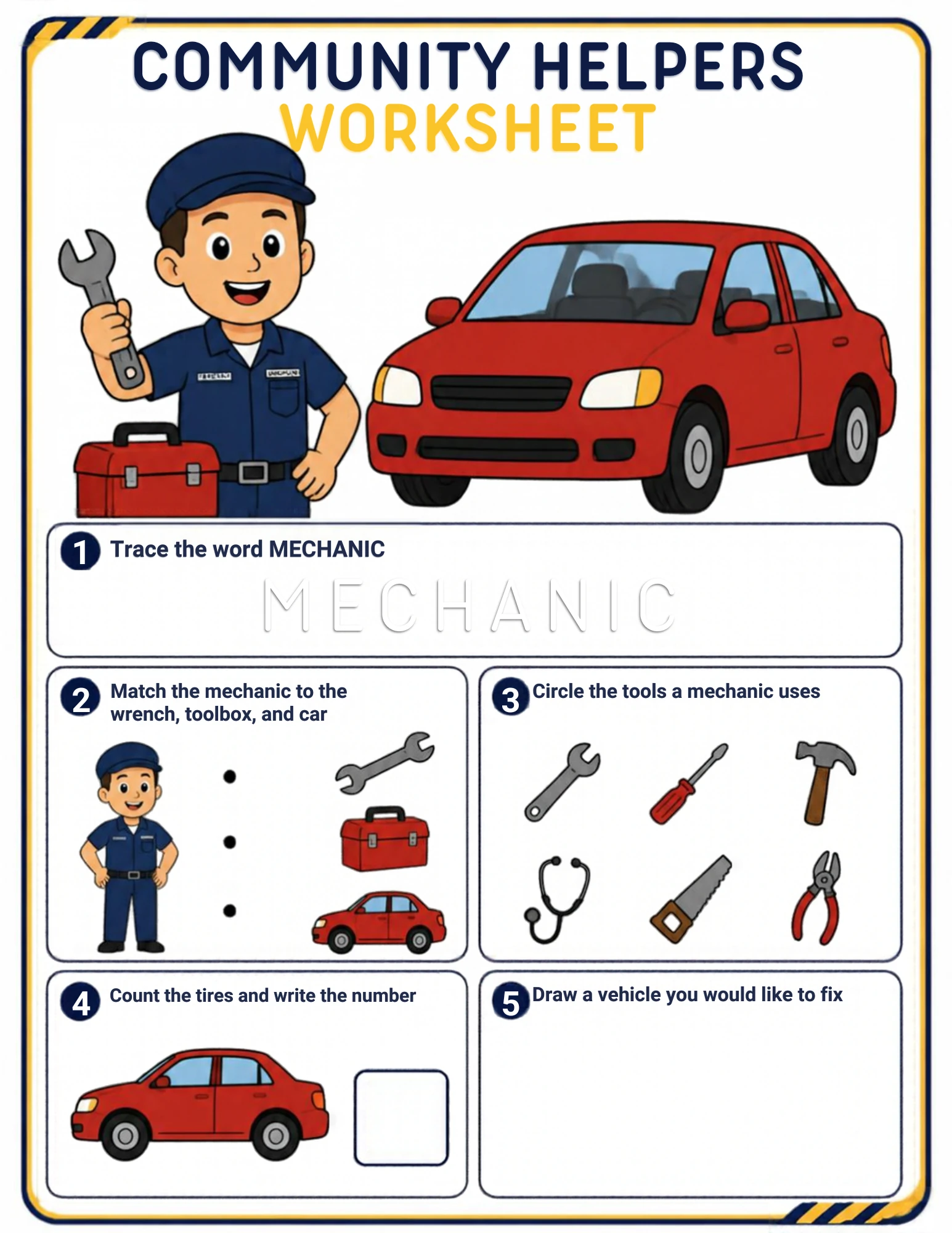
Trace MECHANIC, match the mechanic to the wrench, the toolbox and the car, circle the tools a mechanic uses, count the tires and draw a vehicle you would like to fix.
Your sheet is ready.
Pick a color or the eraser, then trace, match, circle, count and draw straight on the sheet with your finger, a stylus or the mouse. Press Save my work when you are proud — that is what marks this activity cleared for your child.
What this worksheet teaches.
What the child is learning: What a mechanic fixes under the hood, which tools mend engines, and how to tell a mechanic’s tools from a doctor’s — plus how to write the word MECHANIC.
Knowledge to have ready: A mechanic keeps cars and trucks running: the wrench turns the bolts, the toolbox holds every size, and the car rolls up on its tires for a check. Here is a funny one — a stethoscope listens to hearts, not engines; that tool belongs to the doctor!
Why this activity matters: The mechanic-versus-doctor mix-up is the funniest, most memorable sort on the whole set — and memorable is the point. Naming the garage world makes every oil stop interesting, and the vehicle draw box turns observers into little engineers.
- Garage vocabulary
- Tool matching
- Job-versus-job sorting
- Word tracing
- Counting practice
- Vehicle drawing
What to say before you start: "This is a mechanic — the helper who keeps cars running strong. Trace the name, then connect the wrench, the toolbox and the car. Now the six tools: which ones fix engines? One of them is very silly here! Count the tires on the red car, and then draw the vehicle YOU would love to fix."
What to look for on the sheet: Find the red car in the match row and count its wheels right on the sheet. In the grid, ask of each tool: would this fix an engine, a wooden shelf, or a person? The stethoscope is the giggler — it listens to people, not pickups. In the draw box, ask for a hood that really opens.
Questions to ask along the way: "What does the mechanic turn with the wrench?" "Which grid tool belongs to the doctor, and why is that funny?" "What do tires do for a car?" "What vehicle would YOU fix first — and what is broken on it?"
Helpful hints without giving it away: One tool in the grid is wearing the wrong uniform — ask "who listens with this, a mechanic or a doctor?" For every other tool, wonder out loud: would this turn a bolt, cut wood, or fix something else entirely?
Parent tips: Next oil change or tire stop, bring the vocabulary: let your child name the wrench, the jack, the tires. Garages are workplaces, not playgrounds — watching happens beside a grown-up, always.
Understanding check: Ask: "Who fixes cars? Name two mechanic tools from the grid. How many tires does the red car have?" The mechanic, two tools, the tire count = the sheet landed.
Real-life practice: Bicycle maintenance day: pump the tires, check the brakes, wipe the frame — with your child as head mechanic explaining each move. Two wheels are the perfect first garage.
This activity belongs to Class 33 — Community Helpers & Our Neighborhood on the Learning Path. Progress is saved on this device for the child chosen in My Classroom — and only a real save of finished work marks it cleared, never just opening the page.
How did it go?
One tap, no writing, no name. Pick the face that matches how it went — reactions are counted instantly and stay anonymous.
Parent reviews.
A different thing from the quick faces above: a star rating for the grown-ups, plus an optional line about how it went. Every review is read by the school office before it appears.
No parent reviews yet — yours could be the first.
Parent comments.
How did you use this page Share the game, the moment or the trick that worked in your house. Comments are read by the school office before they appear, and they are about your ideas — never about your child.
No parent comments yet — yours could be the first.