
Plumber — solve it right on the sheet.
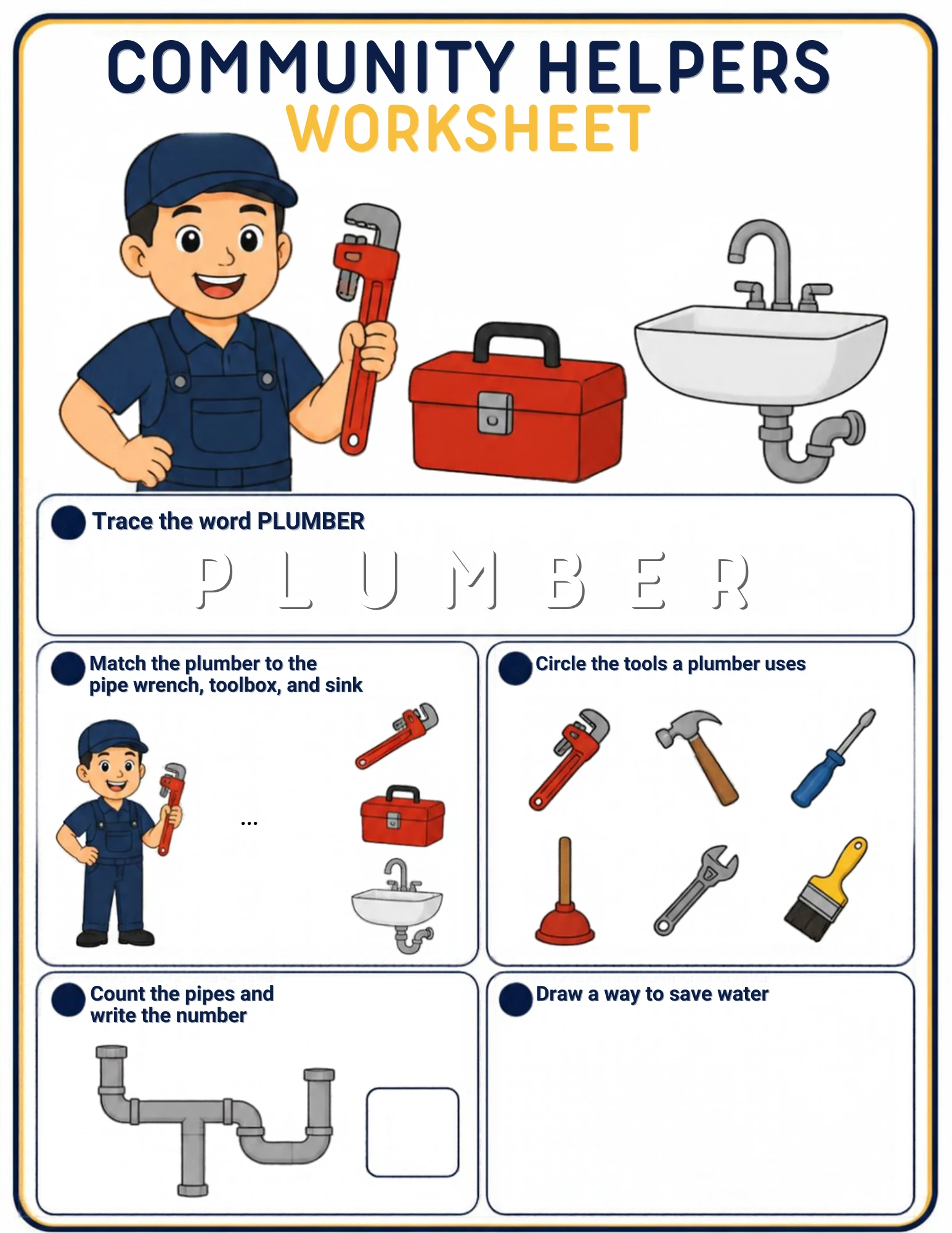
Trace PLUMBER, match the plumber to the pipe wrench, the toolbox and the sink, circle the tools a plumber uses, count the pipes and draw a way to save water.
Your sheet is ready.
Pick a color or the eraser, then trace, match, circle, count and draw straight on the sheet with your finger, a stylus or the mouse. Press Save my work when you are proud — that is what marks this activity cleared for your child.
What this worksheet teaches.
What the child is learning: What a plumber fixes behind walls and under sinks, which tools steer the water, and why water is worth saving — plus how to write the word PLUMBER.
Knowledge to have ready: A plumber takes care of the pipes that bring clean water in and carry used water out: the pipe wrench turns big pipe nuts, the plunger politely pushes a blockage away, and the toolbox holds it all. Water is precious — turning the tap off while brushing is a plumber’s favorite trick.
Why this activity matters: Plumbers are invisible helpers until a pipe bursts, and this sheet makes them visible and valued. The tool grid invites careful talk about each tool, and the save-water draw box plants an earth-caring habit that pays for itself on the next bill.
- Community helper vocabulary
- Tool matching
- Water awareness
- Word tracing
- Counting practice
- Water-saving drawing
What to say before you start: "This is a plumber — the helper who takes care of our water pipes. Trace the name, then connect the pipe wrench, the toolbox and the sink. Now the six tools: which ones does a plumber really use? Let’s talk about each. Count the pipes, and then draw one way to save water at home."
What to look for on the sheet: Find the sink in the match row and trace where the water goes. In the grid, take each tool one at a time — the hammer builds, the paintbrush paints, and the wrenches and the plunger work with water. In the pipe drawing, pipes bend and cross; follow each one with a finger so the count stays true.
Questions to ask along the way: "What does the pipe wrench turn?" "Which two grid tools belong to a builder and an artist instead?" "Where does the water go when it leaves our sink?" "How can WE save water today?"
Helpful hints without giving it away: Two tools in the grid never touch a pipe — one bangs nails and one swims in paint. Ask of each tool: does this help water flow, or does it do a different job altogether?
Parent tips: Turn the tap off while brushing teeth — two minutes, twice a day, a small bucket saved every single time. If a plumber ever visits, let your child watch the wrench work and hand over the flashlight: helpers love small apprentices.
Understanding check: Ask: "Who fixes the pipes? Name two plumber tools from the grid. How can we save water?" The plumber, two tools, one saving idea = the sheet landed.
Real-life practice: Tonight, brush teeth with the tap OFF and count the seconds together — then celebrate the saved water out loud. Small ritual, real habit, exactly what the draw box was for.
This activity belongs to Class 33 — Community Helpers & Our Neighborhood on the Learning Path. Progress is saved on this device for the child chosen in My Classroom — and only a real save of finished work marks it cleared, never just opening the page.
How did it go?
One tap, no writing, no name. Pick the face that matches how it went — reactions are counted instantly and stay anonymous.
Parent reviews.
A different thing from the quick faces above: a star rating for the grown-ups, plus an optional line about how it went. Every review is read by the school office before it appears.
No parent reviews yet — yours could be the first.
Parent comments.
How did you use this page Share the game, the moment or the trick that worked in your house. Comments are read by the school office before they appear, and they are about your ideas — never about your child.
No parent comments yet — yours could be the first.