
Scientist — solve it right on the sheet.
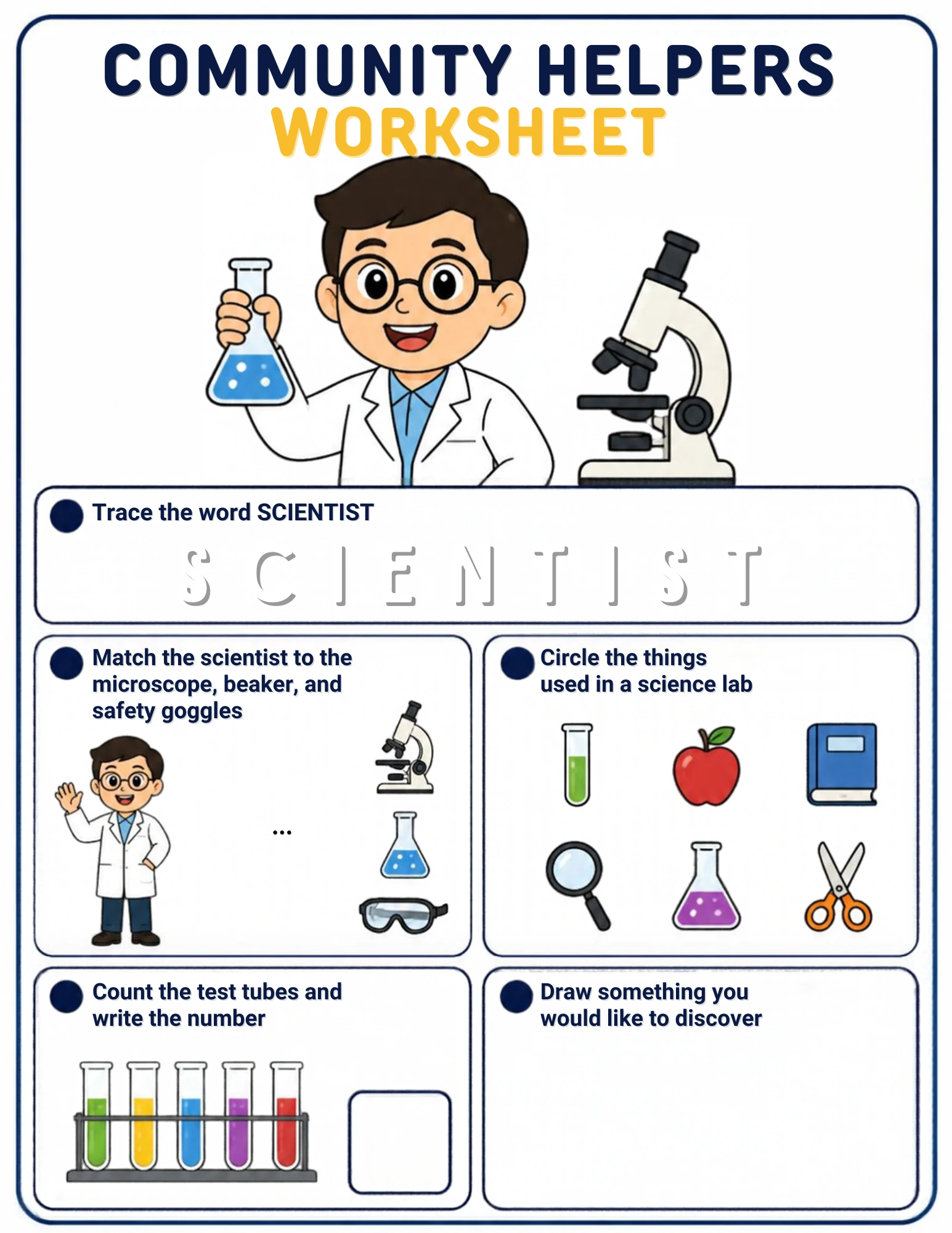
Trace SCIENTIST, match the scientist to the microscope, the beaker and the safety goggles, circle the things used in a science lab, count the test tubes and draw something you would like to discover.
Your sheet is ready.
Pick a color or the eraser, then trace, match, circle, count and draw straight on the sheet with your finger, a stylus or the mouse. Press Save my work when you are proud — that is what marks this activity cleared for your child.
What this worksheet teaches.
What the child is learning: What a scientist does in the lab, which tools hold, magnify and protect, and which grid tiles belong to the kitchen, the library and the craft box — plus how to write the word SCIENTIST.
Knowledge to have ready: A scientist asks questions and tests them: the microscope makes tiny things huge, the beaker holds liquids for mixing, and the safety goggles protect curious eyes. Test tubes, flasks and magnifying glasses live in the lab — apples live in kitchens, books in libraries, scissors in craft boxes!
Why this activity matters: The lab is where curiosity becomes a job, and this sheet hands your child the tools to imagine it. Tile-by-tile sorting builds the careful looking real science runs on, and the discover-draw box ends the whole collection with the biggest question of all: what will YOU find out?
- Science vocabulary
- Tool matching
- Lab sorting
- Word tracing
- Counting practice
- Discovery drawing
What to say before you start: "This is a scientist — the helper who asks questions and finds answers. Trace the name, then connect the microscope, the beaker and the safety goggles. Now the six pictures: which ones really work in a lab? Let’s talk about each one. Count the test tubes in the rack, and then draw something YOU would love to discover."
What to look for on the sheet: Find the goggles and ask what they protect — a scientist’s eyes come first! In the grid, go tile by tile and ask where each thing really lives: the lab, the kitchen, the library or the craft drawer. In the count row, test tubes stand in a rack like crayons in a box — count left to right, one touch each.
Questions to ask along the way: "What does the microscope make bigger?" "Why does a scientist wear goggles?" "Which grid tiles belong to other rooms — and which rooms?" "What would YOU love to discover one day?"
Helpful hints without giving it away: Take each tile to its home: the lab, the fruit bowl, the bookshelf or the craft table — ask of each: would this sit on a lab bench, or somewhere else altogether? The goggles-and-gloves scientist only uses what belongs in the lab.
Parent tips: Labs have one big rule worth borrowing at home: real experiments happen WITH a grown-up and safety first. Do a kitchen-lab session — baking soda, vinegar, goggles from the dress-up box — and let your child narrate like the scientist they drew.
Understanding check: Ask: "Who asks questions for a living? Name two lab tools from the grid. What do the goggles protect?" The scientist, two tools, the eyes = the sheet landed.
Real-life practice: Do one tiny experiment this week — sink or float, baking-soda fizz, a magnifying glass over a leaf. Ask first, guess second, watch third: that order IS science, and your child just did it.
This activity belongs to Class 33 — Community Helpers & Our Neighborhood on the Learning Path. Progress is saved on this device for the child chosen in My Classroom — and only a real save of finished work marks it cleared, never just opening the page.
How did it go?
One tap, no writing, no name. Pick the face that matches how it went — reactions are counted instantly and stay anonymous.
Parent reviews.
A different thing from the quick faces above: a star rating for the grown-ups, plus an optional line about how it went. Every review is read by the school office before it appears.
No parent reviews yet — yours could be the first.
Parent comments.
How did you use this page Share the game, the moment or the trick that worked in your house. Comments are read by the school office before they appear, and they are about your ideas — never about your child.
No parent comments yet — yours could be the first.