
Ask for Help — a step-by-step lesson for grown-up and child
This lesson teaches the sentence that keeps children safe and learning: "help, please" — when to try first, when to ask, WHO the trusted grown-ups are, and why asking is strength, never failure.
What is this?
Asking for help means telling a trusted grown-up when something is too hard, too scary or going wrong — with clear words: who, what, and "help, please."
What does it mean?
Struggling in silence helps nobody: the stuck zipper stays stuck, the lost feeling stays lost, the danger stays dangerous. Asking converts a problem into a solved one in seconds — and asking EARLY, before tears, is the master move.
What does the child need to know?
Two rules in balance: TRY first (one honest attempt — the zipper pulled, the block placed), then ASK. And know your list of trusted grown-ups by name: at home, at school, in the neighborhood. Asking a NAMED person beats hoping someone notices.
Why this matters
Children who ask for help early are safer — the lost child who asks a mommy-with-children is found in minutes — and learn faster, because no struggle can hide a needed lesson. Help asked for is also never met with a sigh in families that teach this lesson.
What it teaches
Self-advocacy (the seed of every skill adults call confidence), distinguishing solvable-from-stuck, naming trusted adults, clear sentence-building, and the emotional lesson that needing others is normal, not shameful.
Words to learn
helpasktrustedgrown-uptry firstproblem
Say this to your child
“"When something is too hard or too scary, you find a grown-up you trust and say: ‘Can you help me, please?’ First you try once — then you ask. Asking is not being small; it is being smart and safe. Do you know your trusted grown-ups? Let’s say their names."”
Step by step
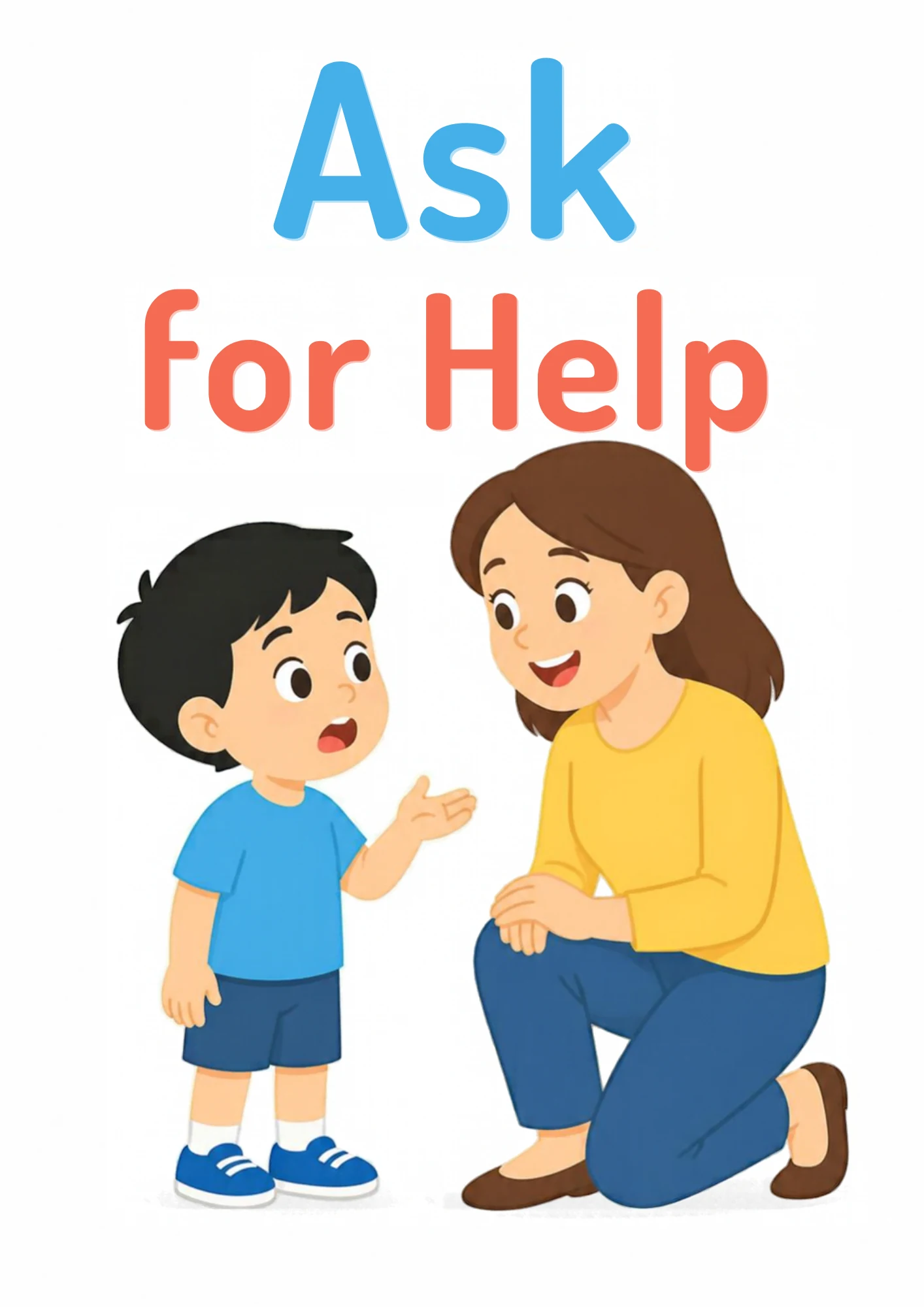
- Show the card: the boy’s palm is up, his mouth open mid-ask; the woman kneels close, listening warmly. Name both halves: the asking and the receiving.
- Teach the sentence in its full form: "Can you help me, please?" — plus the emergency short form: "HELP!" for real trouble.
- Build the trusted list together, by name: Mum, Dad, Grandma — and the school names, and the neighborhood names. A list with faces beats a rule without one.
- Rehearse the order: try once first, then ask — "pull the zipper once, then say help please" — so the asking rides on real effort, not instant surrender.
- Praise the asking itself, every time — especially when the ask came instead of a meltdown: "you ASKED — that was so smart."
Look closer at the picture
Ask your child: what is the boy doing with his hand — fist or open palm? Is his mouth quiet or asking? What is the grown-up doing — standing far away or kneeling close? Does her face look cross or kind? Who are YOUR trusted grown-ups?
Ask your child
"What do we say when something is too hard?" "What do we try first — the zipper or the ask?" "Who are your trusted grown-ups at home? At school?" "What is the loud word for real trouble?"
What your child can say or do
"Can you help me, please?" "I tried once, then I asked!" Your child may recite the trusted list like a roll of honour, or narrate a preschool moment: "Omar asked the teacher — that was smart."
Out in the real world
Asking happens everywhere: the shop assistant who finds the right size, the librarian who reaches the high shelf, the teacher with the stuck zipper, the neighbor when a ball goes over the wall. Each real ask is a rep with a real answer.
Try it together
Help-desk game: you are the helper at a "counter"; your child brings problems — a stuck jar, a tangled toy, a hard puzzle step — with the full sentence. Swap roles so your child hears what a good ask sounds like from the receiving end.
Understanding check
Ask: "What is the help sentence? What do we try first? Name two of your trusted grown-ups." The sentence, try-once, named grown-ups = landed.
Parent tips
Praise the asking, not just the solved problem — a child who is sighed at stops asking, and silent children find worse solutions. Model your own asks aloud: "I need help lifting this — watch how I ask." The list of trusted grown-ups needs refreshing each school year.
Staying safe
This lesson is a safety lesson wearing everyday clothes: teach the trusted-grown-up list as protection, the loud HELP for danger, and the rule that secrets a grown-up asks you to keep from your parents are never kept. Asking for help is also the skill behind every stranger-danger and body-safety talk to come.
This lesson pairs with the Ask for Help flashcard in the library — print it, show it, keep it on the fridge. Back to Life Skills & Good Habits (Class 32).