
Be Kind — a step-by-step lesson for grown-up and child
This lesson makes kindness small, visible and repeatable: what kind hands, kind words and a kind face actually DO at four, one tiny mission a day, and the bedtime hunt that makes kindness a habit.
What is this?
Being kind means noticing what someone else needs or feels and doing a small something about it — a greeting, a helping hand, a compliment, a share, a gentle wait.
What does it mean?
Kindness at four is concrete, not philosophical: it has hands (helping, holding, sharing), words (greetings, compliments, comfort) and a face (smiles, attention). Abstract "be good" teaches nothing; "give Sam the first turn" teaches everything.
What does the child need to know?
The daily mission: one small, named kindness per day, chosen in the morning, reported at bedtime. The bedtime kindness hunt — "when were you kind today? When was someone kind to you?" — closes the loop and trains the noticing.
Why this matters
Kindness is the social skill that opens every group: the second child invited into games, the first one trusted. It is also the most copyable virtue — children repeat what gets named, and named kindness multiplies.
What it teaches
Empathy (reading what another person needs), social initiative (acting without prompting), emotional vocabulary, moral identity — "I am someone who is kind" — and the attention training of the bedtime hunt.
Words to learn
kindkind wordshelpsharesmilenotice
Say this to your child
“"Kindness has hands, words and a face. Hands help and share. Words greet and comfort. A face smiles and pays attention. Each morning we pick one small kindness for the day, and at bedtime we hunt for it: when were you kind today? When was someone kind to you?"”
Step by step
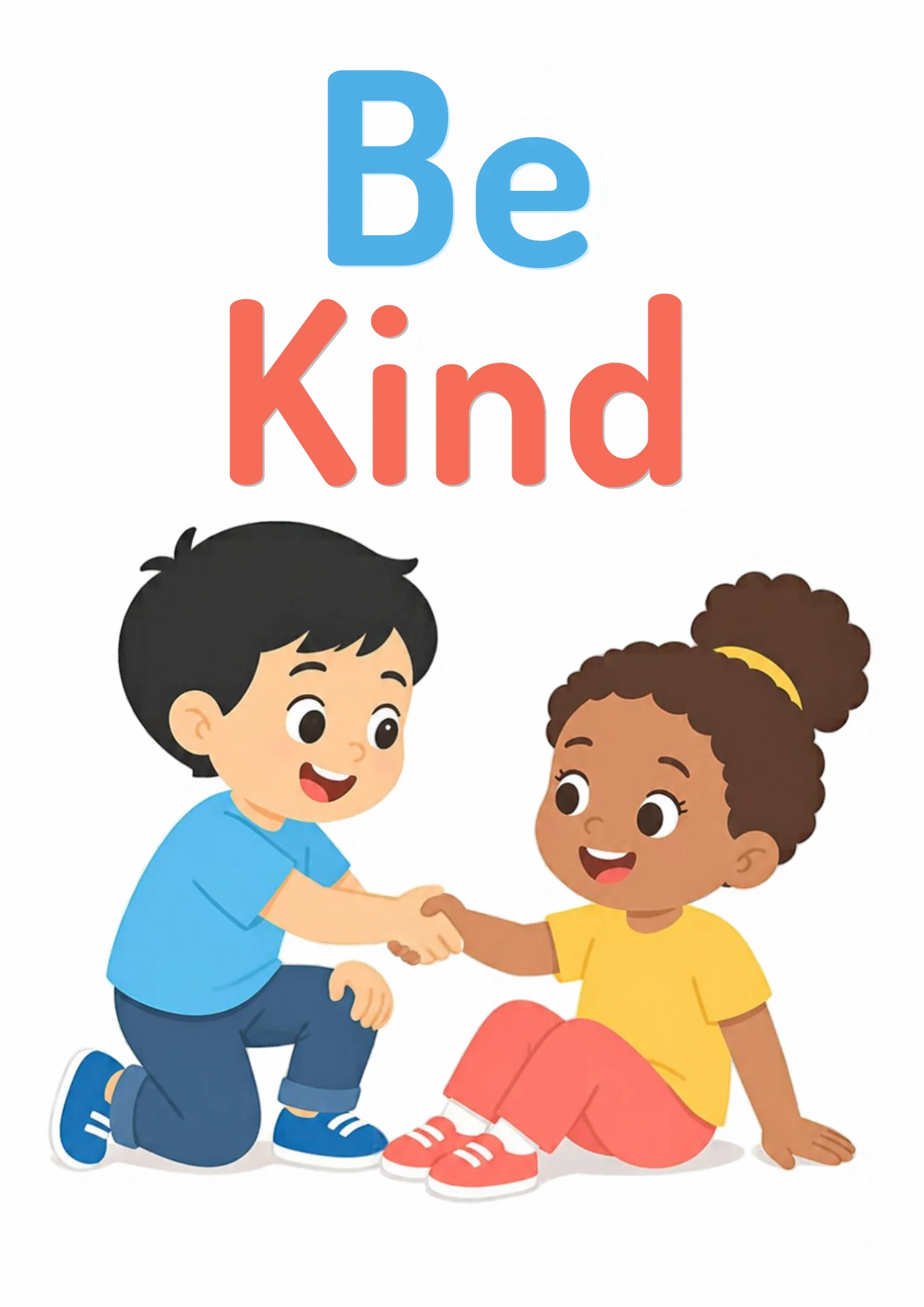
- Show the card: a boy kneels to hold hands with a girl who is sitting on the floor — name the kind move: he came down to her level to help her up.
- Collect kind examples in your child’s own world: who helped you today? What did it look like? Hands, words or face?
- Start the daily mission: each morning, pick one tiny kindness — "give Grandma a compliment", "help carry the spoon", "greet the new boy."
- At bedtime, run the hunt: one kindness your child gave, one they received. Naming is the growing.
- Praise the specific, not the vague: "you shared your crayons without being asked" lands; "good boy" evaporates.
Look closer at the picture
Ask your child: what is the boy doing — standing tall or coming down low? Whose hands are they holding? What are both faces doing? Has the girl started to stand up? What might have happened next?
Ask your child
"What did your hands do kindly today?" "What kind words can we say at the door tomorrow?" "How did it feel when someone was kind to you?" "What kindness mission shall we pick for tomorrow?"
What your child can say or do
"I helped Ilya carry his cup!" "Maya was kind to me — she waited for me." Your child may propose missions unprompted, or report a friend’s kindness with the delight of a good-news reporter.
Out in the real world
Kindness lives in plain sight: greeting the bus driver, holding a door, noticing a sad friend, letting the smaller child go first. The hunt trains the eyes; once noticed, these moments appear everywhere, and your child starts collecting them.
Try it together
Kindness jar: a pom-pom in the jar for every noticed kindness — given or received. The jar is never cashed in for prizes; the fullness itself is the point, and the counting at the end of the week is a happiness lesson.
Understanding check
Ask: "What are the three kinds of kind? What is the bedtime hunt? What was today’s mission?" Hands-words-face, given-and-received, the mission = landed.
Parent tips
Praise the specific deed, never the vague label — named kindness repeats, praised identity can wilt. Never force an apology or a hug; forced kindness is not kindness. Model it hardest when tired — they are watching exactly then.
Staying safe
Kindness keeps one sharp edge: children must know that saying NO, keeping their body safe and telling a grown-up about bad behaviour are also kind — to themselves. Being kind never means accepting an unwanted touch or keeping a scary secret.
This lesson pairs with the Be Kind flashcard in the library — print it, show it, keep it on the fridge. Back to Life Skills & Good Habits (Class 32).