
Say Excuse Me — a step-by-step lesson for grown-up and child
This lesson teaches the most versatile phrase in the politeness kit: excuse me covers passing through, joining a conversation and post-sneeze grace — and this lesson names all three jobs for your child.
What is this?
Saying excuse me means using one polite phrase for three moments: when passing through someone’s space, when you need a grown-up’s attention mid-conversation, and after a burp, cough or sneeze.
What does it mean?
Excuse me is a small announcement: "I am here, I see you, I mean no bump." It replaces pushing past, shouting over and pretending nothing happened — each with a gentler, clearer alternative.
What does the child need to know?
The interruption rule is the crown skill: put a hand on the grown-up’s arm, wait for the pause, then speak. The hand says "I am waiting"; the pause is your opening. Passing through and post-sneeze are the quick uses.
Why this matters
A child with one polite interruption tool stops shouting, tugging and butting in — the three behaviours that exhaust adults. The phrase buys attention respectfully and gets it faster than any grab.
What it teaches
Impulse control (waiting for the pause), social awareness (reading when a conversation is busy), body-space respect, and conversation mechanics — knowing that talk has turns, and turns can be requested.
Words to learn
excuse mepassinterruptwaitpausesneeze
Say this to your child
“"Excuse me has three jobs. Walking through someone’s way: excuse me. Needing my attention while I talk: hand on my arm, wait for the pause, then excuse me. After a sneeze: excuse me — then the tissue does its work. One phrase, three kindnesses."”
Step by step
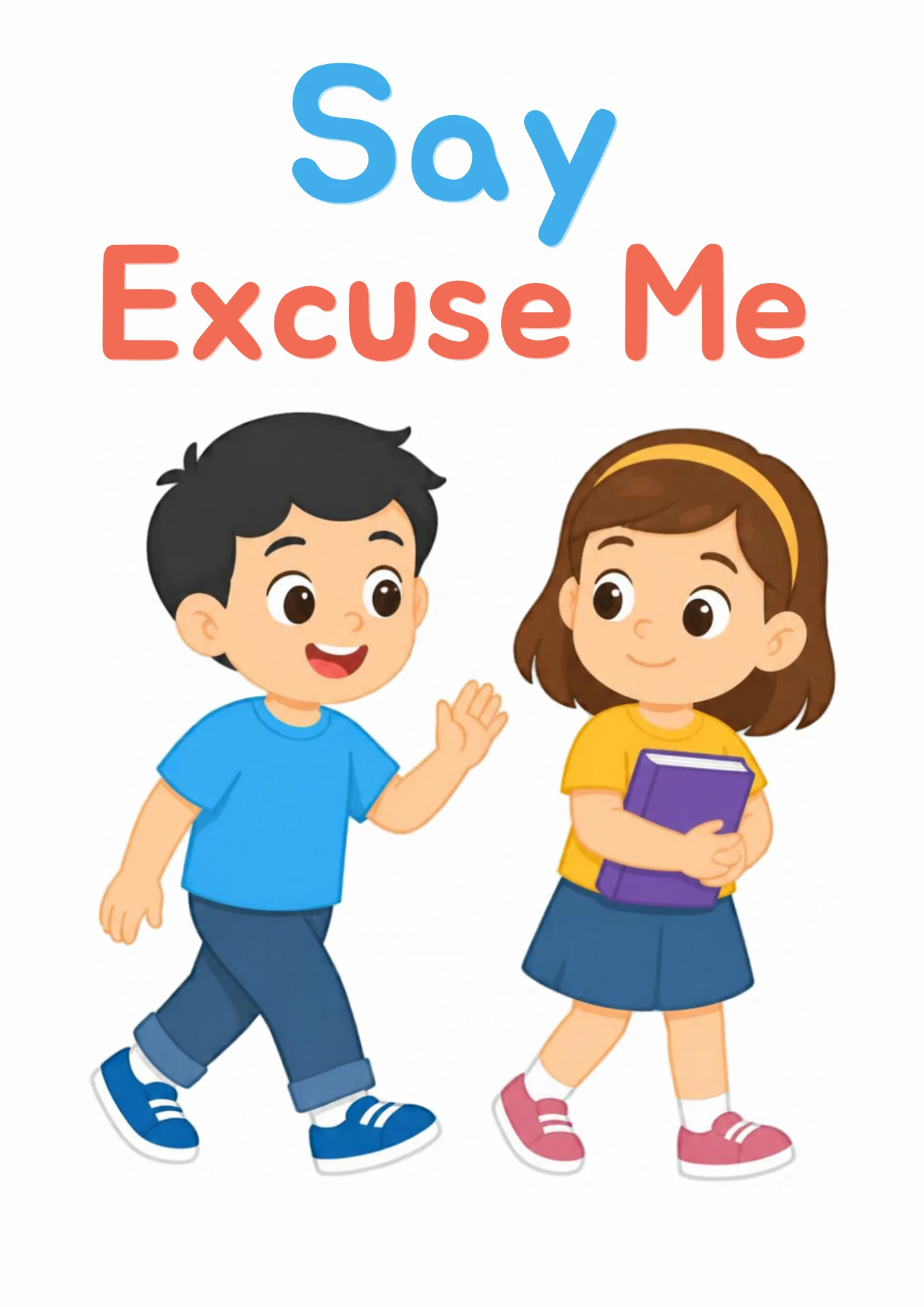
- Show the card: the boy walks past the girl with one hand raised, mid-hello; the girl holds her book and smiles — two people sharing one path politely.
- Name the three jobs of excuse me: passing through, joining a conversation, after a cough or burp. Children love collecting the uses.
- Teach the interruption rule with your own arm: their hand on your arm, your nod when the pause arrives, then they speak.
- Practise the doorway: walk through a real door together — who goes first, who says what, and the small body turn that keeps shoulders from bumping.
- Rehearse the sneeze line until it is automatic: "excuse me" — tissue — hands washed.
Look closer at the picture
Ask your child: what is the boy doing — walking past or standing still? What is raised — his hand or his voice? What is the girl holding? Do they look squished or comfortable? Where are their feet going?
Ask your child
"What are the three jobs of excuse me?" "What does your hand do while it waits?" "What do we say after a sneeze?" "How do we pass through a doorway where someone stands?"
What your child can say or do
"Excuse me, passing through!" "Excuse me — can I say something?" Your child may apply the arm-hand rule with perfect ceremony, or catch the family cat’s rude doorway behaviour as a teaching moment.
Out in the real world
Excuse-me moments happen hourly: the supermarket aisle, the crowded bus, the doctor’s waiting room, the kitchen mid-conversation. Each is a live rep — passing, joining or post-sneeze — and your child now has the phrase ready.
Try it together
Busy-grown-up drill: you talk on a toy phone; your child practises the hand-arm-pause-speak chain until it is smooth. Swap roles so your child feels how pleasant a patient hand is compared to a shout.
Understanding check
Ask: "Name the three jobs. What does the waiting hand do? What follows a sneeze?" Three uses, waits-for-pause, excuse-me-and-tissue = landed.
Parent tips
Practise when nobody needs interrupting — calm rehearsals build the real skill. Answer the successful interrupt promptly: a child who waits politely and is then ignored learns that shouting works better. Keep the phrase warm, not robotic.
Staying safe
Excuse me is for space and turns — it is not permission to touch strangers or follow them. Bodies stay in their own space, hands ask before touching anyone, and an adult’s arm is for the waiting hand only when the adult is YOURS.
This lesson pairs with the Say Excuse Me flashcard in the library — print it, show it, keep it on the fridge. Back to Life Skills & Good Habits (Class 32).