
Share and Take Turns — a step-by-step lesson for grown-up and child
This lesson turns the hardest wait of preschool into game mechanics: one toy, two players, turns named out loud and swapped on a count — until waiting becomes part of the fun instead of the end of it.
What is this?
Taking turns means using one toy together in an agreed order — my turn, then your turn, then mine again — so both players get the whole fun, just at different times.
What does it mean?
A turn is a promise with a shape: it starts, it ends, then it returns. Unnamed turns feel like losing; named turns with visible swaps feel like a game with rounds. The words "my turn — your turn" ARE the mechanism.
What does the child need to know?
The starters: roll a ball back and forth, stack blocks alternately, push the truck on a count of ten. The wait-timer makes the wait concrete — a sand timer, ten counts, a short song — because "soon" means nothing at four.
Why this matters
Turn-taking is the training wheels of every friendship, game and conversation to come. A child who can wait for a named turn keeps the play going; a child who grabs ends it. The skill is worth more than any single toy.
What it teaches
Impulse control across a real delay, trust (my turn WILL come), turn vocabulary and sequence, joint attention (watching someone else play happily), and emotional recovery when a turn ends.
Words to learn
turnmy turnyour turnwaitswaptimer
Say this to your child
“"One truck, two players — so we take turns. My turn: vroom, vroom. Your turn — and I wait and watch, because my turn always comes back. We can count to ten for the swap, or let the sand timer run out. Waiting is part of the game — it is how two people get more fun than one."”
Step by step
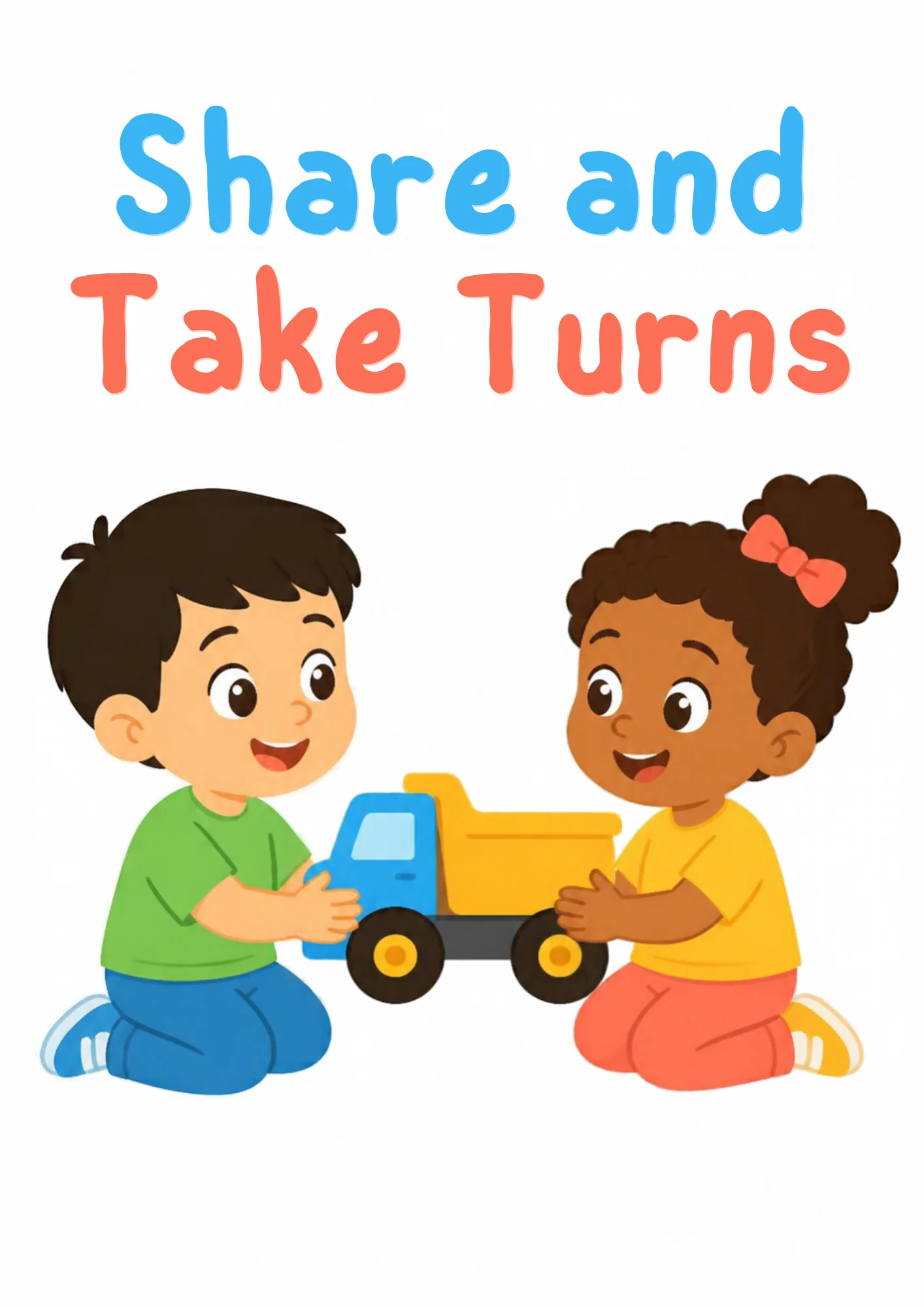
- Show the card: two children kneel facing each other, both hands on one truck — nobody grabbing, both smiling. Name the picture: one truck, two players, no fight.
- Play with one toy and two players: name the turns out loud — "MY turn... now YOUR turn" — with your hands showing the swap.
- Swap on a count of ten; let your child be the counter and the announcer — the announcer always knows the turn is coming.
- Add a visible timer for longer turns so the wait has a shape your child can watch drain.
- Graduate to real games with built-in turns: rolling a ball, alternate block-stacking — turn-taking IS the fun there.
Look closer at the picture
Ask your child: how many children are playing? How many trucks? Whose hands are ON the truck right now — one child or both? What are their faces doing? Are they kneeling face to face or back to back?
Ask your child
"Whose turn is it now? How will you know when it is yours?" "What can your hands do while you wait?" "What does the timer tell us?" "What happens after your turn ends?"
What your child can say or do
"My turn — your turn!" "Ten, nine, eight... SWAP!" Your child may announce turns for the whole family at dinner, or referee two toys’ turns with the gravity of a football match.
Out in the real world
Turns run the world: the slide queue, the swing wait, the video-game controller, the conversation itself. Each is a named turn your child can now spot — and the noticing turns resentment into anticipation.
Try it together
Turn-machine: a ball rolled back and forth with turns announced by the roller; blocks stacked alternately to build one tower together. Both games are turn-taking with the fun built in — the wait is the price of admission, paid gladly.
Understanding check
Ask: "What do we say when we swap? What does the timer do? Whose turn comes after yours?" Named turns, visible wait, yours-again = landed.
Parent tips
Practise turns on toys nobody cares about first; save the battle-truck for when the skill is warm. The waiting child needs a job — counting, announcing, timer-watching — idle waits curdle. Keep turns SHORT at four: many small turns beat one long hostage situation.
Staying safe
Turn-waiting ends where safety starts: a child never has to wait to call for help, and grabbing is corrected calmly, never with the toy snatched back — the grown-up’s hands model the turn-taking they are teaching.
This lesson pairs with the Share and Take Turns flashcard in the library — print it, show it, keep it on the fridge. Back to Life Skills & Good Habits (Class 32).