
Wait Your Turn — a step-by-step lesson for grown-up and child
This lesson gives waiting a shape a four-year-old can hold: visible finish lines, the named wait — "three more turns" — and the calm stance that turns queue-time into watch-time instead of agony.
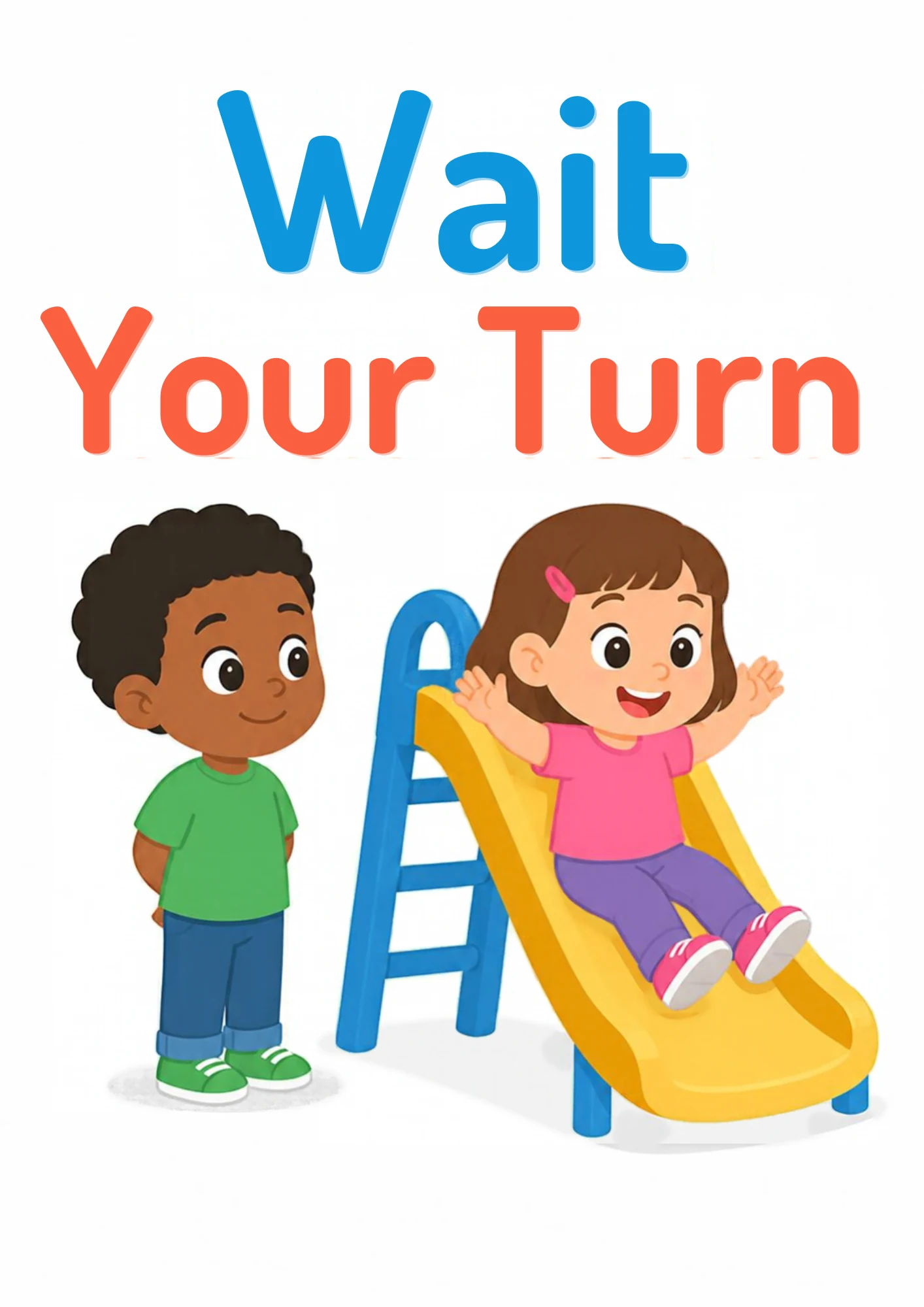
What is this?
Waiting your turn means letting someone finish while you watch calmly, knowing your turn begins the moment theirs ends — on the slide, the swing, the queue, the speaking circle.
What does it mean?
Waiting hurts when it is endless and invisible; it works when it has a finish line you can see. The slide shows it best: she climbs, she sits, she slides, she steps off — now me. Patience at four is measured in visible minutes, not virtues.
What does the child need to know?
The tools: name the wait ("three more turns, then you"), stay near, narrate what you see ("she’s climbing up... she’s sitting... now it’s you!"), and celebrate the WAITING itself — "you waited for the whole slide" — not just the turn.
Why this matters
The slide queue is the first real queue of a child’s life, and queues run the world after it. A child who can wait a visible turn keeps their place in games, groups and conversations — and keeps friends, too.
What it teaches
Impulse control across a real delay, time concepts (first, next, then me), emotional regulation with a reward in sight, observation skills — and trust that the world keeps its promises about turns.
Words to learn
waitturnnextwatchpatiencequeue
Say this to your child
“"She is on the slide, so we watch and wait — and look how her turn ends: she steps off, and the slide is yours. I will name the wait: two more turns. Your hands can rest behind your back like the boy on the card. Waiting with a finish line is easy to hold."”
Step by step
- Show the card: the girl is sliding down the yellow slide, arms up; the boy stands beside it, hands behind his back, smiling. Name his hands — that stance IS the waiting skill.
- At the playground, narrate the finish line in real time: "she’s at the top... she’s sitting... she’s sliding... NOW it’s your turn."
- Give the wait a number when numbers apply: "two more turns." Vague waits stretch; numbered waits hold.
- Give the waiting hands a job: behind the back, or holding your hand, or watching the slider’s face — busy eyes make short waits.
- Celebrate the waiting out loud, immediately: "you waited for her WHOLE slide — that was patient!"
Look closer at the picture
Ask your child: who is ON the slide? What is she doing with her arms? Where is the boy standing — on the ladder or beside it? What are HIS hands doing? Is his face angry or calm? Whose turn comes next?
Ask your child
"How will you know when your turn comes?" "What do your hands do while you wait?" "What can you watch while you wait?" "How long was your wait — one turn or two?"
What your child can say or do
"Two more turns — I’m counting!" "I waited the WHOLE slide!" Your child may adopt the hands-behind-back stance unprompted at the park, or narrate another child’s turn kindly from the queue.
Out in the real world
Queues are everywhere: the slide, the swings, the shop till, the bus door, the water fountain. Each is a wait with a visible finish line — and your child now has the tools to hold every one of them.
Try it together
Waiting race: line up three toys for one slide; your child is the queue-master who names whose turn is next and celebrates each waiter. Being the keeper of turns teaches the skill from the inside out.
Understanding check
Ask: "What makes a wait easy to hold? What do your hands do? What do we say after a good wait?" Visible finish line, calm hands, "you waited!" = landed.
Parent tips
Stay near — waiting alone is a different, harder skill for later. Name the wait honestly; children forgive a known length, never a promised "soon" that never lands. If the wait collapses, step back to shorter waits and rebuild — patience is a muscle, not a mood.
Staying safe
Queues have edges: no climbing up the slide’s ramp to skip the wait, feet first only, and clear the bottom fast — the next slider is already coming. Grown-ups hold the queue rules; the child holds the wait.
This lesson pairs with the Wait Your Turn flashcard in the library — print it, show it, keep it on the fridge. Back to Life Skills & Good Habits (Class 32).