
Nine Peaches — a step-by-step lesson for grown-up and child
This lesson counts to the edge of the first decade: nine, one away from ten. Your child counts nine peaches grouped four, three and two, feels the big pause before ten, and learns that counting backwards is just as important as counting up.
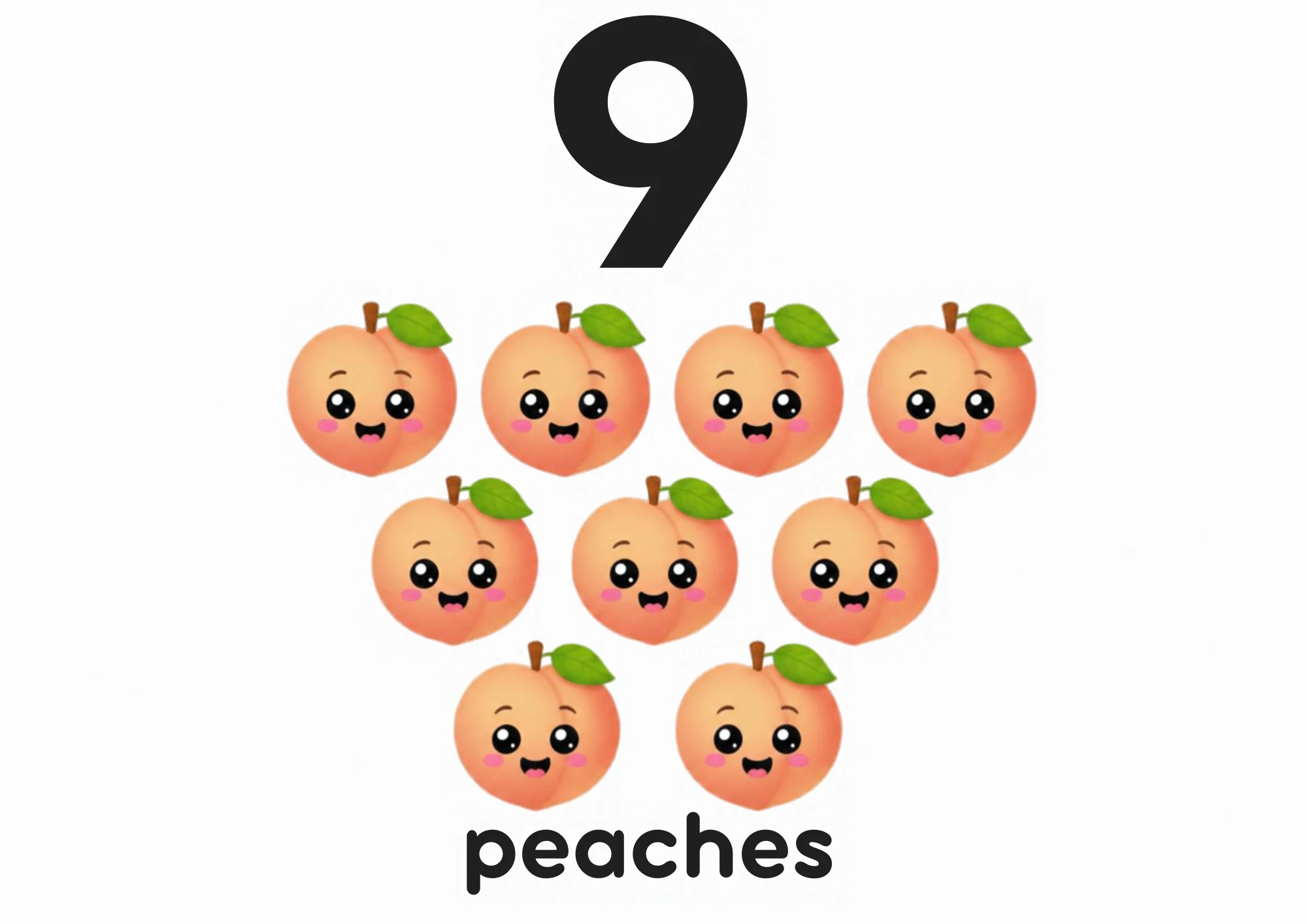
What is this?
Nine is eight and one more — nine peaches grouped four, then three, then two on the card. Nine is famous for one thing: it is one short of ten, the number every young counter is aiming for.
What does it mean?
Being "one away" is a powerful mathematical feeling. Nine teaches nearness: how close counting gets you to the finish, and what happens when one more joins. Backwards from nine also makes nine a launching pad, not just a stop.
What does the child need to know?
Your child needs three nines: careful counting of nine in its funny three groups; the one-more question — "what comes after nine?"; and counting backwards from nine to zero with the voice slowing at the end.
Why this matters
Counting backwards builds the number line in both directions, which subtraction will need later. And the drama of nine-then-TEN makes ten arrive as an event — the loudest, best-earned number of the whole first decade.
What it teaches
Forward and backward counting, anticipation of the next number, group-reading (four, three, two as separate clusters), and impulse control — waiting for the one-more that turns nine into ten.
Words to learn
ninealmostone morebackwardscountdownnext
Say this to your child
“"Nine peaches — four, three and two. Nine is one away from ten. Let us count up, stop at nine, and see who can wait for the ten... and then count backwards like a rocket: nine, eight, seven..."”
Step by step
- Show the card: "Nine peaches — four, three and two. Nine is one away from ten. How close is that?"
- Count the groups: four, then three, then two — nine peaches in all. Big numbers get easier when they travel in small packs.
- Count forward and stop dead after nine. Let the silence stretch. "What comes next?" Let ten be shouted, whispered or exploded — whatever arrives is correct.
- Count backwards from nine, voice sinking like a rocket about to launch: nine, eight, seven... and blast off on zero with a jump.
- Walk nine steps down the hallway, count them, turn around, count nine back. Same nine, both directions.
Look closer at the picture
On this card a big black numeral 9 stands over nine smiling peaches with leaves, gathered in three groups — four peaches, then three, then two — and the word "peaches" is printed below.
Ask your child
"How many peaches? What comes right after nine?" "Can you count backwards from nine?" "How many more peaches would make ten?"
What your child can say or do
Your child might say: "Nine! Almost ten!" "TEN comes next!" or the rocket count: "Nine, eight, seven, six... BLAST OFF."
Out in the real world
Nines live on elevators (button nine, top floor of many buildings), in nine-inning games watched on sofas, and in the countdown ritual — rockets, races and microwaves all count backwards, and now your child knows why.
Try it together
The tidy-up countdown: collect nine toys counting up, then send them home counting down — nine to zero, with the last one landing as a touchdown. Then one-more peach: line up nine snacks and let your child add the tenth with full ceremony.
Understanding check
Ask: "How many peaches? What comes after nine? Count backwards for me." Nine peaches, one away, rocket countdown — the door to ten is open.
Parent tips
Do not rush the pause after nine — that silence is your child's brain building the next number. Backwards counting feels silly and that is exactly why it works; join in with the rocket voice and let them out-count you.
This lesson pairs with the Nine Peaches flashcard in the library — print it, show it, keep it on the fridge. Back to Numbers, Counting & Early Math (Class 35).