
Ten Blueberries — a step-by-step lesson for grown-up and child
This lesson reaches the summit of first counting: ten, a full pair of hands. Your child counts ten blueberries in two rows of five, matches every berry to a finger and learns that all the teen numbers ahead are built on this one.
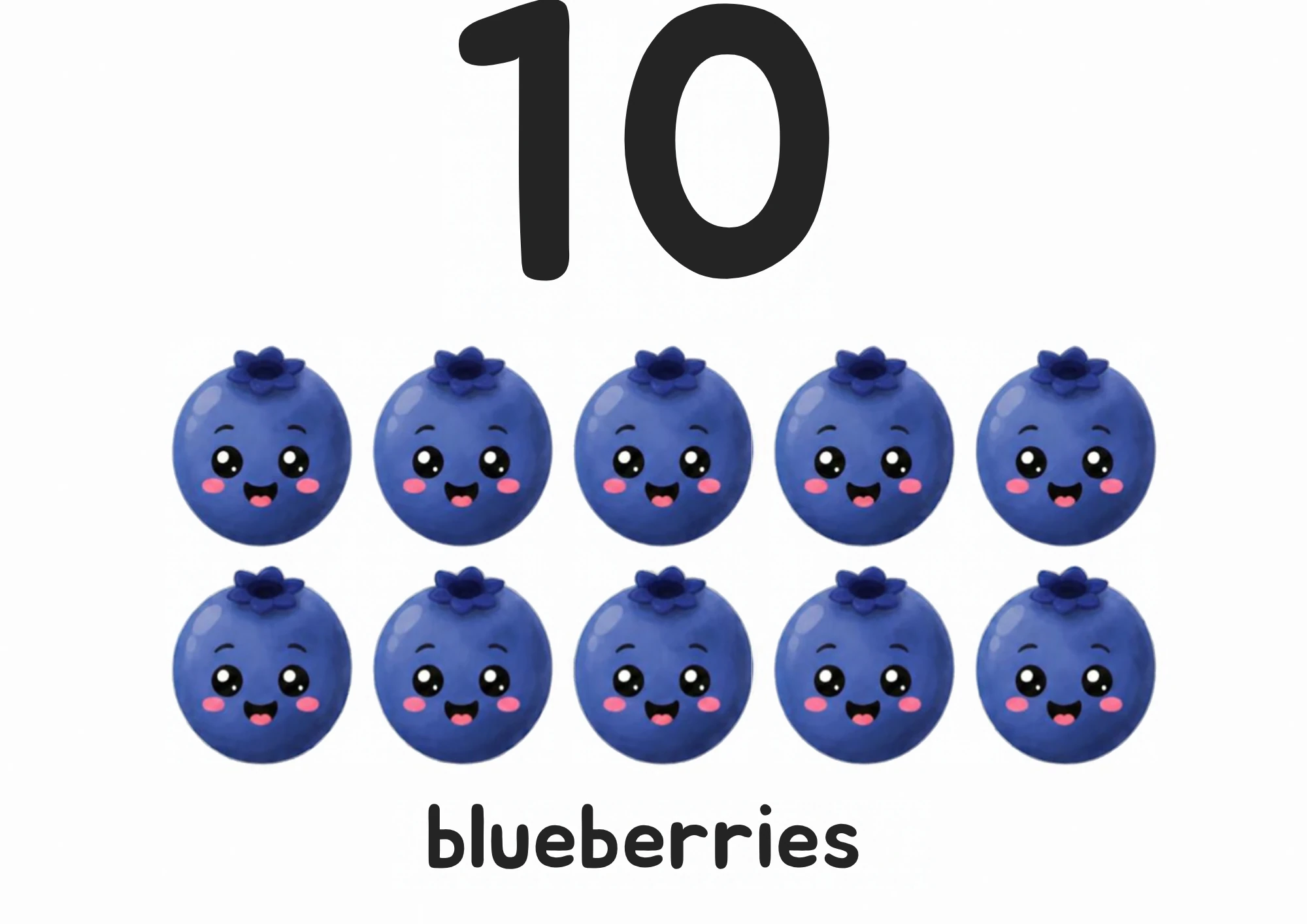
What is this?
Ten is nine and one more — ten blueberries in two perfect rows of five. Ten is all ten fingers held up at once, the finish line of first counting and the starting block for everything after.
What does it mean?
Ten is the number the whole number system is built on: every bigger number is "some tens and some more". Seeing ten as two fives — two rows, two hands — plants the idea that big numbers are made of handy, countable parts.
What does the child need to know?
Your child needs three tens: counting all ten fingers, left hand then right; the two-rows-of-five picture that matches the card and the hands; and the proud feeling of a finished decade — ten is an achievement, not just a word.
Why this matters
Ten is the base of place value, the king of the number line, and the first number worth celebrating hard. A child who owns ten — eyes closed, fingers out — will meet eleven to twenty as "ten and some more" instead of a scary new world.
What it teaches
Two-hand counting, five-plus-five structure, the finished-decade feeling, one-to-one matching between berries and fingers, and celebration stamina — big counts deserve big finishes.
Words to learn
tenblueberriesfingersdoublehandfuldecade
Say this to your child
“"Ten blueberries, ten fingers — two rows of five, two hands of five. Ten is the whole number line in your two hands. Count every finger: one, two, three... all the way to ten!"”
Step by step
- Show the card: "Ten blueberries — two rows of five. And hold up your hands: ten fingers. Ten is all of them."
- Count the top row: one to five. Count the bottom row: six to ten. Then count all ten in one long, careful line.
- Match berry to finger: point at each blueberry and raise one finger per berry until both hands stand open. Ten berries, ten fingers — the same ten.
- Say the secret: "Everything after ten is ten and some more. You just learned the base camp of all the big numbers."
- Celebrate like a finish line: ten claps, ten jumps, ten cheers — one per number, all the way up.
Look closer at the picture
On this card a big black numeral 10 stands over ten smiling blueberries in two neat rows of five, and the word "blueberries" is printed below — the two-row shape matching two open hands of five fingers each.
Ask your child
"How many blueberries? How many rows? How many in each?" "Show me ten fingers. What comes after ten?" "Five and five make...?"
What your child can say or do
Your child might say: "Two rows of five!" "Ten — all my fingers!" or the finish-line shout: "I counted all the way to ten!"
Out in the real world
Tens run the world: ten toes to match the fingers, ten pins in bowling, ten dimes in a coin strip, ten numbers on a phone pad. Count change into tens, count stairs in tens, and let the microwave countdown count down from ten one more time.
Try it together
Finger theater: tell a tiny story where each finger wakes up one at a time — ten characters, counted in order, waving goodbye in reverse. Then berry match: scatter ten snacks and race to build two rows of five exactly like the card before eating the evidence.
Understanding check
Ask: "How many berries? Show me ten. What two rows make ten?" Ten blueberries, ten fingers, five and five — the first decade is conquered.
Parent tips
Match berries to fingers physically — the one-to-one touching between card and hands is the lesson, so go slow enough for both to keep up. Make the celebration genuinely huge: a child who remembers reaching ten will sprint toward twenty.
This lesson pairs with the Ten Blueberries flashcard in the library — print it, show it, keep it on the fridge. Back to Numbers, Counting & Early Math (Class 35).