
Seven Cherries — a step-by-step lesson for grown-up and child
This lesson teaches seven through the calendar: seven cherries on the card, seven days in the week. Your child counts seven slowly, splits it four-and-three, and learns why every week ever made has exactly this many days.
What is this?
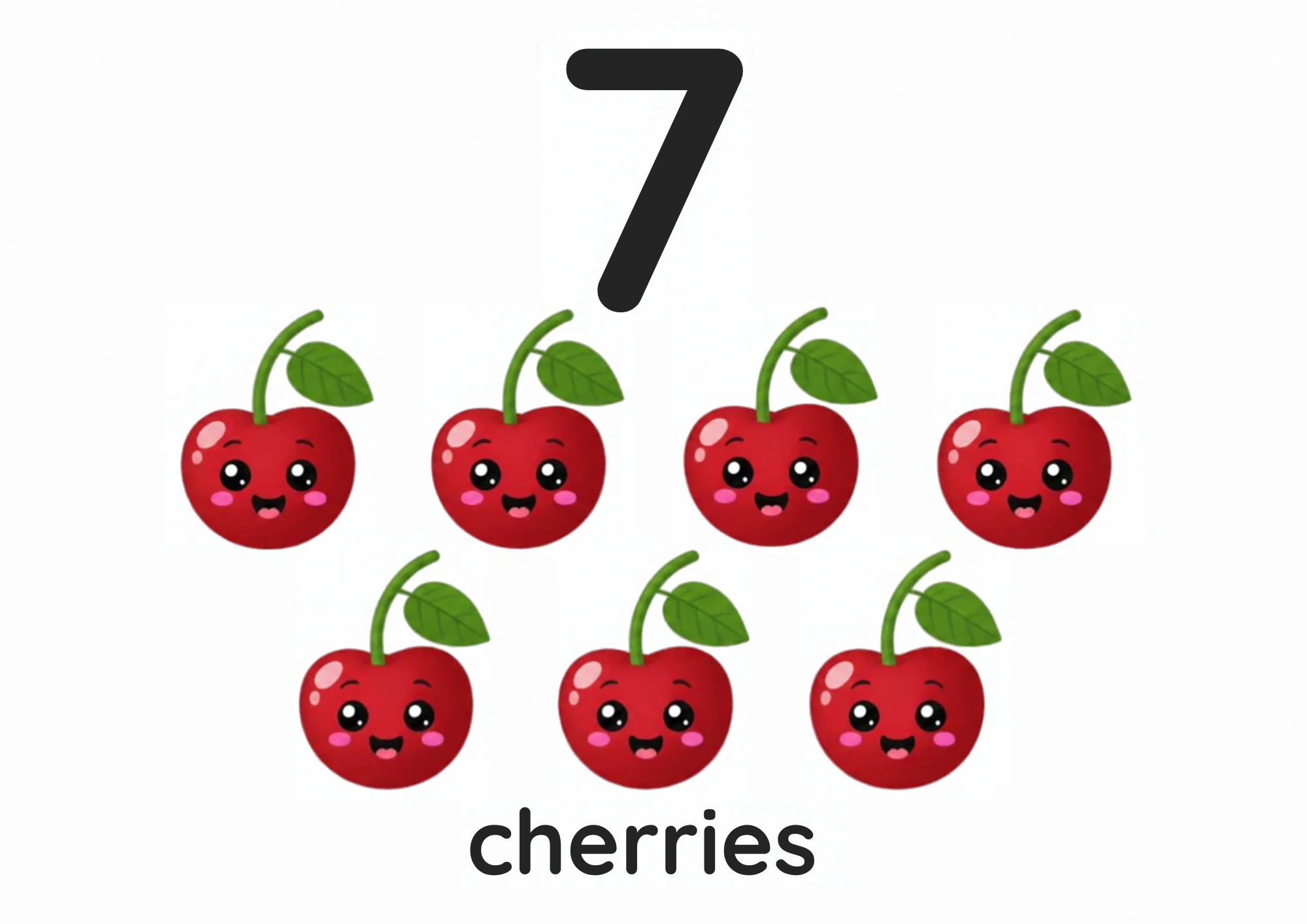
Seven is six and one more — seven cherries on the card, four on top and three below. Seven is also the number of days it takes to get from one Monday to the next: the whole week in one number.
What does it mean?
Seven is a counting marathon: too big to see at a glance, big enough to wobble. Splitting it into four and three teaches the greatest trick in arithmetic — break a big number into pieces you already know.
What does the child need to know?
Your child needs three sevens: careful touch-counting of seven without losing the place; the four-and-three split from the card's own rows; and the week idea — seven days, and each day has a name.
Why this matters
The week is the first big cycle a child can name, and it is made of sevens. Counting the card's rows teaches decomposition — seeing parts inside numbers — which is how all future mental math will work.
What it teaches
Decomposing numbers (four and three), keeping place in a longer count, sequencing the days of the week, and the first taste of cycles: after seven days, everything starts over.
Words to learn
sevenweekdaystopbottomsplit
Say this to your child
“"Seven cherries, seven days in our week. Four cherries on top, three below — four and three make seven. Every Monday we start counting the week all over again."”
Step by step
- Show the card: "Seven cherries — four on top, three below. Seven is how many days are in a whole week!"
- Count the top row: one, two, three, four. Count the bottom row: five, six, seven. Four and three, seven in all.
- Count the week on fingers: Monday, Tuesday, Wednesday, Thursday, Friday, Saturday, Sunday — seven days, one finger each. Run out of week? That is why it starts over.
- Trace the numeral 7 with one finger — down, then across — then draw it in the air. The seven shape is its own small lesson.
- Finish with the week plan: pick one thing for each of the next seven days — park day, bath night, Grandma day — one cherry per plan.
Look closer at the picture
On this card a big black numeral 7 stands over seven smiling red cherries with their stems on — four cherries in the top row and three in the bottom row — and the word "cherries" is printed below.
Ask your child
"How many cherries? How many on top? How many below?" "What day comes after Sunday?" "How many days until our park day?"
What your child can say or do
Your child might say: "Four and three — seven!" "Sunday, then Monday again!" or the planner's line: "Three more sleeps until Saturday."
Out in the real world
The calendar itself is the practice sheet: cross off one day each night and count how many are left in the week. Seven also shows up in nature — seven colors in a rainbow, if the sky cooperates this week.
Try it together
Cherry week: tape seven paper cherries on the wall, one per day, and pull one off every morning — "six cherries left in our week!" Then the split game: drop seven counters in a cup, spill them, and count the groups they land in. Seven always splits somehow.
Understanding check
Ask: "How many cherries? How many days in a week? What two rows make seven?" Seven cherries, seven days, four and three — the week number is learned.
Parent tips
A wobble between six and seven is normal — slow the touching, not the counting voice. Let your child own one weekly ritual (Friday popcorn, Sunday pancakes); waiting for a named day teaches the seven rhythm better than any drill.
This lesson pairs with the Seven Cherries flashcard in the library — print it, show it, keep it on the fridge. Back to Numbers, Counting & Early Math (Class 35).