
Six Grapes — a step-by-step lesson for grown-up and child
This lesson crosses the first frontier: six, the number that needs more than one hand. Your child counts six grapes in two neat rows, discovers five-and-one-more, and learns that bigger numbers are just old numbers wearing new sizes.
What is this?
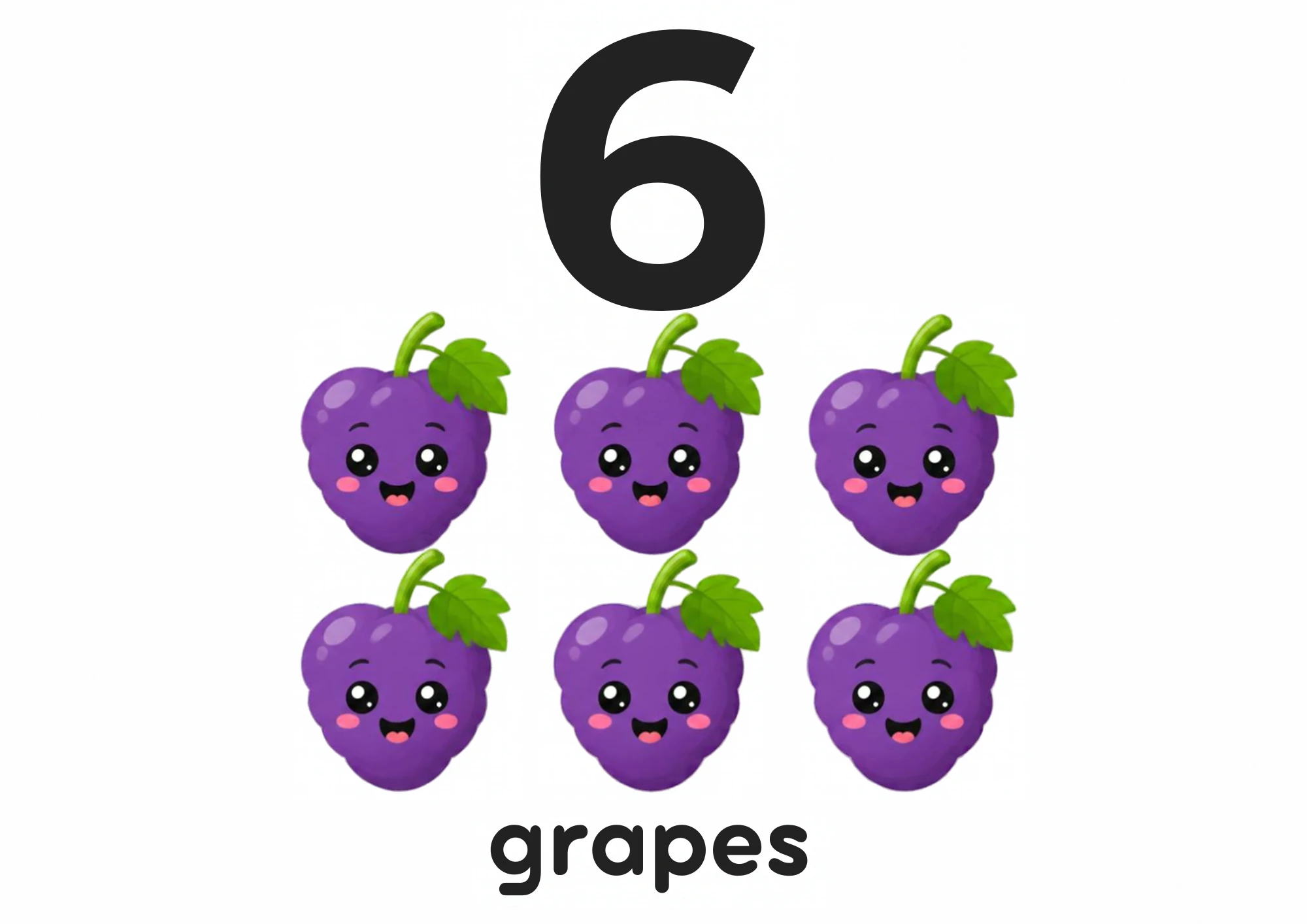
Six is five and one more. On the card, six smiling grape bunches sit in two rows of three — the same shape as the six face on a dice. It is the first number that will not fit on a single hand.
What does it mean?
Once counting passes five, the hand becomes a helper: count five, then keep going. Six also arrives with its first real pattern — two rows of three — and patterns are what make big numbers friendly.
What does the child need to know?
Your child needs three sixes: counting six things even when one hand runs out; spotting the two-rows-of-three shape (the dice six); and the plus-one bridge — five fingers plus one finger up equals six.
Why this matters
Six is where children either relax into counting or start to fear it, so this lesson keeps it playful: the hand runs out, everyone laughs, and the count simply carries on. The dice shape they meet here returns in every game they will ever play.
What it teaches
Counting past a handful, recognizing dice and row patterns, splitting numbers into parts (five and one, three and three), and the flexibility to keep a count alive when the tools run out.
Words to learn
sixdicerowsmore thanfive and onebunch
Say this to your child
“"Six grapes — five fingers and one more. Look, the grapes sit in two rows of three, the very same six that lives on a dice. Six is the first number that needs a helper hand."”
Step by step
- Show the card: "Six grapes — more than one hand can hold! Let us count and find out."
- Count all six, touching each bunch. When the hand fills up at five, hold up the other hand for number six: "Six needs a helper finger!"
- Read the shape: two rows of three. Count the top row, count the bottom row, count them all: three and three make six — just like the six on a dice.
- Prove it with snack: line up six grapes like the card. Eat one and count what is left — five! Add it back — six again.
- Roll a dice if you have one: find the six face, match it to the card, and shout six together.
Look closer at the picture
On this card a big black numeral 6 sits over six smiling purple grape bunches arranged in two rows of three, and the word "grapes" is printed below — the exact pattern of the six face on a dice.
Ask your child
"How many grapes? Which hand ran out of fingers?" "How many rows? How many in each row?" "Can you find the six on this dice?"
What your child can say or do
Your child might say: "Six needs two hands!" "Three and three!" or the dice discovery: "The six looks just like our card!"
Out in the real world
Sixes wait in the kitchen and the game shelf: six muffins in a half-dozen box, six eggs cracked for pancakes, six faces on every dice, six strings on a guitar worth a slow strum and count.
Try it together
Dice match: roll a dice, then build the rolled number with grapes or buttons in the same pattern as the dots. Roll a six and the whole room shouts. Then snack subtraction: start with six, eat your way down and count every step.
Understanding check
Ask: "How many grapes? What makes six — five and how many? What shape do the rows make?" Six grapes, one helper finger, two rows of three — past-the-hand counting has begun.
Parent tips
When the hand runs out mid-count, celebrate the moment — "five full, one more!" — because that tiny pause is where place value will someday live. Keep a dice in the snack drawer; it is the cheapest counting teacher ever made.
This lesson pairs with the Six Grapes flashcard in the library — print it, show it, keep it on the fridge. Back to Numbers, Counting & Early Math (Class 35).