
Rabbit — a step-by-step lesson for grown-up and child
This lesson teaches Rr and its curling sound with the rabbit card: your child traces the letter, revs like a race car, and learns the sound made where no mirror can see — pure listening, pure tongue.
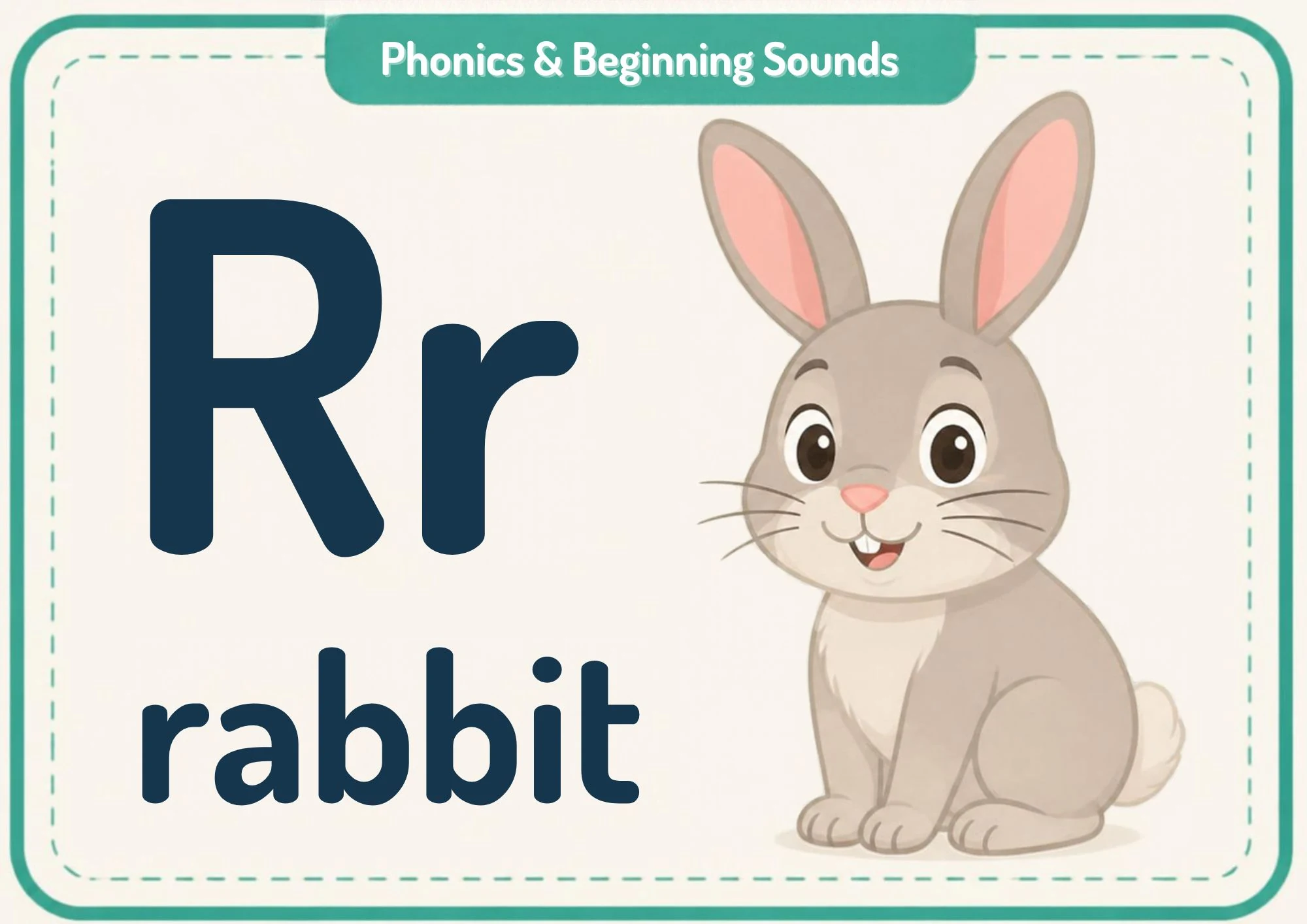
What is this?
Rr is the letter that stands for the first sound in rabbit — the tongue curls up toward the roof of the mouth and touches NOTHING, while the voice runs: r-r-rabbit.
What does it mean?
R is the alphabet’s invisible one: no lips to watch, no tongue tip to see. Children who learn r by feel (the growl, the engine) beat children who learn it by instruction.
What does the child need to know?
Your child needs the curled-tongue feel without touching, the running voice, and a warren of r-words: rabbit, run, red, rain.
Why this matters
/r/ drives run, red, ride and ready — the movement words of childhood. It is also famously the LAST sound to mature, so early playful exposure plants it without pressure.
What it teaches
Tongue-body control without visual feedback, sustained voicing, and trusting listening over looking — the deepest mouth-awareness lesson in the set.
Words to learn
rrabbitrunredrainroad
Say this to your child
“"Curl your tongue up like a wave and let the engine run: rrrr. That is r! R says rrr, like rabbit. Rev the sound: r, r, rabbit."”
Step by step
- Show the card: "Rr. Curl your tongue up — but touch nothing! It says the rabbit sound."
- Finger-trace the Rr on the canvas: the tall post with its little arm — the arm curls, the tongue curls.
- Play the race-engine game below; the engine rev is the sound’s natural home.
- Run-say three r-things: rabbit, rain, red. Tongue curled, voice driving.
- Finish with three bunny hops, one r-word per hop.
How to say it
Tongue curled toward the roof of the mouth, close but touching nothing, voice on: "rrr". It can run like an engine. If it becomes w ("wabbit"), the tongue flattened — curl it again.
Look closer at the picture
On this card the big navy pair Rr sits beside a grey rabbit with long ears, and the word "rabbit" is printed below — the hoppiest animal in the set, carrying the sound children master last.
Ask your child
"Can your tongue touch anything for r?" "What does a race car say?" "What r-word hops?"
What your child can say or do
Your child might say: "r-r-r-rabbit!" with full engine sounds, or request the growl game daily — revving is practice disguised as fun.
Out in the real world
Car rides are r-practice: roads, roundabouts, red lights, rain. Rabbit visits in storybooks, and every run around the garden is a chance to say run while doing it.
Try it together
Race-engine game: be the driver and the car. Start the engine — "rrr, rrr, rrrr" — then drive to a destination called out by the grown-up: a red cushion, a round table, the rabbit’s burrow. Park, turn the engine off, pick a new r-destination. Traffic noises encouraged; r-words required at every red light.
Understanding check
Ask for the sound: a running "rrr" with the tongue clearly NOT touching is the pass. If "wabbit" appears, stay calm — r is the last sound to settle, and growls and engines do the teaching without any corrections.
Parent tips
Skip the corrections entirely — “wabbit” is a normal stop on the way to r. Keep the engine games silly and frequent, and let the tongue arrive on its own schedule; months of gentle practice are perfectly normal.
This lesson pairs with the Rabbit flashcard in the library — print it, show it, keep it on the fridge. Back to Phonics & Beginning Sounds (Class 28).