
Queen — a step-by-step lesson for grown-up and child
This lesson teaches Qq, the only letter that carries two sounds at once: a /k/ click straight into a /w/ puff. Your child traces the letter, plays the quick-flash game, and learns why q never walks alone.
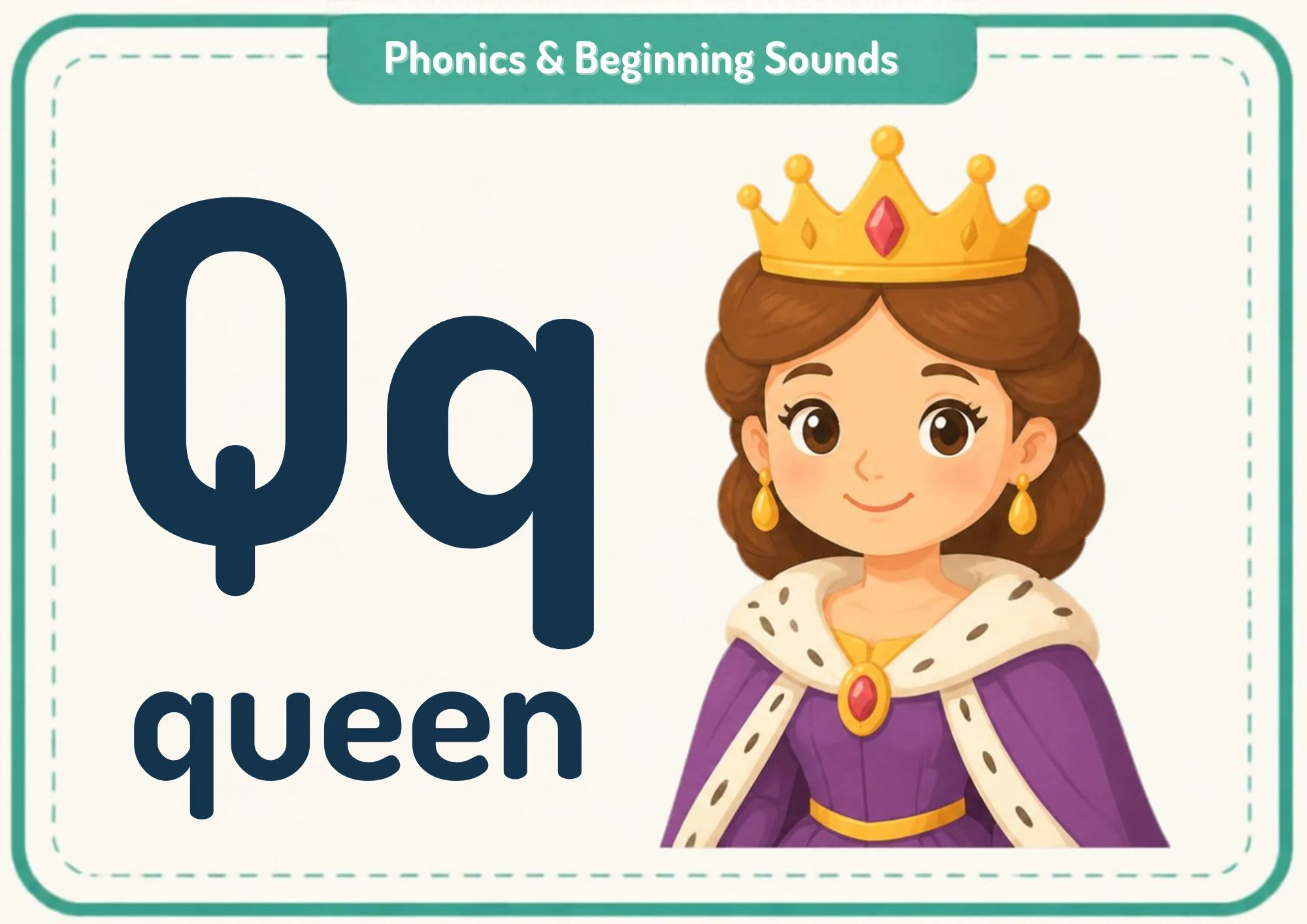
What is this?
Qq stands for the first sound in queen — /kw/, two sounds glued into one burst: the k click of cat followed instantly by the w of wind.
What does it mean?
Q is the set’s first two-sound letter — proof that letters can be teams. And q has a famous friend: almost every q in English brings the letter u, because u helps make the w.
What does the child need to know?
Your child needs to feel the click-then-puff as ONE motion, hear /kw/ at the start of queen, quick and quiet, and know that q and u are a package deal.
Why this matters
/kw/ is rare but mighty: queen, quick, quilt and quiet are story-time royalty. Learning the two-in-one burst now makes the strangest letter feel like a trick, not a problem.
What it teaches
Sound blending at its smallest (two sounds, one burst), back-click plus lip-round coordination, and letter-team awareness (q + u forever).
Words to learn
qqueenquickquietquiltquack
Say this to your child
“"Make the k click and blow it into a puff of wind — kwuh! That is Q’s sound: two sounds in one. Say it royal: kw, kw, queen."”
Step by step
- Show the card: "Qq. It says kw — a click and a puff in one: queen!"
- Finger-trace the Qq on the canvas: the circle, then the tail — and draw the u next to it, because q never travels alone.
- Play the quick-flash game below; every flash ends with a /kw/ word.
- Burst-say three q-things: queen, quick, quack. One click-puff each.
- Finish with a royal bow and a very quiet "quiet" — the hardest q-word, said perfectly.
How to say it
Back click (/k/) released straight into rounded lips (/w/), voice on: "kwuh". Said fast it is one burst; said slow it falls apart. Speed is the glue.
Look closer at the picture
On this card the big navy pair Qq sits beside a smiling queen with a golden crown and a purple gown, and the word "queen" is printed below — the majesty that owns the two-sound letter.
Ask your child
"How many sounds does q make?" "What letter always comes after q?" "Can you say quick as fast as possible?"
What your child can say or do
Your child might say: "kw-kw-kween!" with royal waving, or spot the pattern forever after: "that word has q — where is its friend u?"
Out in the real world
Queens and quacks rule story-time; quilts wait at grandparents’ houses. Quick and quiet run every game of hide-and-seek — two q-words hiding in plain sight.
Try it together
Quick-flash game: the grown-up calls an action, the child does it QUICKLY — and announces each one with the /kw/ burst: clap kw-ickly! touch toes kw-ickly! sit down kw-ickly! Finish the round with the hardest command of all: "now be kw-iet" — a royal whisper wins the crown.
Understanding check
Ask what sound q makes and listen for the glue: "kw" as one burst (not "k…wuh" in two pieces) is the pass. Then ask what comes after q in a word — "u!" means the team-fact landed too.
Parent tips
Say /kw/ as one burst, not two separate sounds — slow it down only to demonstrate, then speed it back up. And enjoy the oddness: q is the weird one, and children love being insiders on the weird one.
This lesson pairs with the Queen flashcard in the library — print it, show it, keep it on the fridge. Back to Phonics & Beginning Sounds (Class 28).