
Van — a step-by-step lesson for grown-up and child
This lesson teaches Vv and its buzz with the van card: your child traces the letter, plays an invisible violin through a v-word concert, and switches the voice ON — the difference between fan and van.
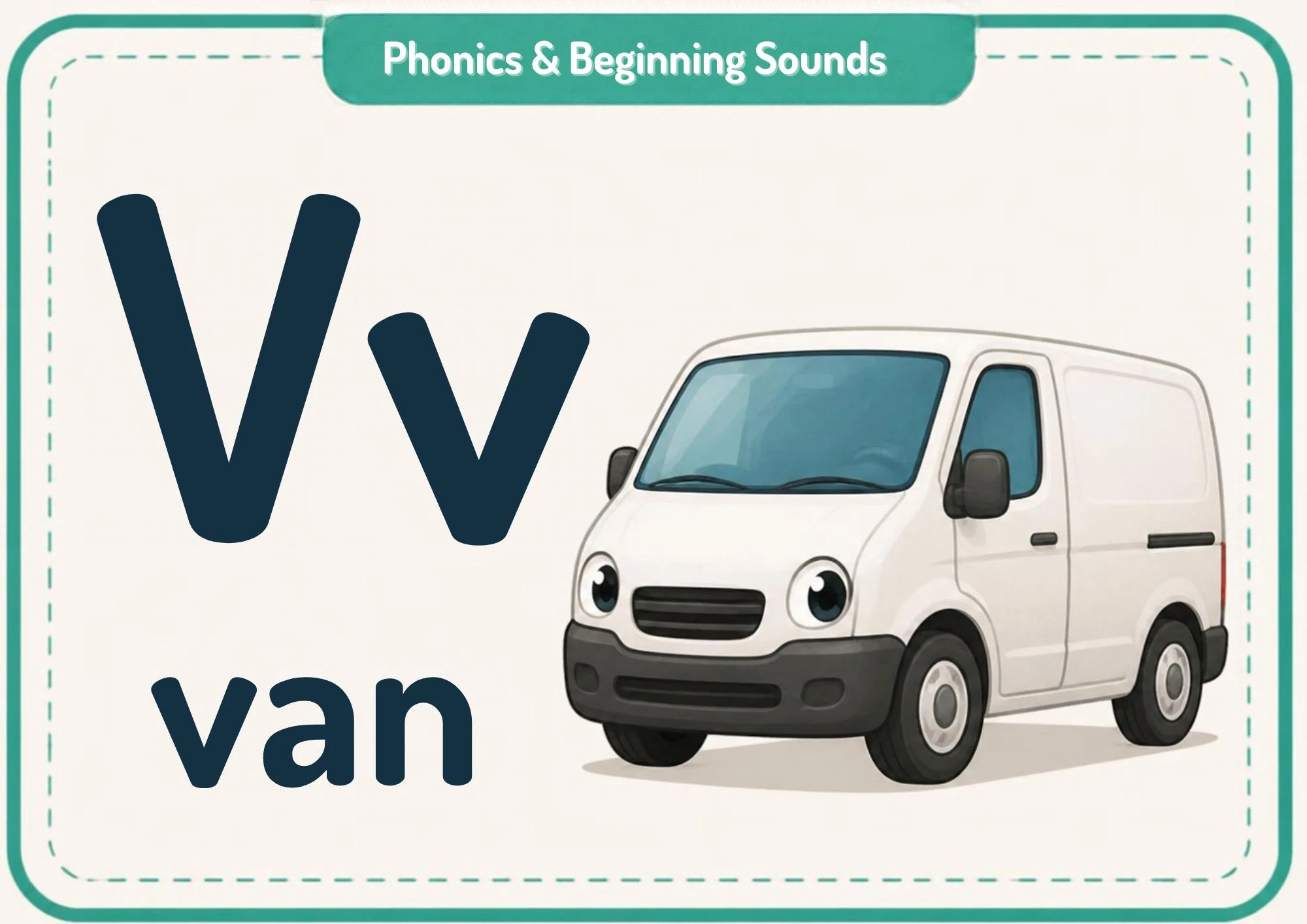
What is this?
Vv is the letter that stands for the first sound in van — top teeth on the bottom lip, air buzzing through WITH the voice on: vvv.
What does it mean?
V completes a famous pair: f whispers, v buzzes — same teeth, same lip, one switch. V is the first sound in the set taught entirely as a switch: find the f, turn the voice on.
What does the child need to know?
Your child needs the teeth-on-lip shape WITH the throat buzzing, the f-to-v switch as a game, and a streetful of v-words: van, vet, violin, vase.
Why this matters
/v/ drives van, video, visit and five — wait, five hides v in the MIDDLE. That is v’s second secret: it loves word endings and middles (five, love, over) as much as beginnings.
What it teaches
Teeth-lip coordination with voicing, the on/off voice switch (f/v), and word-position awareness — v works at the front, middle and end.
Words to learn
vvanvetviolinvasefive
Say this to your child
“"Bite your lip softly like f — but turn your voice on: vvv. Feel it buzz? That is v! V says vvv, like van."”
Step by step
- Show the card: "Vv. Teeth on the lip — but this time it BUZZES: vvv! The van sound."
- Finger-trace the Vv on the canvas: two slopes meeting in a point, one buzz down each slope.
- Play the violin game below — every bow stroke hums.
- Buzz three v-things: van, vase, violin. Feel the throat running.
- Finish with the f-v switch: fff…vvv…fff…vvv. The throat is the switch.
How to say it
Top teeth resting on the bottom lip, air through, voice ON: "vvv". It holds and hums. Same shape as f; the only difference is the buzzing throat.
Look closer at the picture
On this card the big navy pair Vv sits beside a white delivery van with a friendly face, and the word "van" is printed below — the vehicle that drives the buzz past your window most mornings.
Ask your child
"Is your throat buzzing or quiet for v?" "What is the difference between fan and van?" "What v-word drives?"
What your child can say or do
Your child might say: "vvvvan!" with a full-buzz engine, or deliver the twin-fact unprompted: "f whispers, v buzzes — I can feel it in my neck!"
Out in the real world
Vans, vets and visits; violins at concerts, vases on shelves. Five and love carry v inside, and every video call starts with someone saying vee very clearly.
Try it together
Violin game: prop an invisible violin under the chin, take an invisible bow, and play. Each bow stroke must hum a v-word: vvv-van, vvv-violin, vvv-five. Request songs by v-name, take turns as conductor and soloist, and end the concert with the longest vvv in the family’s history. Standing ovation optional; buzzing mandatory.
Understanding check
Ask for the sound and hold the throat: buzzing teeth-on-lip is the pass. Then run the switch test — fff (quiet) to vvv (buzz) and back. If your child can flip the switch, fan and van will never blur again.
Parent tips
If van arrives as fan, the voice is off — have your child hunt the buzz with a hand on their own throat, then flip between the two sounds until the switch feels like theirs. V wants the buzz; that is the whole letter.
This lesson pairs with the Van flashcard in the library — print it, show it, keep it on the fridge. Back to Phonics & Beginning Sounds (Class 28).