
Whale — a step-by-step lesson for grown-up and child
This lesson teaches Ww and its glide with the whale card: your child traces the letter, delivers a full weather report in w-words, and learns the sound that moves — lips round, then slide open.
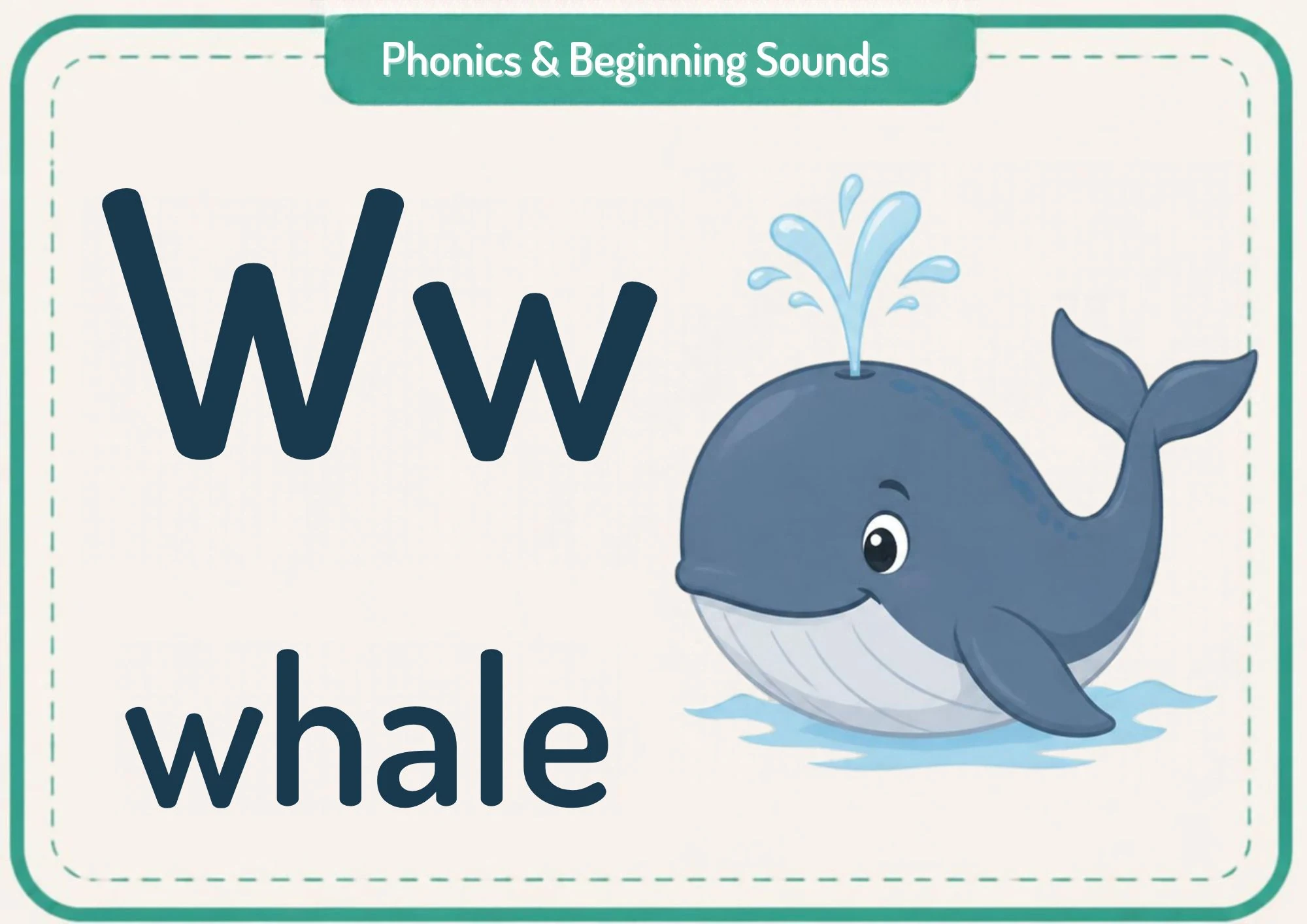
What is this?
Ww is the letter that stands for the first sound in whale — lips rounded small, then gliding open into the vowel with the voice on: wuh.
What does it mean?
W is a moving sound: nothing stays still. The lips travel from a tight little "oo" shape out into the open word — a glide, not a stop. Sounds that move are actions as much as noises.
What does the child need to know?
Your child needs the round-then-open glide, a running voice, and a seaful of w-words: whale, water, wave, wind.
Why this matters
/w/ powers water, want, we and wow — the splash words of childhood. It also looks like two v’s but sounds like nothing else, which makes it a favourite sorting puzzle.
What it teaches
Lip-glide control (round to open), voice carry-through, and connecting a physical motion to a sound — w is phonics choreography.
Words to learn
wwhalewaterwavewindwow
Say this to your child
“"Pucker up like you are going to say oo — then slide open: wuh. That is w! W says wuh, like whale. Glide it: w, w, whale."”
Step by step
- Show the card: "Ww. Round your lips small, then open into the word — wuh! The whale sound."
- Finger-trace the Ww on the canvas: four waves, one glide each, voice running the whole way.
- Play the weather-reporter game below — the glide gets a whole forecast.
- Glide three w-things: whale, water, wave. Round, open, voice on.
- Finish with the arms-as-spout whoosh and one enormous WOW.
How to say it
Lips rounded tightly, then released open with the voice running: "wuh". The motion is one smooth glide — if the teeth touch the lip, it turned into v; keep teeth and lip apart.
Look closer at the picture
On this card the big navy pair Ww sits beside a blue whale spouting water, and the word "whale" is printed below — the spout itself is the sound’s shape: rounded, rising, opening out.
Ask your child
"Do your lips start round or open for w?" "Do they move or stay still?" "What w-word says itself in the bath?"
What your child can say or do
Your child might say: "w-w-w-whale!" with rising arms, or report the news perfectly: "today is windy, wet and wavy" — a forecast with a phonics grade.
Out in the real world
Water play, windy walks and washing days are w-festivals. Waves at the beach (or in the bath), wobbly jelly, and every wow your child gasps — the glide is already in the day.
Try it together
Weather-reporter game: hand over a pretend microphone — your child is today’s weather reporter. The forecast must be w-heavy and delivered with glides: "today is windy! expect waves! whales everywhere! wow!" Swap roles and let the grown-up flub a report on purpose ("today is very… d-windy?") so the child can correct the news.
Understanding check
Ask for the sound and watch the lips: they should START rounded and MOVE open. If teeth bite the lip (vvvale), reset with "oo-uh" slid together fast. Then try r — w is round and gliding, r is curled and running.
Parent tips
If w bites into v, the teeth sneaked in — keep them behind the lip-line. The quick launch from a tiny lip-circle is the move to rehearse, and every weather report rehearses it for free.
This lesson pairs with the Whale flashcard in the library — print it, show it, keep it on the fridge. Back to Phonics & Beginning Sounds (Class 28).