
Xylophone — a step-by-step lesson for grown-up and child
This lesson teaches Xx, the alphabet’s famous oddball: mostly it says /ks/ at the END of words (box, fox, six), but on this card — at the start of xylophone — it borrows /z/. Both jobs are true, and children love the honesty.
What is this?
Xx has two jobs. Its day job is /ks/ at the end of words: box, fox, six, mix. Its rare gig is at the START of xylophone, where it sounds like /z/. This card shows the rare gig; the lesson teaches both, honestly.
What does it mean?
X teaches the most grown-up phonics truth: not every letter follows the rules, and THAT IS FINE. Meeting the exception as a friend — “this one is the weird one!” — builds reading confidence, not confusion. Out loud, twice, until it feels like insider knowledge.
What does the child need to know?
Your child needs the /ks/ ending as x’s main job, the /z/ exception named out loud as special, and the pride of knowing the alphabet’s strangest letter.
Why this matters
/ks/ finishes box, fox, six and mix — words a child already counts with. And xylophone gives x a famous face, so the rarest letter never feels forgotten.
What it teaches
Ending-sound attention (most lessons hunt beginnings; x hunts endings), honest exception-handling, and the flexibility that keeps rules and quirks friends.
Words to learn
xxylophoneboxfoxsixmix
Say this to your child
“"X is a finisher — it loves the END of words: bo-ks! fo-ks! si-ks! Say them with me and listen to the ending. And xylophone? That is x’s one fancy day job, sounding like z."”
Step by step
- Show the card: "Xx — the weird one! At the end of words it says ks: box! But here, at the start of xylophone, it borrows z."
- Finger-trace the Xx on the canvas: two crossing strokes — one for /k/, one for /s/, crossing like the sounds do.
- Play the treasure-box game below; every lid close clicks /ks/.
- End-say three x-words: box, fox, six. Listen for the sound at the END.
- Finish with one rainbow xylophone glissando and the honorary title: x-insider.
How to say it
/ks/ is two sounds in a row: the back click (/k/) straight into the hiss (/s/) — "ks", quick and dry, at word endings. For xylophone, borrow the buzzing /z/ — and say honestly that this one is the exception.
Look closer at the picture
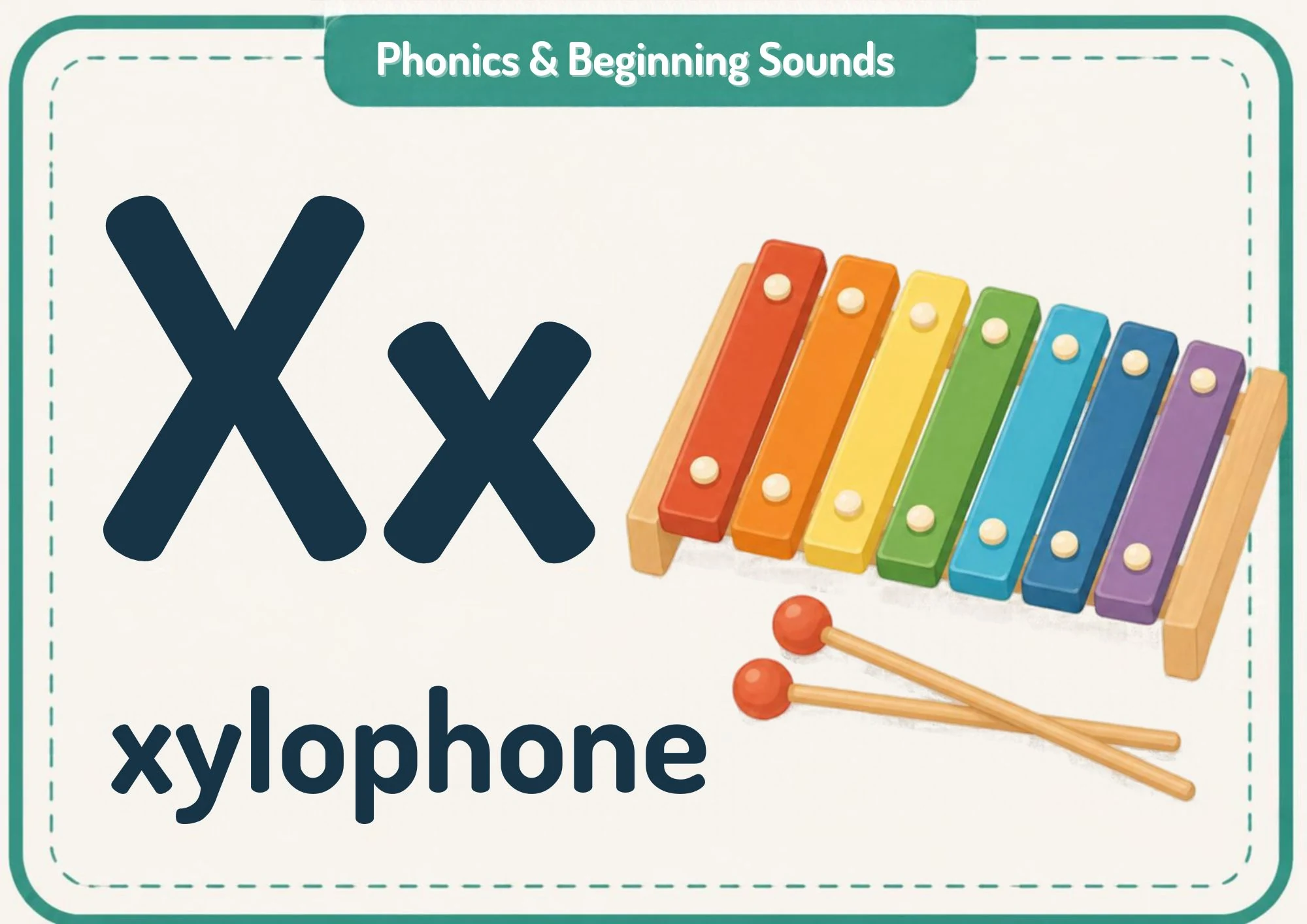
On this card the big navy pair Xx sits beside a rainbow toy xylophone with two mallets, and the word "xylophone" is printed below — the most beautiful exception in the whole alphabet.
Ask your child
"Where does x like to hide — the start or the end of words?" "What does x say in box?" "And in xylophone? (Careful — it is the weird one!)"
What your child can say or do
Your child might say: "box ends with ks!" while slamming lids, or guard the secret jealously: "xylophone starts with a z-sound — I KNOW, it is weird."
Out in the real world
Boxes close with a /ks/ click all day: lunch boxes, toy boxes, shoe boxes. Foxes fill storybooks, six fills counting, and xylophones wait in every music corner.
Try it together
Treasure-box game: fill an imaginary box with treasure. Each item must be named and boxed away with a proper /ks/ click: a fo-ks! a bo-ks! si-ks gold coins! When the lid slams shut — "KS!" — the treasure is safe. Then, for the finale, play the xylophone: x’s one fancy, z-sounding day job, performed with two mallets and total seriousness.
Understanding check
Ask where x lives: "at the END — box, fox, six" is the pass, plus the bonus fact that xylophone is the famous weird one. Two jobs named out loud, both honest — x is fully understood.
Parent tips
Teach the exception AS an exception — children adore being told "this one is the weird one", and the honesty makes them phonics insiders. Never pretend xylophone starts with /ks/; they will catch you.
This lesson pairs with the Xylophone flashcard in the library — print it, show it, keep it on the fridge. Back to Phonics & Beginning Sounds (Class 28).