
Moon — a step-by-step lesson for grown-up and child
This lesson hands your child the sky object they can actually watch change: the moon. No telescope needed — a window, a diary and a month of checking reveals borrowed light, changing shapes, and the day-shift moon that sometimes shows up before bed.
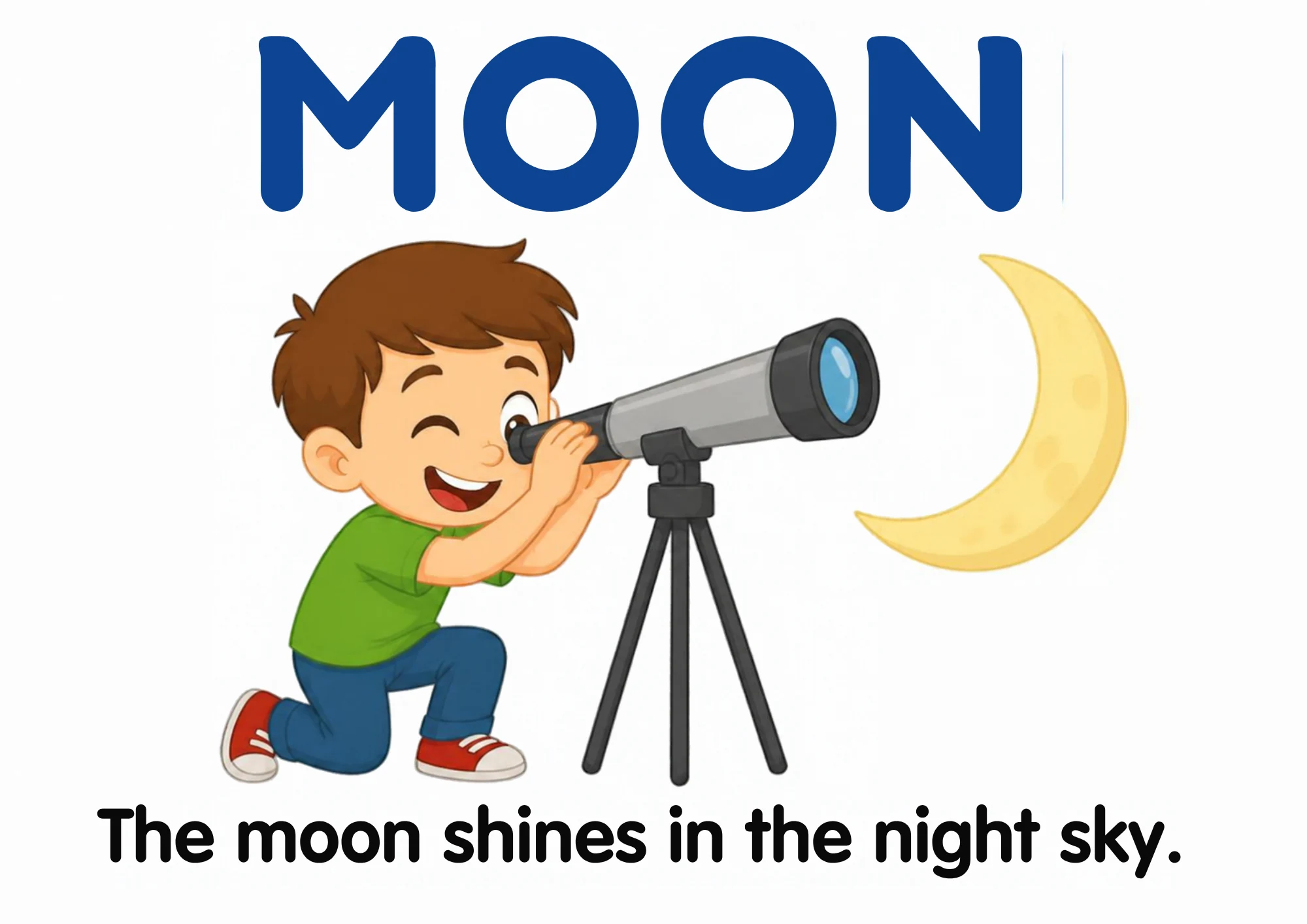
What is this?
The moon is a rocky ball circling Earth, and it glows only with borrowed light — sunlight lands on it and bounces back, like a torch on a mirror. As the month goes round, we see the lit part from different angles: crescent, half, full.
What does it mean?
Moonlight is second-hand sunlight: the moon is a reflector, not a lamp. The changing shape is not the moon being nibbled — it is the same rocky ball, lit from one side, while we watch from a moving Earth. The shapes are geometry your child can see for free.
What does the child need to know?
The moon has no wind and no rain, so astronauts’ footprints from decades ago are still pressed in its dust, fresh as the day they landed. Some nights the moon hides; some mornings it takes the early shift, hanging pale in the daytime sky.
Why this matters
The moon is the nightly observation habit your child can own — no equipment, one drawing a day. Learning that its shine is borrowed links the moon back to the sun, and the changing shapes teach that watching over time is how you see slow things happen.
What it teaches
Long-horizon observation (a month-long diary), recording with drawings, the reflection idea (shining by borrowed light), and comfort with the moon’s pattern — the same shapes return, which is what makes them predictable.
Words to learn
moonnightlightcrescentfullsky
Say this to your child
“"The moon does not glow by itself — it is a big rocky ball, and the sun lights it up like a torch shining on a mirror. That is why its shape seems to change: we see the sunny side from different angles all month. And get this — the footprints astronauts left there are still there, because the moon has no wind to blow them away."”
Step by step
- Show the card: what is the child looking through, and what are they looking at? Name it — Earth’s rocky companion.
- Ask the trick question: does the moon make its own light? No — the sun shines on it and the moon bounces the light back, like a mirror.
- Start the moon diary: draw its shape tonight — crescent, half, or full? Date every drawing. Some nights it hides; those count too.
- Check the early shift: look for the moon before bed AND in the morning — sometimes it hangs pale in the daytime sky.
- Explain the shapes: nothing is eating the moon — it is one ball, lit from one side, and we see the lit part from different angles as the month goes round.
Look closer at the picture
Ask your child: what is the child looking through? What can they see in the sky? Is the picture set at night or in the day? What shape is the moon in the picture?
Ask your child
"Does the moon make its own light?" "Where does the moon’s light come from?" "Why does the moon seem to change shape?" "Why are the astronauts’ footprints still there?"
What your child can say or do
"The moon is a mirror for the sun!" "No wind, no rain — the footprints stay forever!" Your child may guard their moon diary like a treasure, report the moon’s shape from the car window, or shout "day-shift moon!" when it shows up over breakfast.
Out in the real world
The moon is nightly, free and impossible to miss once your child is looking: dog-walk crescents, bath-time full moons, the pale daytime moon over the school run. The diary turns "always there" into "always changing on a schedule" — a pattern your child can crack in one month.
Try it together
Ball-and-torch moon: in a dim room, shine a torch (the sun) on a ball (the moon) and let your child walk around it, watching the lit shape change from crescent to full as the angle changes. Then draw tonight’s real moon and compare it to the model.
Understanding check
Ask: "Does the moon make its own light? Why does its shape change? What makes the moon shine?" No — borrowed, angles, sunlight bouncing back = landed.
Parent tips
Check the moon at the same time each evening for a week before switching times — the shape changes are clearest on a fixed schedule. A torch-and-ball session answers the shape question better than words. Missing-moon nights go in the diary too: hiding is part of the pattern.
This lesson pairs with the Moon flashcard in the library — print it, show it, keep it on the fridge. Back to Science, Nature & Discovery (Class 31).