
Mushroom — a step-by-step lesson for grown-up and child
This lesson breaks the plant-animal pattern: a mushroom is the fruiting cap of a hidden fungus threading through damp soil and old wood. Your child learns where to predict them, what the hidden part does — and the one rule that is never up for negotiation.
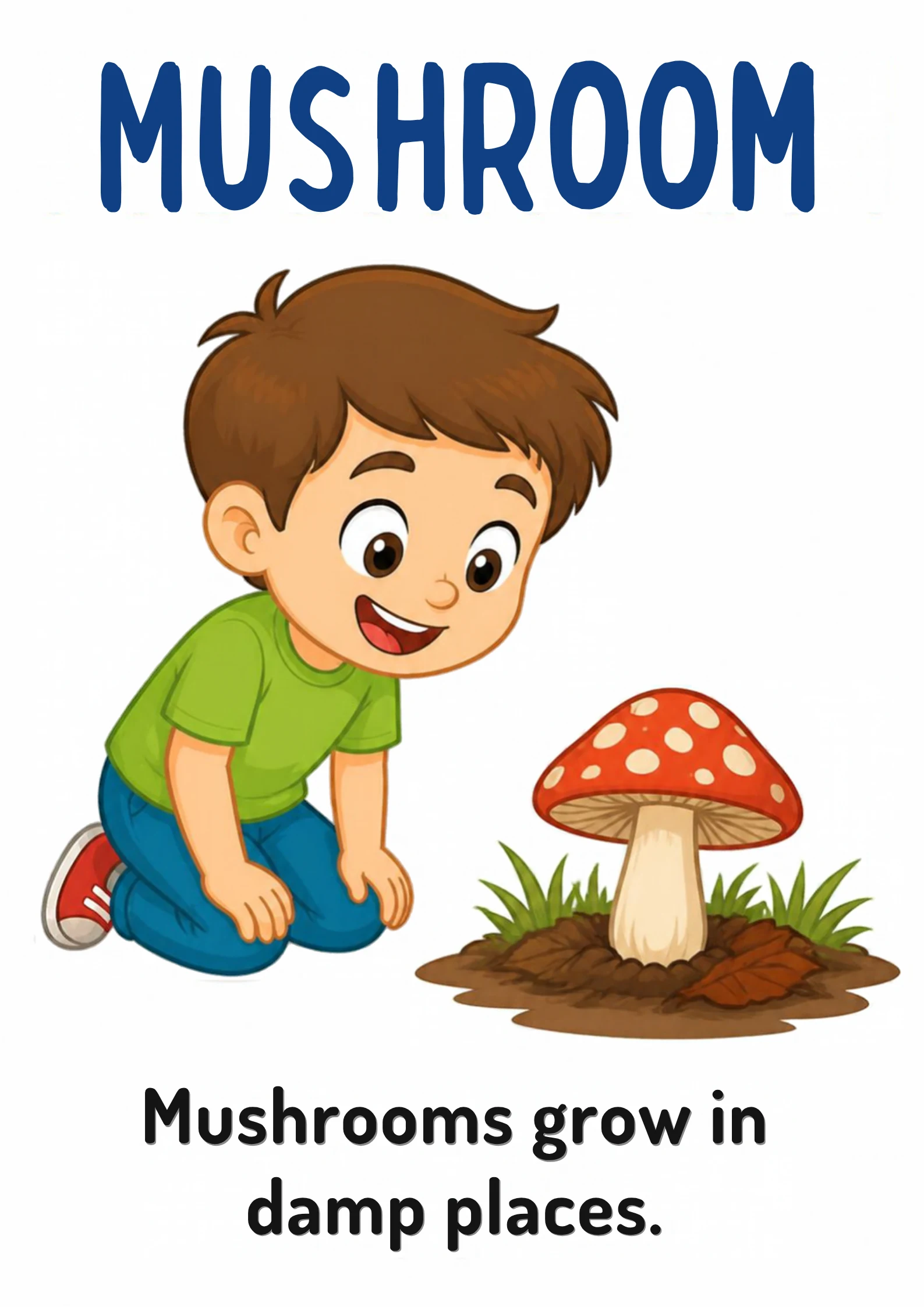
What is this?
A mushroom is not a plant — it is one piece of a fungus, a living thing in its own category. Underground and inside old logs, thread-like fungus strands spread through damp places; when the time is right, a mushroom cap pops up to spread spores.
What does it mean?
Fungi are neither plant nor animal: they cannot cook their food with sunlight like plants, and they do not eat like animals — they soak up food from damp, decaying places. The mushroom you see is like the apple of a tree whose real body is hidden below.
What does the child need to know?
Mushrooms love damp: shady grass, rain-soft soil, old logs — after rain is mushroom o’clock. The cap opens like an umbrella to let spores drift off on the wind. Some wild kinds are poisonous, and that is why the family rule is look-only: shops and grown-ups pick what gets eaten.
Why this matters
Mushrooms open a third category in your child’s living-things map — plant, animal, fungus — which is a genuine scientific upgrade. The damp-rule also works as prediction: after rain, your child knows exactly where to look, and being right feels like magic.
What it teaches
Category thinking (a third kind of living thing), habitat prediction (damp spots after rain), respectful-distance discipline with wild things, and drawing or photographing as the way to collect what you must not touch.
Words to learn
mushroomfungusdampsporescapsoil
Say this to your child
“"A mushroom is not a plant and not an animal — it is a fungus. The real fungus lives underground as tiny threads, and the mushroom is just its fruit, pushing up when the ground is damp. We look with eyes and camera only — wild mushrooms are never food, because some kinds are poisonous."”
Step by step
- Show the card: what is the child crouching beside, and what colour is the cap? Name it — a mushroom, and it is not a plant.
- Sort it out: plants cook with sunlight, animals eat, and fungi soak up food from damp, rotting places — a third kind of living thing.
- Tell the secret: the real fungus is threads under the ground; the mushroom is its apple, popped up to spread spores like tiny seeds.
- Predict together: where would a mushroom like to live — the dry sandpit or the shady corner under the tree? Then test after rain.
- Set the rule with its reason: wild mushrooms are never touched or tasted, because some kinds are poisonous, and it is always a grown-up or a shop that decides what gets eaten. We look, we photograph, we draw.
Look closer at the picture
Ask your child: what is the child crouching beside? What colour is the mushroom’s cap? Is it growing in the grass? How does the child look — curious, or careful?
Ask your child
"Is a mushroom a plant, an animal, or something else?" "Where do mushrooms like to grow?" "What is hiding under the ground?" "What is our rule about wild mushrooms — and why?"
What your child can say or do
"Mushrooms are fungus — a whole third thing!" "The mushroom is the fungus’s apple!" Your child may check the same damp corner after every rain, draw the caps they find instead of picking, or correct a grown-up who calls a mushroom a plant.
Out in the real world
Mushrooms shop-shelf versus garden-wild is the honest split: button mushrooms in the pack are food, wild caps are look-only. Yeast in bread and the fuzzy mould on forgotten fruit are the same category — fungus is hiding all over a normal week.
Try it together
Spore-print art: with a grown-up, place a shop-bought mushroom cap gills-down on dark paper under a cup overnight — next morning, a spore print! A soft round shadow the fungus made all by itself. Frame it: your child collected something without touching the wild.
Understanding check
Ask: "What three kinds of living things have we met? Where do mushrooms grow? Who decides what gets eaten?" Plant-animal-fungus, damp places, grown-ups = landed.
Parent tips
Wait for a rainy morning, then walk the same short loop — parks, hedge bases, old stumps — and let your child call the damp spots first. A photo collection titled "our mushrooms" beats any bouquet: it grows rain by rain, and nothing wilts.
Staying safe
Wild mushrooms are a never-eat, full stop: poisonous kinds can look almost exactly like safe ones, and no clever trick tells them apart — that decision belongs to grown-ups and shops alone. Touching a cap is safe; the habit to build is look, draw, photograph — because at four, hands-off has to hold even when no grown-up is watching.
This lesson pairs with the Mushroom flashcard in the library — print it, show it, keep it on the fridge. Back to Science, Nature & Discovery (Class 31).