
Volcano — a step-by-step lesson for grown-up and child
This lesson lets your child run an eruption — a safe one — while learning the honest version: deep underground, rock melts, pressure builds, and mountains occasionally let go. The kitchen model bubbles; the real thing creeps downhill glowing, and both are Earth showing its hot inside.
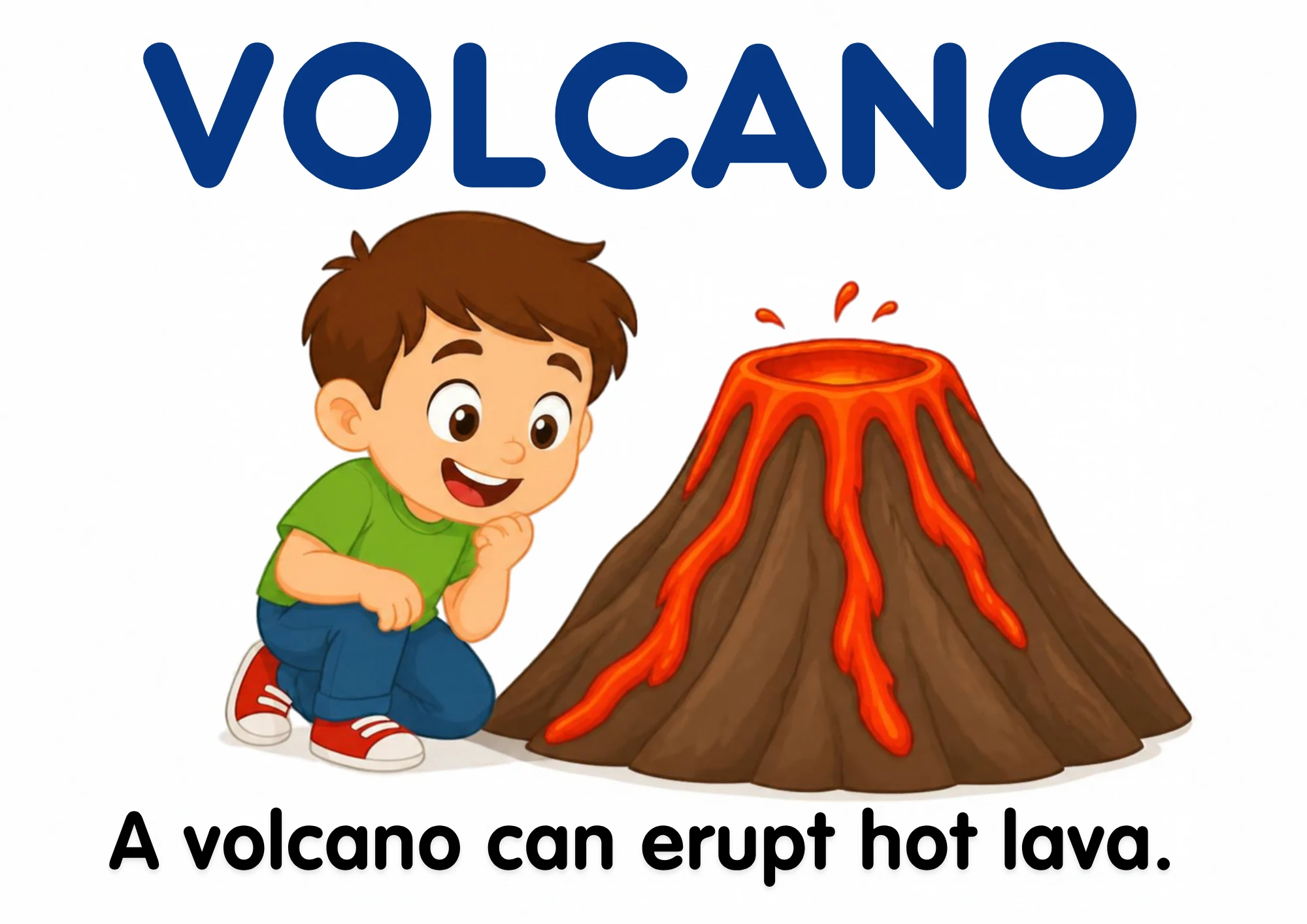
What is this?
A volcano is a mountain connected to the hot rock deep below the ground. Down there it gets so hot that rock melts; the melted rock — lava — rises, pressure builds, and sometimes the mountain erupts, pouring glowing lava down its sides until it cools hard into new rock.
What does it mean?
The ground under your feet has a hot heart: the deeper you go, the hotter it gets, and volcanoes are the places where that heat sometimes reaches the top. Lava is rock so hot it flows — and when it cools, it is rock again. The kitchen model copies the flow, not the heat.
What does the child need to know?
Real lava is over a thousand degrees and creeps downhill slowly, like extremely thick honey — slow enough that people can usually walk away from it. There are about 1,500 active volcanoes on Earth, and most grumble gently, puffing steam instead of booming. Erupted lava hardens into brand-new rock.
Why this matters
Volcanoes show Earth as active — the ground has an inside, and it is hot. Running the baking-soda model gives your child the predict-pour-watch thrill of experiments, and the honest comparison (foam versus lava) keeps it real without a single nightmare.
What it teaches
Cause-and-effect under pressure (build-up, eruption, flow), model-versus-reality comparison, the underground-heat idea, and experimental thrills with grown-up handles on anything hot — a first lab-safety division of labour.
Words to learn
volcanolavaerupthotrockpressure
Say this to your child
“"A volcano is a mountain with a job: when the rock deep underground melts and the pressure builds up, the mountain erupts and glowing lava pours down its sides. It creeps slowly, like the thickest honey ever — and when it cools down, it turns back into solid rock. Our kitchen volcano does the same flow with bubbles: the grown-up handles the fizz, you handle the watching."”
Step by step
- Show the card: what is the mountain doing, and what color is the lava? Is the child watching from far away or close up? Name the eruption.
- Tell the inside story: deep underground, rock melts because of the heat; the melted rock is called lava, and it climbs and climbs until the mountain lets go.
- Compare flows: real lava creeps like extremely thick honey, glowing red-hot, and cools into new rock. Where do you think our foam model will flow?
- Run the kitchen eruption: build a dough mountain around a cup, spoon in baking soda, and let the grown-up pour the vinegar — then step back and watch it bubble over.
- Close the loop: our foam lava flowed downhill just like the real thing — but the real lava is rock a thousand degrees hot, which is why a grown-up handles all heat, always.
Look closer at the picture
Ask your child: what is the mountain doing? What color is the lava pouring down? Is the child standing close or far away? Where do you think the lava will stop?
Ask your child
"What is lava — melted what?" "Why does a volcano erupt?" "What happens to lava when it cools down?" "Who pours the vinegar in our kitchen volcano — and why?"
What your child can say or do
"Lava is rock that melted!" "It cools back into rock — new rock!" Your child may rebuild the dough volcano daily, narrate eruptions with a slow honey-voice, or explain that volcanoes are "mountains letting off steam — and sometimes lava".
Out in the real world
Volcano evidence is in the ground everywhere: black rocky cliffs in holiday photos, hot springs and steaming vents in volcanic countries, and the island chain of Hawaii — whole islands built by cooled lava, layer on layer, still growing today.
Try it together
Dough volcano repeat lab: build the mountain, erupt, then reshape and re-run — does more baking soda make a bigger flow? Steeper mountain, faster foam? Let your child change ONE thing each round, exactly like a fair test, and crown the best eruption of the day.
Understanding check
Ask: "What is lava? What happens when it cools? Who handles the hot parts of experiments?" Melted rock, it hardens into new rock, grown-ups = landed.
Parent tips
Film the eruption on the second run — after the surprise, your child will want to watch the foam flow frame by frame. Old dough mountains dry into permanent volcanoes for the toy shelf. Book the science-fair volcano for later; yours already works.
Staying safe
The kitchen eruption is fizz, not fire — but the honest rule stands: grown-ups handle anything hot, and real lava at over a thousand degrees is a look-at-pictures, never-go-near event. On holiday near volcanic areas, marked paths and barrier fences are there because the ground itself can be hot; feet stay on the safe side, always.
This lesson pairs with the Volcano flashcard in the library — print it, show it, keep it on the fridge. Back to Science, Nature & Discovery (Class 31).