
Jet, Seaplane, Glider & Blimp — a step-by-step lesson for grown-up and child
This lesson stretches "airplane" into a family: the jet that outruns sound, the seaplane that parks on lakes, the glider that flies on silence and the blimp that is in no hurry at all.
What is this?
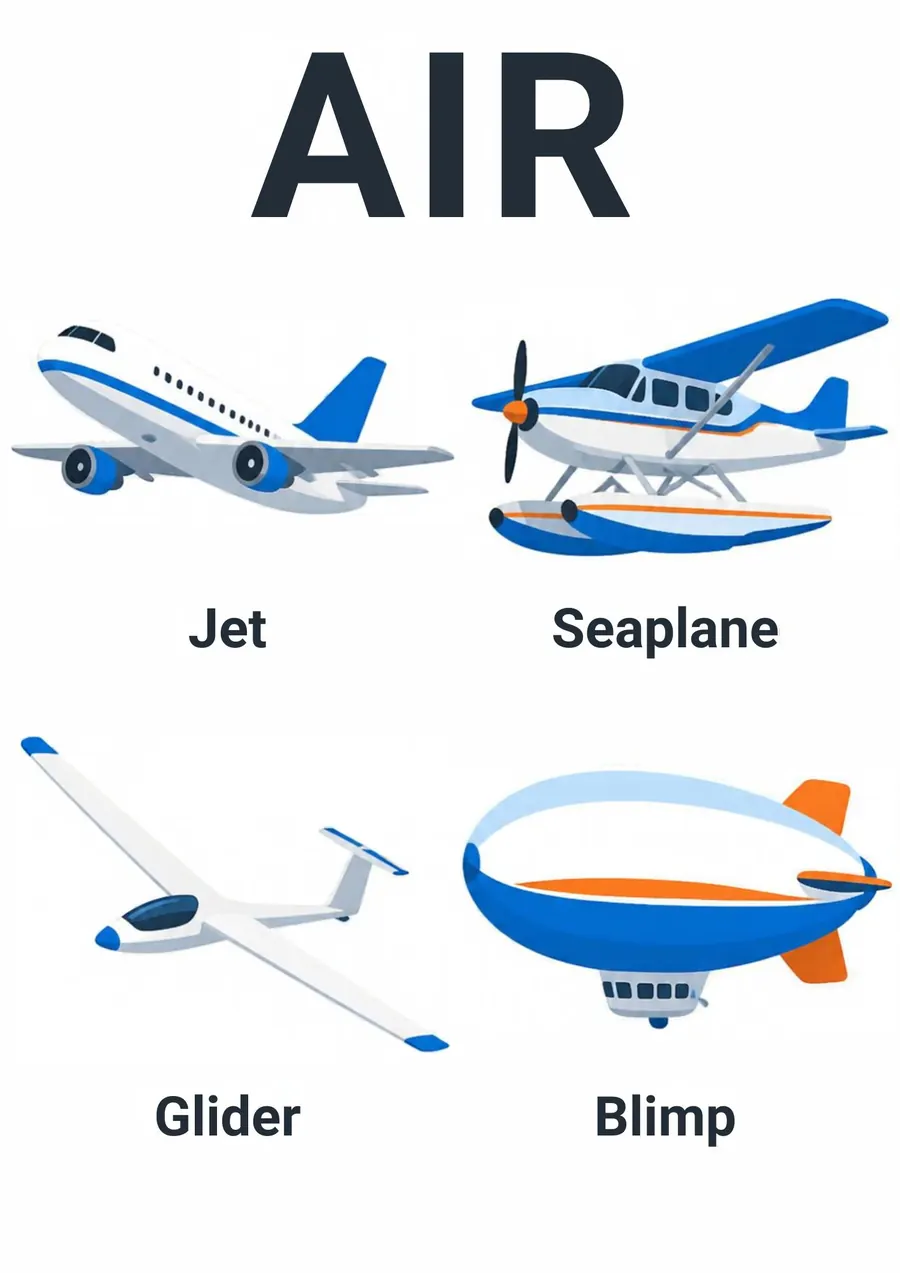
Four air vehicles: jet (fast, high), seaplane (water landings), glider (no engine — wind only) and blimp (floating giant, slower than a bicycle).
What does it mean?
One word — flying — covers four different answers: power (jet), place (seaplane), silence (glider) and slowness (blimp). The glider’s trick — wings work without engines — is real physics a paper plane can prove.
What does the child need to know?
You need the card and a paper "glider" thrown gently: how far can silence travel? The blimp riddle: why so slow? (It floats — it is in no hurry.)
Why this matters
The glider is the card’s physics star and the blimp is its joke — proof that flying does not always mean fast. Contrast teaches the category better than any single example.
What it teaches
Air-category splitting (power/water/silence/float), glide experiments, sound vocabulary (WHOOSH vs shhh), and gentle-throw motor control.
Words to learn
jetseaplanegliderblimpglidefloatsilent
Say this to your child
“"Jet — WHOOSH, faster than sound! Seaplane — splash, lands on the lake! Glider — shhh, riding the wind with no engine at all. Blimp — the world’s slowest flight, and proud of it. Four ways to fly!"”
Step by step
- The family: "jet — faster than sound, WHOOSH! Seaplane — lands on LAKES. Glider — no engine, just wind — shhh. Blimp — slow and round, the giant fish of the sky."
- The glide test: gentle paper-glider throws — "engine off… how far did SILENCE fly?"
- The parking question: "where does a seaplane park? On the lake — no runway needed!"
- The blimp riddle: "why is the blimp slowest of all? It FLOATS — flying without hurrying is still flying."
- The sound line-up: jet WHOOSH, seaplane splash, glider shhh, blimp… (drumroll of nothing). Four flyers, four sounds.
Look closer at the picture
On this card the heading "Air" sits over a blue jet, a seaplane on its pontoons, a white glider and a round blimp — the air family, four answers.
Ask your child
"Which needs no runway?" (seaplane!) "Which has no engine?" (glider) "Which is slowest?" (blimp!) "How far did your glider fly?"
What your child can say or do
Your child might throw whisper-glides on repeat, park toy planes on bath water, or defend the blimp’s honour — the family, split and sorted.
Out in the real world
Airshows display all four: jets scream, seaplanes scoop, gliders circle silently, blimps drift over stadiums. One airshow covers the family.
Try it together
Glide Contest: same paper, different throws — hard (jet!) vs gentle (glider). Chart which went further. The physics argues for gentle, every time.
Understanding check
Ask: "Who lands on water?" "Who flies engineless?" "Who is slowest?" — power, water, silence, float: four ways to fly, sorted.
This lesson pairs with the Jet, Seaplane, Glider & Blimp flashcard in the library — print it, show it, keep it on the fridge. Back to Transportation & Vehicles (Class 24).