
Rain Boots — a step-by-step lesson for grown-up and child
This lesson makes the boots routine child-owned from pull to peg: what waterproof boots do, the pull-on wiggle with the heel-all-the-way-down check, the sole inspection before the wet pavement, puddle judgement — splashers versus monsters — and the tray by the door that ends the wet-sock era.
What is this?
Rain boots are tall waterproof boots of rubber or plastic, worn over socks on wet days. They rise above the ankle so shallow water stays out, and their ridged soles grip wet, shiny ground.
What does it mean?
Boots change the maths of a rainy day: wet ground becomes walkable, puddles become toys instead of hazards, and feet stay warm because they stay dry. The tall shaft guards against the shallow slosh; the sole guards against the slip. Both deserve a quick check before the door.
What does the child need to know?
Your child needs three rain-boot ideas: boots go over socks — the wiggle test makes sure heels are down and toes can wiggle; soles get a quick check for grip and stones before wet ground; and puddles are judged — small splashers are for stepping in, deep monsters and kerb-side ones are for stepping around.
Why this matters
Boots are usually the first weather garment a child masters alone — which makes them the confidence engine of the whole wet-day routine. And puddle judgement is genuine risk assessment at child scale: which water, how deep, where does it lead? That thinking grows up into every safety decision after.
What it teaches
Independent dressing (the wiggle), observation and comparison (soles, puddle depth), risk judgement at a safe scale, responsibility for kit (tray, drying), and the pure gross-motor delight of sanctioned splashing.
Words to learn
rain bootswellieswaterproofwigglesolegrippuddlesplash
Say this to your child
“"Rain boots are waterproof feet for wet days. Socks on, toe in, push and wiggle — heel down, toes free. We check our soles for grip, we splash the small puddles, we step around the deep ones and never at the road. After, the boots live on their tray by the door, drying for tomorrow."”
Step by step
- Show the card: "Rain boots are waterproof feet — wet ground cannot get us now."
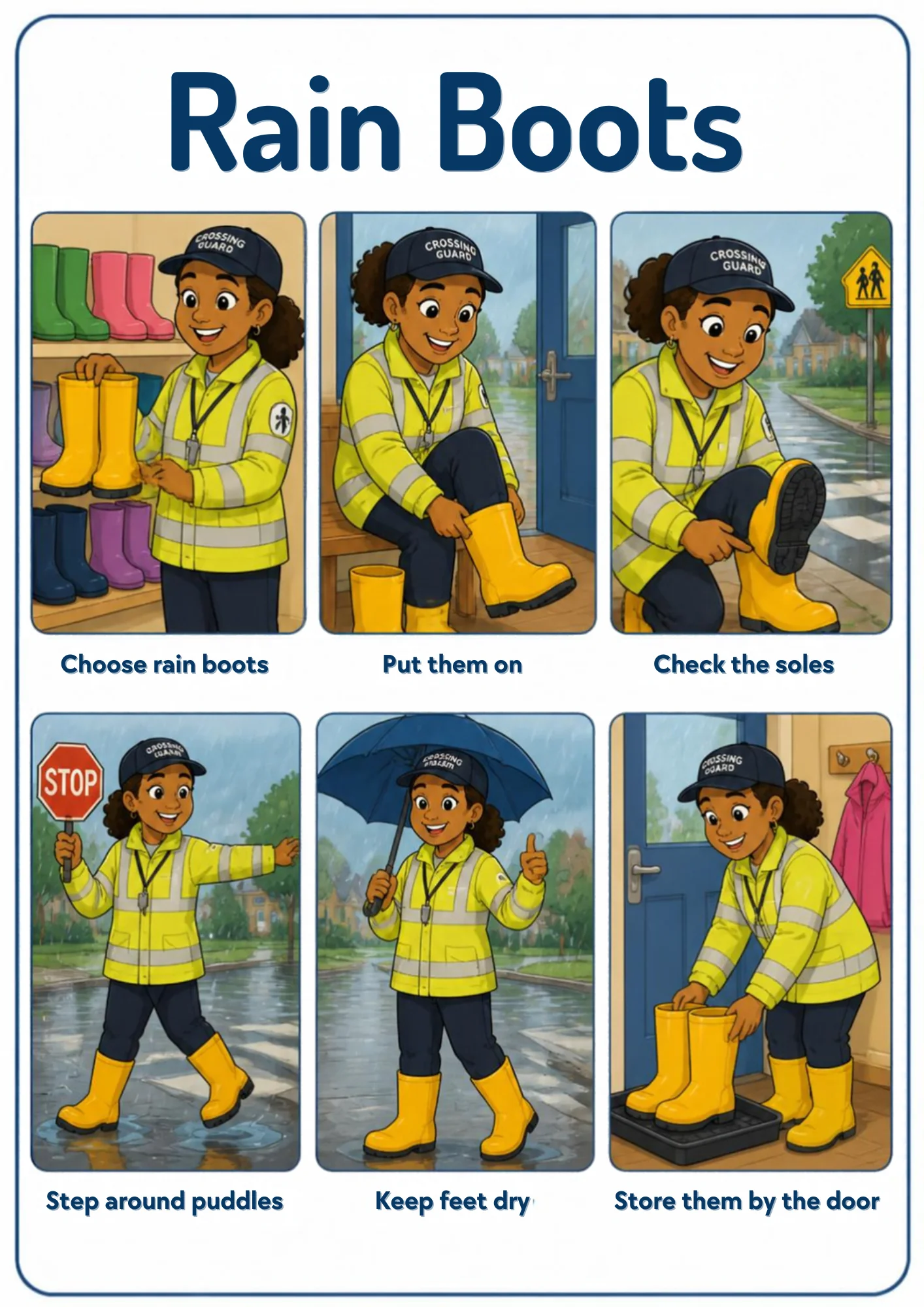
- Read the picture: the crossing guard in a yellow high-visibility jacket chooses yellow boots from a shop shelf of colours, sits on a bench pulling them on, kneels to check a boot sole on the wet pavement, steps carefully around a puddle at the zebra crossing, gives a thumbs-up under her umbrella, and sets the boots on a black tray by the door at home.
- Master the wiggle: sit, point the toe, push, then wiggle — heel all the way down, toes free. Do the squat-check: a little jump — did the heel come up? Then down again and re-wiggle.
- Check the soles like the guard: flip one boot — is the grip pattern clear of stones? Slippery soles slip; grippy soles grip. Feel the difference on the doormat.
- Draw the puddle map after the next rain: splashers (green circles) and monsters (red Xs) on your street. Walk it together — child as the map-reader.
Look closer at the picture
The rain-boots card follows the crossing guard in her navy cap and bright yellow high-visibility jacket: she picks yellow rain boots from a shop shelf stacked with green, pink, purple and navy pairs, sits on a bench by a blue door pulling a yellow boot on, kneels on wet pavement pointing at a boot sole beside a pedestrian-crossing sign, steps carefully around a puddle while holding her stop sign, stands under a navy umbrella giving a thumbs-up in the rain, and places both boots on a black tray by a door where a pink coat hangs on a hook.
Ask your child
"What does the wiggle check?" "Why do we look at our soles?" "Which puddles may we splash?" "Where do the boots live after the rain?"
What your child can say or do
Your child might report: "Heel down, toes wiggling — good to go!" grade the street: "That is a splasher, that one is a MONSTER," or finish the routine: "Boots on the tray — dry for tomorrow."
Out in the real world
Visit a boot shop and let your child pick from two joyful options — ownership starts at the shelf. Check real soles after a wet week: worn grips versus new grips, felt on the doormat. Study the big puddles on your street after rain: where do they form, why there, and which are always monsters?
Try it together
Wiggle-school with a jump-check finish. Puddle-map cartography after the next rain — green circles and red Xs, laminated if possible, consulted proudly on every wet walk. Sole-compare: grippy versus smooth on the doormat. And the sanctioned splash finale: full kit, chosen splasher, one mighty two-footed jump — socks stay dry, and the child knows exactly why.
Understanding check
Ask: "What does the wiggle do? Why check soles? Which puddles are never for splashing?" Heel-down, grip-and-stones, and kerb-side-never — waterproof feet, fully managed.
Parent tips
Boots over bare feet cause rubs — the sock rule is non-negotiable and worth saying once, clearly. Let the colour be loud: the child who adores their boots asks to go out in rain. And hold the line on monsters: the map works because the judgements are real, and real judgement needs a real no sometimes.
Staying safe
Boot safety: socks always under boots; heels all the way down or the trip risk doubles; soles checked for worn grip and lodged stones. Puddles: splashers yes, kerb-side and road-edge puddles never, and nothing deeper than the boot top — monsters are for looking, not wading.
This lesson pairs with the Rain Boots flashcard in the library — print it, show it, keep it on the fridge. Back to Weather, Seasons & What We Wear (Class 34).