
Raincoat — a step-by-step lesson for grown-up and child
This lesson makes the raincoat routine automatic: what waterproof fabric does, the four moves — arms in, zip up, hood on, sleeves down — the hood practice that wins over hood-haters, and the hang-it-on-the-peg finish that keeps tomorrow’s coat dry.
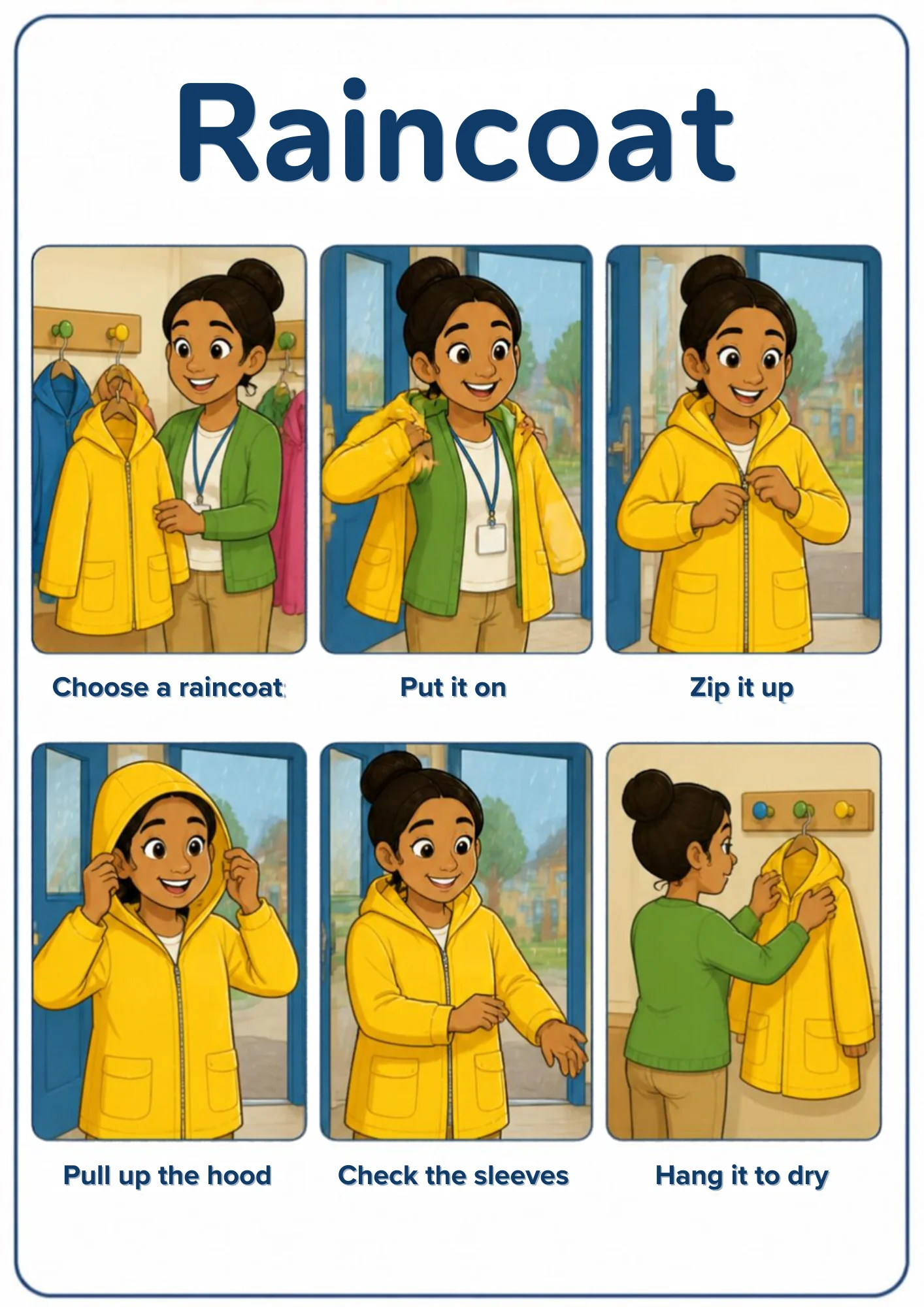
What is this?
A raincoat is a coat made of waterproof fabric with a hood and a zip: rain lands on it, beads up and slides off, while the clothes underneath stay completely dry.
What does it mean?
The raincoat works as a system — the hood saves the head, the zip seals the front, the sleeves cover the wrists, the pockets flap over their openings. Miss one part and the rain finds it: the unzipped collar, the pushed-up sleeve, the bare head in a downpour.
What does the child need to know?
Your child needs three raincoat ideas: the raincoat keeps clothes dry so bodies stay warm; the sequence is arms in, zip to the top, hood up, sleeves down — all four, every rainy day; and after the rain, the coat hangs on its peg to dry, ready for next time.
Why this matters
The raincoat is the gateway garment of self-dressing: the zip is a milestone, the hood is an sensory hurdle, the sequence is memory work — and unlike the winter coat, it is light enough to practise daily. A child who owns the raincoat routine walks to preschool as the boss of their own dryness.
What it teaches
Four-step sequencing, zip fine-motor work, sensory tolerance (the hood!), responsibility for drying and stowing, and the pride loop of staying dry because of what I did myself.
Words to learn
raincoatwaterproofziphoodsleevespegdrydrizzle
Say this to your child
“"My raincoat keeps the rain off my clothes. Arms in, zip to my chin, hood over my head, sleeves down past my wrists — four moves and I am waterproof. After the rain, my coat hangs on its peg to dry, ready for the next grey morning."”
Step by step
- Show the card: "The raincoat is your waterproof shell — rain knocks, but it cannot come in."
- Read the picture: the teacher with a bun and a green cardigan picks the yellow raincoat from a hanger on the coat rack, slips it on over her cardigan, zips it to the top, pulls the hood over her head, checks her sleeves are down, and hangs it back on the peg rack to dry by the door.
- Teach the sequence as four beats with actions: ARMS (both in), ZIP (bottom tooth to the top), HOOD (over the head), SLEEVES (pulled down past the wrists). Chant it on drizzly mornings until it runs itself.
- Practise the hood gently, never in a rush: hood-up in a mirror game, hood-up on teddy, hood-up for one slow count of three — tolerance grows in play, not in panic.
- End the ritual at the peg: after the rain, the coat hangs up, zipped open to air, hood flipped out. Tomorrow’s dry coat is tonight’s small job.
Look closer at the picture
On this card a teacher with dark hair in a bun, wearing a green cardigan over a white top: chooses the yellow raincoat from a hanger on a wooden rack with a blue and a pink coat behind, slips her arms in at the blue door, zips it up to the collar, pulls the hood on over her bun, checks the sleeves down to her wrists while standing by the open door in the rain, and hangs the coat on the peg rack to dry with her back to us.
Ask your child
"What are the four raincoat moves?" "Which part keeps the rain off your head?" "Why does the coat hang on the peg after rain?" "What happens if we forget the zip?"
What your child can say or do
Your child might chant it solo: "Arms, zip, hood, sleeves!" report from the mirror: "Hood up — I can still see!" or do the finish unprompted: coat on the peg, hood out, "Ready for next time."
Out in the real world
Spot the raincoat system at preschool pickup: every good coat rack has hooks at child height and space for wet coats to air. Watch the zip-workers at the door. Notice who is dry by lunchtime — the four-moves crowd — and who arrived soaked: the collar-open, hood-forgotten crowd. The sequence is the difference.
Try it together
Four-moves race on a dry day: arms-zip-hood-sleeves against the clock, then teaching the sequence to teddy. Hood-desensitising game: peek-a-boo hoods in the mirror, then hood-up for a slow three-count, then a hood-up dance move. Peg-practice: the hang-it-dry routine as a fine-motor challenge — coat on the hook, hood out, zip open to air. Certification: your child runs the door-check for the whole family on the next drizzle.
Understanding check
Ask: "Name the four moves. Why the hood? What do we do with the coat after rain?" Arms-zip-hood-sleeves, head-dry, peg-to-dry — the routine now belongs to your child.
Parent tips
The hood is the hill to take slowly — never force it down in a hurry, because a hood fight at the door poisons the whole routine. Practise in play, choose coats with hoods your child likes, and accept hood-today-hair-tomorrow. And keep the peg low: the drying step sticks only when the hook is within reach.
Staying safe
Raincoat rules: all four moves before the door, in real rain — the damp-drizzle compromise is how colds catch rides. Check the zip does not catch chin skin, and the hood tie (if any) is not a long loose cord. Hang wet coats to dry properly: a damp coat tomorrow is a shivery child by lunchtime.
This lesson pairs with the Raincoat flashcard in the library — print it, show it, keep it on the fridge. Back to Weather, Seasons & What We Wear (Class 34).