
Rain — a step-by-step lesson for grown-up and child
This lesson explains where rain actually comes from and what it does for the world, then turns the next shower into a science station — drops to feel, rain to hear and a jar that measures the sky.
What is this?
Rain is water falling from the clouds. Water in seas, rivers and puddles rises up as invisible vapour, gathers into clouds, and when the drops grow big and heavy — down they come as rain.
What does it mean?
Rain is the world’s watering can. It drinks the gardens, fills the rivers and reservoirs, washes the air and the leaves, and tops up every puddle. Every drop is on a loop: ground to cloud to ground again, over and over.
What does the child need to know?
Your child needs three rain ideas: rain comes from water held in clouds; rain gives every plant and animal the water they need; and rainy days ask for rain gear — and offer puddles.
Why this matters
Rain is the entry point to the water cycle, the science story your child will retell for years. It also carries emotional weather: some children find rain gloomy, some find it cosy. Welcoming both feelings teaches that all weather — and all moods — passes.
What it teaches
Circular cause-and-effect (the water loop), sensory vocabulary for sound and touch, care for living things (the garden drinks too), patient measuring, and the dressing-sequencing skills that rainy mornings demand.
Words to learn
rainraindroppuddlesplashsoakshowerumbrellawellies
Say this to your child
“"Rain is how the clouds water the whole world — the trees, the flowers, you and me. Water goes up to make clouds, then falls back down as rain, then goes up again. On rainy days we wear our raincoat and boots, and the puddles are waiting."”
Step by step
- Show the card: "Rain is water falling from the clouds — the clouds are giving the world a drink."
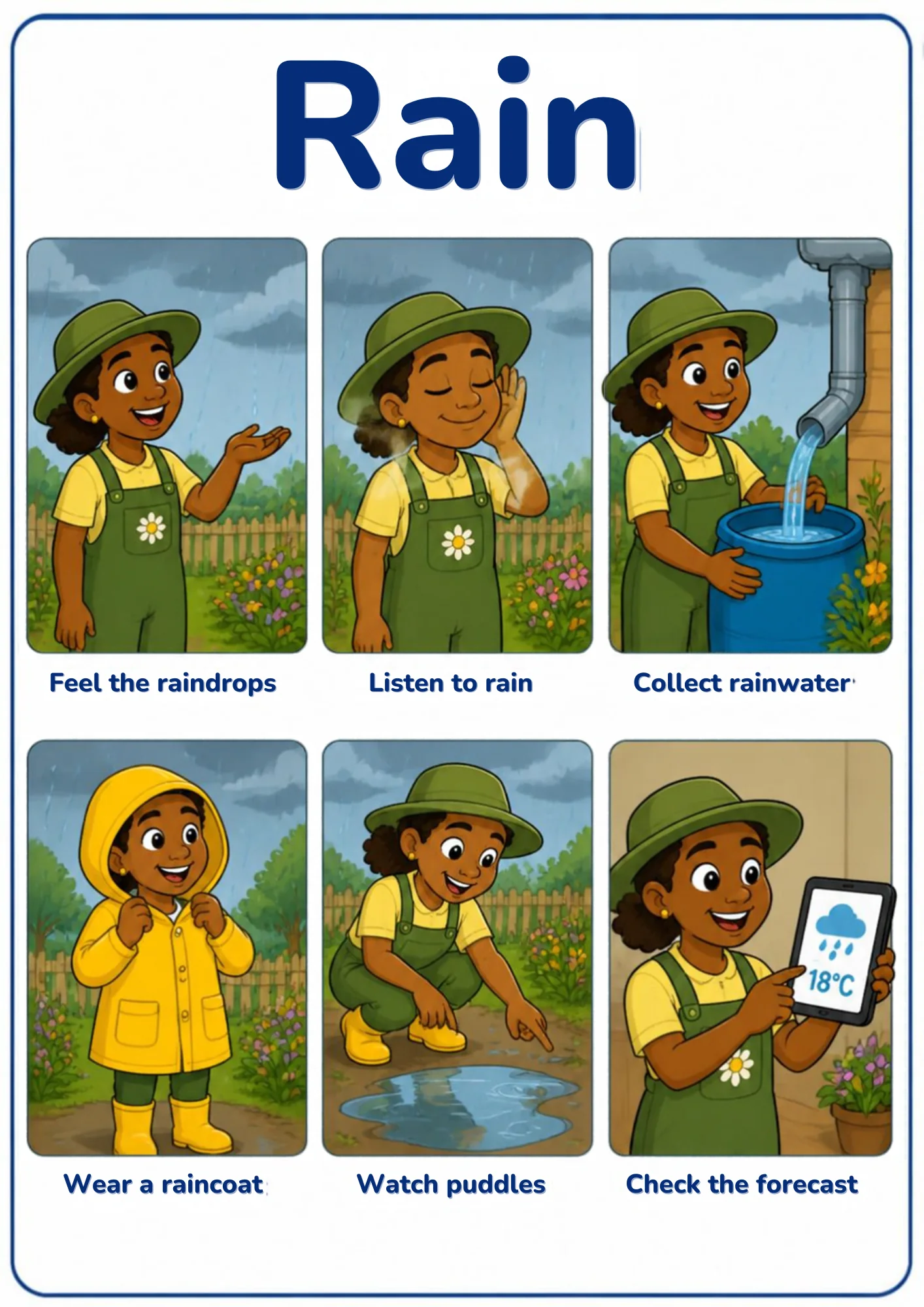
- Read the picture: the girl feels raindrops land on her hand, listens to the rain with her eyes closed, collects rainwater in a big blue barrel from a pipe, wears a yellow raincoat, points at a puddle and checks a forecast that reads 18 degrees.
- Trace the water loop with your finger in the air: puddle → up to the cloud → rain → puddle again. It never ends!
- Catch the next rain on the doorstep: feel a drop on a palm, listen to it on the hood, watch it bead and run off the raincoat — the coat works!
- Put a jar outside before bed and measure the catch in the morning: that much sky-water fell while you slept.
Look closer at the picture
On this card a girl in a green hat and green overalls stands in a rainy garden: she holds her palm out to feel the raindrops, cups her ear to listen with eyes closed, watches rainwater pour from a big pipe into a blue barrel, wears a yellow hooded raincoat, crouches to point at a puddle and holds a tablet showing a rain-cloud forecast at 18°C.
Ask your child
"Where does rain come from?" "Who drinks the rain?" "What do we put on before a rainy walk?" "What happens to puddles when the sun comes back?"
What your child can say or do
Your child might say: "Rain comes from the clouds," "The garden is drinking!" or the dressing report: "Raincoat zipped, hood up, boots on — ready!"
Out in the real world
Watch rain land in the birdbath, the sandpit cover and the watering can. Visit a rain barrel at a community garden. Notice which things love rain (worms, washed cars, ducks) and which hide from it (cats, picnics, chalk drawings).
Try it together
Puddle symphony: tap a tray of water slowly, then fast, then drum the rim — which sounds like today’s rain? Then the water-loop pantomime: everyone crouches as a "puddle", rises as vapour, huddles as a cloud, and sprinkle-falls back down as rain.
Understanding check
Ask: "Where does rain come from? What does rain give the garden? What do we wear in the rain?" Clouds, a drink, raincoat-and-boots — the loop is learned.
Parent tips
Do not rush to comfort a child who grumbles at rain — hand them the measuring jar or the listening game instead, and let the rain become interesting before it becomes background. And own the gear: a child who picked their own wellies begs for rain.
Staying safe
Rain makes slopes, painted lines and leaves slippery — walking feet near roads, always. Wet roads make cars slower to stop, so hands are held at crossings. And when thunder joins the rain, the lesson shifts to storm rules: inside, cosy, away from windows.
This lesson pairs with the Rain flashcard in the library — print it, show it, keep it on the fridge. Back to Weather, Seasons & What We Wear (Class 34).