
Rainbow — a step-by-step lesson for grown-up and child
This lesson explains the rainbow’s two ingredients — sunshine and raindrops — walks the seven colours in order, and gives your family the mist-spray trick that puts a rainbow in your own hands.
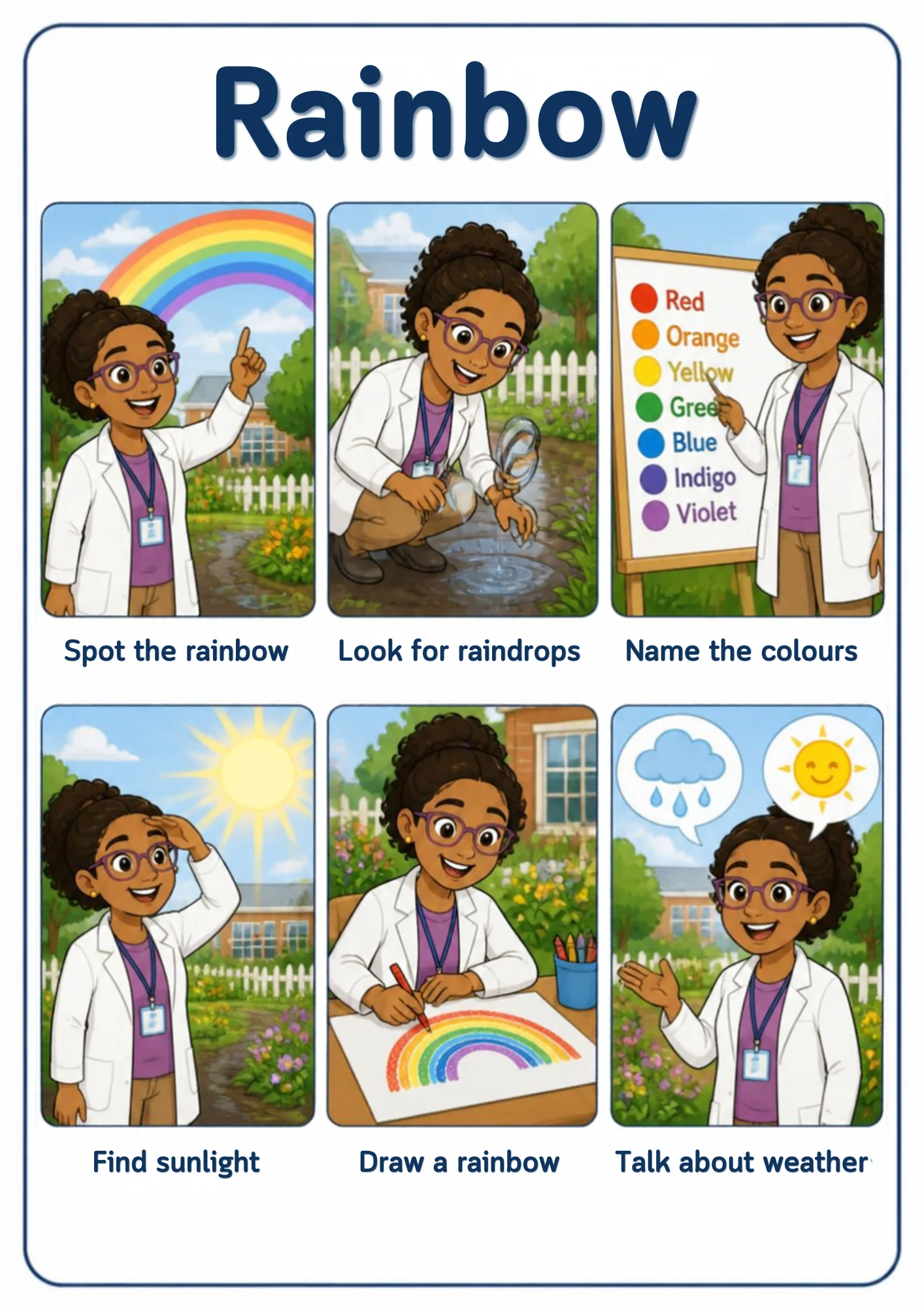
What is this?
A rainbow is a giant arc of coloured light. It appears when the sun shines through falling raindrops: each drop splits the white light into its colours, and together the drops paint the arc across the sky.
What does it mean?
A rainbow needs both of its ingredients at once: light from behind you, rain in front of you. That is why rainbows visit right after showers and fade when the drops dry. The colours always arrive in the same order: red, orange, yellow, green, blue, indigo, violet.
What does the child need to know?
Your child needs three rainbow ideas: rainbows come from sun plus rain; the colours follow a fixed seven-colour order; and rainbows are quick visitors — enjoy them now, draw them later.
Why this matters
A rainbow bundles colour knowledge, sequencing and the first optics into one unforgettable sight. Naming seven colours in order is genuine memorisation practice — and the brief visit teaches, gently, that some wonderful things do not last, which is a big feeling made safe.
What it teaches
Colour naming and ordering, sequential memory, light-and-water science, the emotional literacy of enjoying-and-letting-go, and art transfer — drawing the rainbow afterwards keeps both the colours and the memory.
Words to learn
rainbowarccolourslightraindropsprismfadesky
Say this to your child
“"A rainbow comes when sun and rain are both in the sky. The sunbeam dives into the raindrops and comes out in seven colours: red, orange, yellow, green, blue, indigo, violet. Rainbows do not stay long — we enjoy them, then we draw them so they stay with us."”
Step by step
- Show the card: "When the sun shines through raindrops, the light splits into its colours — a rainbow!"
- Read the picture: the scientist spots a rainbow over a house, crouches by a puddle with a special glass that splits light, points at a chart naming all seven colours, shades her eyes from the sun, draws a rainbow with crayons and stands between two thought bubbles — a rain cloud and a smiling sun.
- Chant the seven colours with finger-counts: red, orange, yellow, green, blue, indigo, violet. Again, faster. Again, whispering.
- Teach the recipe like a cake: sunshine behind you + raindrops ahead = rainbow. Both, same time, that is the whole trick.
- Try the kitchen version on a sunny day: fine water mist from a hose or spray bottle, sun behind you — hunt the little rainbow hiding in the spray.
Look closer at the picture
The rainbow card follows a scientist with round glasses and a white lab coat: she points up at a big rainbow arcing over a house and trees, kneels by a puddle holding a special glass that bends light, presents a whiteboard with seven labelled colour dots — Red, Orange, Yellow, Green, Blue, Indigo, Violet — shades her eyes from a bright sun, colours a rainbow band picture with crayons, and gestures between a rain-cloud bubble and a smiling-sun bubble as if explaining how both make it together.
Ask your child
"What two things make a rainbow?" "Which colour comes first? Which is last?" "Why do rainbows go away?" "What could we do to keep the memory?"
What your child can say or do
Your child might chant the seven colours unprompted for days, announce "Sun plus rain makes rainbow!" from the back seat of the car, or declare the mist-spray rainbow the best discovery of the summer.
Out in the real world
Keep rainbow-spotting alive all season: after every shower, check the sky in the shower’s direction with the sun at your back. Garden sprinklers, car washes and fountain spray all hide little rainbows on sunny days.
Try it together
Rainbow restaurant: lay out coloured paper "plates" and serve toy food sorted to each colour band. Rainbow hunt at home: find one object per colour, laid on the floor in arc order. Then the big art: a seven-band crayon rainbow, one colour chanted per band.
Understanding check
Ask: "What makes a rainbow? Name the colours you remember. Why can we not keep a rainbow?" Sun-plus-rain, any ordered run of the seven, and a soft "it fades" — that is the full arc.
Parent tips
When a real rainbow fades mid-hug, let the disappointment exist and answer it with action: "Let us draw it quick, before we forget!" The drawing ritual converts loss into making. And learn the colours yourself by heart — confidence is contagious.
Staying safe
Rainbow-hunting means back to the sun — say it out loud together: we look at the rainbow sky, never at the sun. Wet grass and slopes are slippery, so rainbow-chasing feet walk. Spray-bottle rainbows are for sunny days, never for eyes.
This lesson pairs with the Rainbow flashcard in the library — print it, show it, keep it on the fridge. Back to Weather, Seasons & What We Wear (Class 34).