
Snowy Day — a step-by-step lesson for grown-up and child
This lesson choreographs the snowy day from first look out the window to the cocoa return: what the white world is doing, the dressing order that keeps it fun, the penguin walk for icy patches, and the jobs — snowploughs! — that keep the town moving.
What is this?
A snowy day is when snow falls and settles: white roofs, white paths, footprints telling who went where, and a special hush because fresh snow softens every sound in the street.
What does it mean?
Snowy days change how everything works: walking slows, cars crawl or stop, schools sometimes close, and big machines come out to help — snowploughs push the snow aside so buses and ambulances can get through.
What does the child need to know?
Your child needs three snowy-day ideas: snowy days ask for the full kit in order — coat, hat, gloves, boots; icy paths need penguin steps, tiny and careful; and we never walk or play near a working snowplough — we watch from far away with a grown-up.
Why this matters
A snowy day is the year’s biggest routine test: five garments, one order, cold consequences. Mastering it feels enormous to a four-year-old. Add the neighbourhood drama of the snowplough and the sheer joy of the first angel, and the day teaches preparation, patience and celebration at once.
What it teaches
Multi-step sequencing under excitement, balance and body control on slippery ground, community awareness (the plough keeps the town open), patience in dressing, and the pure sensory richness of the year’s most different-feeling day.
Words to learn
snowysnowploughfootprintshushicybootsglovessnow angel
Say this to your child
“"A snowy day turns everything white and quiet. We dress in order — coat, scarf, hat, gloves, boots — then we walk like penguins on the slippery bits. We watch the snowplough from far away while it clears the road, and when the snow is fresh and soft, we make a snow angel."”
Step by step
- Show the card: "A snowy day turns the whole street white and quiet — and we have our snow plan."
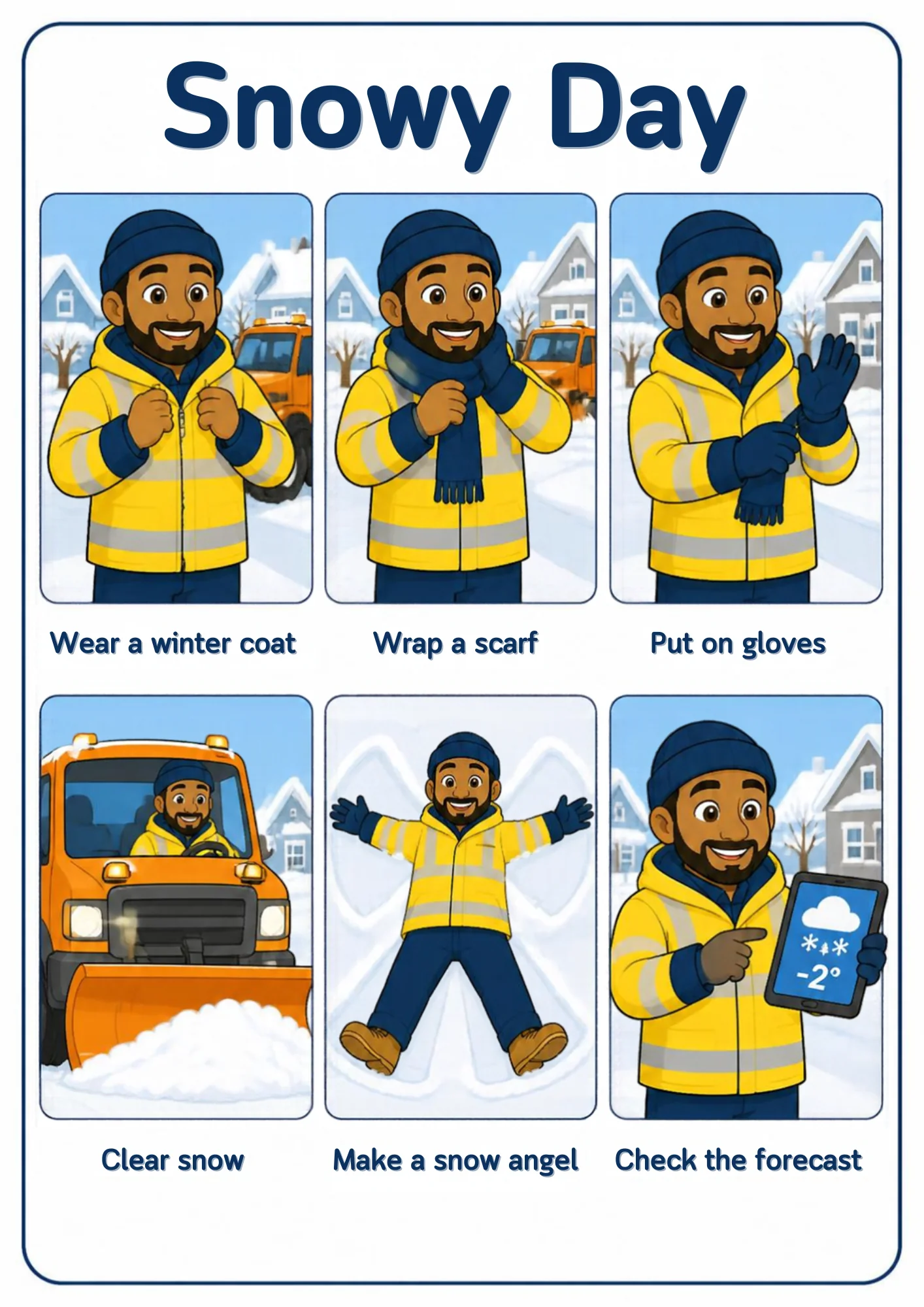
- Read the picture: the snowplough driver in a yellow high-visibility coat zips it up, wraps a navy scarf, pulls on gloves, drives an orange snowplough with a big shovel pushing snow, lies in the snow making a snow angel, and points at a forecast reading minus 2 degrees.
- Drill the dressing order like a song: coat, then scarf, then hat, then gloves, boots last — boots last so nobody skates across the hallway.
- Practise penguin steps on the spot: tiny steps, feet flat, knees soft, arms out for balance. Now cross the "icy patch" (a rug) without a wobble.
- Make the angel: fall gently backward — a sit, then a soft plop — sweep arms up-down, legs in-out, stand up without stepping on the wings, and admire it from above like the picture.
Look closer at the picture
On this card a snowplough driver with a beard, navy beanie and a yellow high-visibility winter coat: zips the coat to his chin, wraps a navy scarf around his neck, pulls on a navy glove, sits in the cab of an orange snowplough with amber lights pushing a mound of snow with its front shovel, lies spread-eagle in fresh snow next to a swept snow-angel shape, and points at a tablet showing snowflake icons and minus 2 degrees.
Ask your child
"What does a snowy day look and sound like?" "What is the dressing order?" "How do we walk on icy paths?" "What does the snowplough do — and how close do we go?"
What your child can say or do
Your child might say: "Coat, scarf, hat, gloves, boots — boots LAST!" "Penguin steps on the ice," or the angel review: "Mine has big wings — I did double arm sweeps!"
Out in the real world
Compare the street before and after the plough passes: where does the snow go? Which paths get gritted? Point out the real helpers — drivers, gritters, post — who keep the town running in the white. And count the bird tracks in fresh snow: the early birds signed their names.
Try it together
Footprint zoo: walk like different animals in fresh snow and guess each other’s prints. Snow-kitchen round two with muffin trays and spoons. The angel gallery: make a whole family of angels — big, small, and teddy-sized — then photograph the flock from a window before the next flurry files it all smooth.
Understanding check
Ask: "What do we put on first? How do we walk on ice? How close do we stand to a snowplough?" Coat-first, penguin steps, and very far away — the snowy day is fully choreographed.
Parent tips
Set the warm-up rhythm before the first mittened step: one outside block, one inside warm-up, repeat. Wet gloves go straight on the radiator, dry ones on. And savour the hush yourself — the child who hears you say "listen how quiet" learns that weather is also something to hear.
Staying safe
Full kit every time — wet plus cold chills fast, and wet gloves get swapped, not endured. Penguin steps on ice, never running on shiny ground. Snowploughs are watched from far away with a grown-up, never followed or touched, and inside we go when the shivers start.
This lesson pairs with the Snowy Day flashcard in the library — print it, show it, keep it on the fridge. Back to Weather, Seasons & What We Wear (Class 34).