
Windy Day — a step-by-step lesson for grown-up and child
This lesson takes the breeze your child already knows and turns the dial to windy: how a windy day differs, what the wind moves and shakes, the hat-and-window preparations, and the step-by-step joy of flying a kite in an open field.
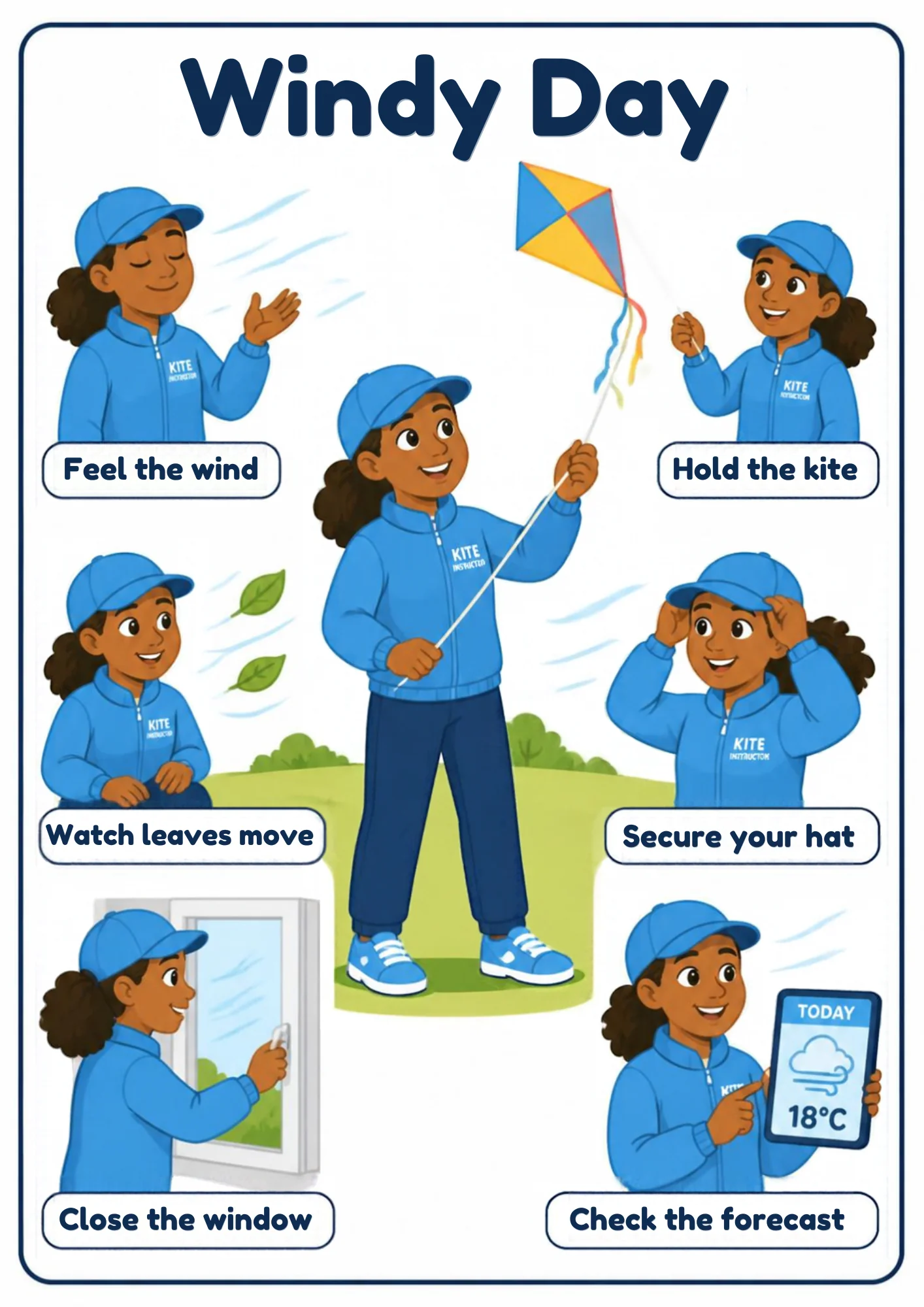
What is this?
A windy day is when the air moves strongly enough to grab attention: hair streaming sideways, trees swaying, washing snapping, leaves skittering and windows humming. Windy is the breeze’s big sister — same air, more push.
What does it mean?
Strong wind has real power: it bends whole trees, blows hats into next week and rattles doors. It also does glorious things — lifts kites, flies flags, races clouds. The windy-day skill is respect plus enjoyment: secure the loose things, then go feel the force.
What does the child need to know?
Your child needs three windy-day ideas: windy means the air pushes hard enough to move lots of things; we secure hats, windows and light objects before playing; and windy days are kite days — in open spaces, away from roads and wires.
Why this matters
A windy day is felt physics: your child leans into the push, watches leaves fly and feels a kite tug the string. Cause and effect become whole-body — run and the kite climbs, stop and it dips — and the safety habits (secured hats, shut windows) are rehearsals for real storm readiness.
What it teaches
Physical force awareness, preparation routines (hat straps, window checks), kite-handling coordination, observational sorting (what moves fast, what barely sways), and the confidence of playing competently in big weather.
Words to learn
windygustkitesecureflutterswayblowopen field
Say this to your child
“"On a windy day the air pushes hard — it moves leaves, hats and even kites! We strap our hats on, we shut our windows, and then we go out and feel the push. And in a big open field, the wind will lift a kite right up into the sky."”
Step by step
- Show the card: "A windy day is when the wind pushes hard enough to move everything — even us!"
- Read the picture: the kite instructor in a blue cap stands on a grassy field flying a blue-and-yellow kite on a long string; the circles show her feeling the wind on her face, holding the string with both hands, watching leaves fly past, pressing her cap on with both hands, closing a window latch, and pointing at a forecast that reads 18 degrees with a windy cloud icon.
- Do the loose-things check before any windy outing: hats on with straps, balloons held tight, windows latched at home. What else could the wind take?
- Feel the force game: lean forward into the wind with your whole body — the wind is pushing back! Take three steps against it, then let it push you home, giggling.
- Fly the kite in order: open field, grown-up launches, child runs holding the string — run and it climbs, slow down and it dips. That tug in the string is the wind, saying hello.
Look closer at the picture
On this card a kite instructor in a light-blue jacket and blue cap flies a blue-and-yellow diamond kite on a white string in the middle of a grassy field. The labelled circles show her: feeling the wind with eyes closed and palm up, holding the kite string with both hands, watching two green leaves blow through the air, pressing her cap down with both hands, closing a window latch, and pointing at a "TODAY" forecast card with a windy cloud icon reading 18°C.
Ask your child
"What is the wind moving today?" "What do we check before a windy walk?" "What happens to the kite when you run? When you stop?" "Where do kites fly — and where never?"
What your child can say or do
Your child might say: "The wind pushed me home!" "My hat is strapped, my window is shut," or the kite report: "I ran and the wind pulled the string — I could FEEL it!"
Out in the real world
Watch the wind workers after a windy night: flags worn out, bins moved, branches down, kites patched. Notice which things sway safely (trees, lamps) and which things should never sway (cranes, wobbly fences). Secure-the-garden becomes a windy-day ritual: balls in, cushions in, trampoline tied.
Try it together
Wind gauge: hold out different papers — tissue, napkin, card — and rank which the wind moves fastest. Sock-in-the-air relay. Then the main event, the kite: practise the run indoors with a ribbon, then take the real kite to the biggest open space you can find. The tug on that string is the whole lesson in one feeling.
Understanding check
Ask: "What kind of day is it when the wind pushes hard? What do we strap on? Where do kites fly?" Windy, hats, open fields far from wires — your child now reads big wind like a local.
Parent tips
Do the preparations as a duo, out loud, every windy time: "Hats? Strapped. Windows? Shut. Loose toys? In the box." The chant becomes the child’s own pre-wind checklist. And manage the down draft: windy-day tiredness is real — big air days end with big snacks and early baths.
Staying safe
Windy-day rules: strap the hat, latch the windows, bring in the light things. Walk clear of old trees, scaffolding and building sites where the wind shakes things loose. Kites fly in open fields only — never near roads, power lines or cables — and the launch is always a grown-up job.
This lesson pairs with the Windy Day flashcard in the library — print it, show it, keep it on the fridge. Back to Weather, Seasons & What We Wear (Class 34).