
Wind — a step-by-step lesson for grown-up and child
This lesson makes invisible air visible: your child learns what wind is, gathers the clues that show it blowing, and ends with the season’s best prize — flying a kite safely in an open field.
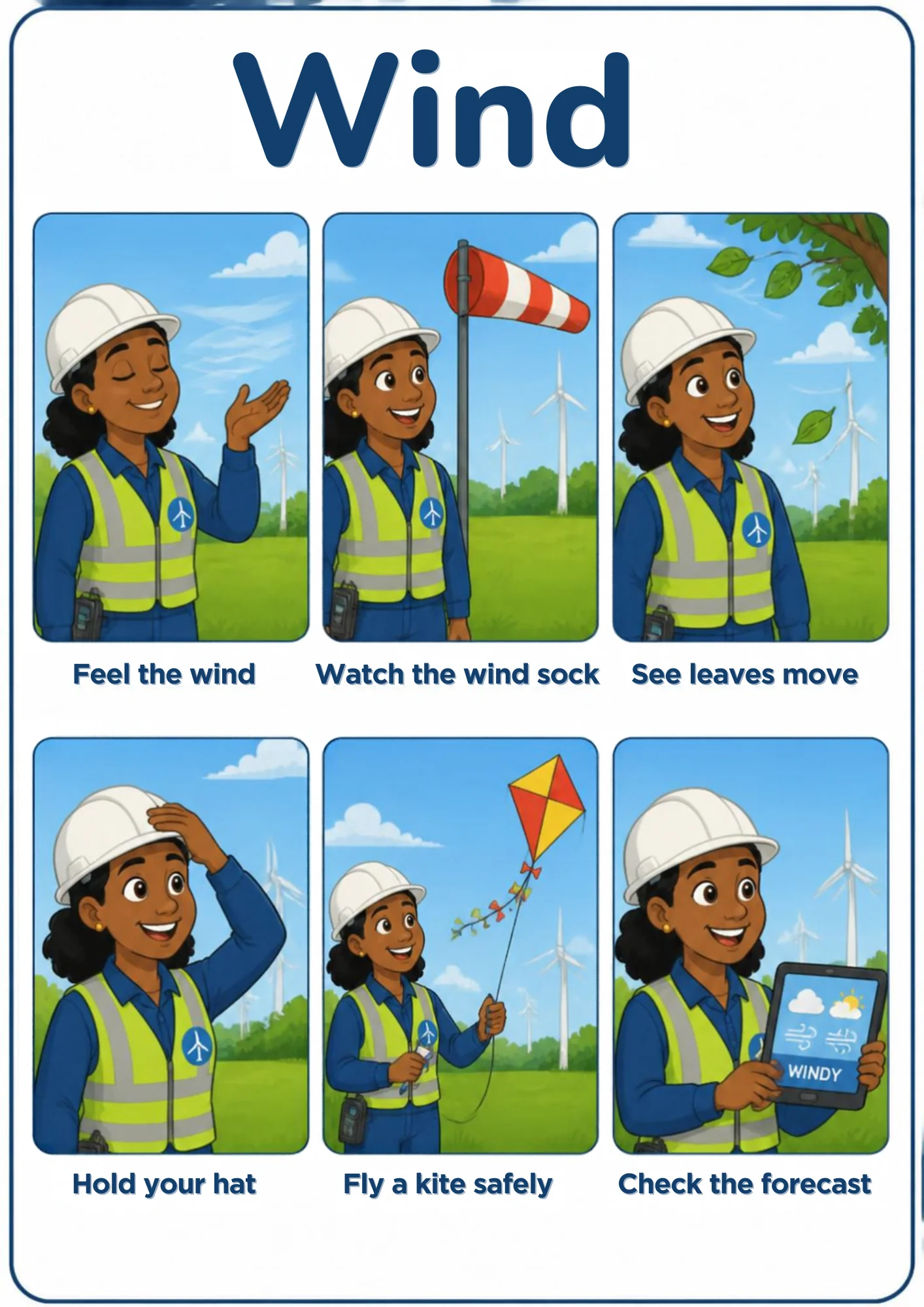
What is this?
Wind is air that is moving. Air is everywhere around us, and when a lot of it travels in one direction we feel it as a breeze on our cheeks, hear it in the trees and see it in everything it pushes.
What does it mean?
Wind has jobs and moods. Gentle wind dries washing, cools hot picnics, carries seeds and spins the big turbines that make electricity. Strong wind bends trees, waves washing on the line and chases hats down the street.
What does the child need to know?
Your child needs three wind ideas: wind is moving air we feel but never see; we know wind is blowing because of what it moves — leaves, branches, washing, wind socks; and windy days ask for hat-holding, and give kite-flying.
Why this matters
Wind is the purest inference lesson in early science: the cause is invisible, so the child reasons entirely from effects. That clue-gathering — leaves moving, sock pointing, hair flying — is the exact thinking scientists use to study things too big or small to see.
What it teaches
Inference from evidence, gradient words (breeze, gust, gale), cause-and-effect through kite flying, gross-motor play against resistance, and safety judgement about flying objects and open spaces.
Words to learn
windbreezegustblowwind sockkitefluttergusty
Say this to your child
“"Wind is air on the move. We cannot see it, but we can see what it does: the leaves dance, the washing flaps, the wind sock stretches out. On windy days we hold our hats — and on a good steady windy day, we fly a kite!"”
Step by step
- Show the card: "Wind is air that is moving — we cannot see air, but we can see what it does!"
- Read the picture: the engineer in a white hard hat and high-visibility vest feels the breeze on her hand, watches a red-and-white wind sock stretch out, sees leaves blown off a tree, holds her hat on her head, flies a red-and-yellow kite and points at a tablet that says WINDY. Behind her: giant white wind turbines.
- Collect wind clues right now: hold a hand out the door — feel it? Throw a scrap of tissue — watch it fly. Which way is the wind pointing today?
- Sort the moods: a breeze tickles, a gust pushes, a gale grabs hats. Act all three with your hands and voices.
- Book the kite: windy day + open field + grown-up = kite day. Practise the run-and-release at home first with a ribbon on a stick.
Look closer at the picture
On this card a wind-farm engineer wears a white hard hat, a navy shirt and a yellow high-visibility vest with a wind-turbine badge: she feels the wind on her raised palm, stands beside a striped wind sock on a pole, watches green leaves blow from a branch, steadies her hard hat with both hands, flies a red-and-yellow diamond kite with bows on its tail, and shows a tablet with wind icons and the word WINDY. Tall white turbines turn in the background.
Ask your child
"What is wind made of?" "How do we know the wind is blowing if we cannot see it?" "What does the wind do to our hats?" "Where do kites fly best?"
What your child can say or do
Your child might say: "The wind is pushing the leaves!" "A breeze is small and a gale is HUGE," or the field report: "My kite flew because the wind pulled it up."
Out in the real world
Count wind workers on any street: washing lines, flags, wind turbines on hills, the trees leaning after a storm. Weather-vane visits, harbour sails and windy-day bus stops all show the air doing visible work.
Try it together
Wind orchestra: paper strips, balloons and a fan — which things does the fan move, which ignore it? Then streamer racing: whose streamer flies straightest? Finish with the classic — faces into the breeze, eyes closed, one deep breath: you just felt the whole sky move.
Understanding check
Ask: "What is wind? Name two things the wind moves. What do we hold on a windy day?" Moving air, any two honest movers, and hats — the invisible is now visible.
Parent tips
Answer "what makes wind?" simply and honestly: air moves from place to place, like a crowd shuffling — warm air rises, cool air slides in, and that shuffle is wind. No need for pressure maps at four; the shuffle picture is enough and it is true.
Staying safe
Skip tree-lined streets and building sites on gusty days — branches and debris travel. Kites fly in open fields far from roads and power lines, launch and landing by a grown-up. And secure or leave home anything the wind can turn into a projectile: hats, balloons, lightweight toys.
This lesson pairs with the Wind flashcard in the library — print it, show it, keep it on the fridge. Back to Weather, Seasons & What We Wear (Class 34).