
Fruit Together — a step-by-step lesson for grown-up and child
This lesson asks the deck’s first group question: of four pictured things, which two go together? The fruit do — and the odd pair makes the answer fun to find.
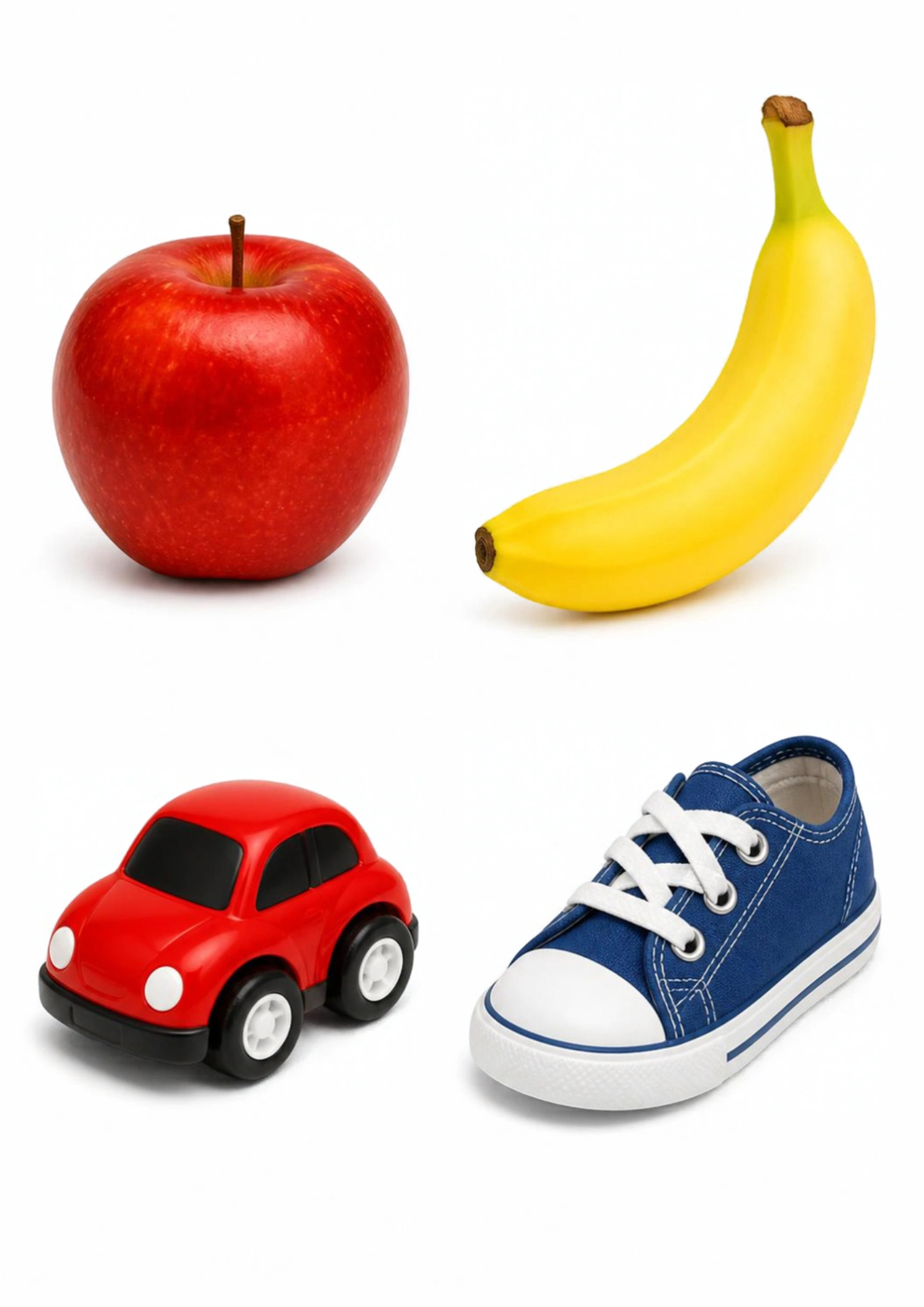
What is this?
A group is things that belong together by kind. Apples and bananas are both fruit — a car and a shoe are both… not. The odd pair is not a mistake; it is the question.
What does it mean?
Grouping jumps from this-matches-that to a rule that covers many things at once. Fruit is the friendliest category going: eaten daily, held daily, named at the table without anyone trying.
What does the child need to know?
The impostors are the teaching: naming what does not belong — the car does not grow on trees! — proves the category from the outside. Laugh at the shoe; the laugh is the lesson landing.
Why this matters
The fruit bowl reruns this card at every meal, and shopping reruns it in the aisles. A category your toddler already eats needs no new vocabulary — just a name said out loud.
What it teaches
Category forming, odd-one noticing, and the two-sided thinking of belongs and does-not-belong — the root of every later is-it-alive, is-it-red, does-it-fit conversation.
Words to learn
fruitgrouptogetherapplebananabelong
Say this to your child
“"Four things! An apple, a banana, a car, a shoe. Which two go together? The apple and the banana — fruit! Fruit together. Can a car grow on a tree? No! Silly car — fruit belong together."”
Step by step
- Show the card and name all four things first, one point each: an apple, a banana, a car, a shoe. No sorting yet — just the roll call.
- Ask the question slowly: which two go together? Then let the looking happen in silence if it wants to.
- Confirm with the group name: the apple and the banana are fruit — fruit go together! Trace a circle around the pair with one finger.
- Give the odd pair their moment: a car is for driving, a shoe is for wearing — neither one grows on a tree. The outsides prove the inside of the group.
- Rerun it at the real fruit bowl: hand your toddler three things, two fruit and one not, and let the fruit get found and named as a group.
Look closer at the picture
The card shows an apple, a banana, a car and a shoe for a grouping activity — two fruit and two everyday things that are not fruit. Ask your toddler to name all four, then point at the two that belong together.
Ask your child
"Which two go together?" "Where is the fruit?" "Does the shoe belong?" "What do we do with a car?"
What your child can say or do
A two-finger grab of the fruit pair, or a push of the car and shoe to one side — clearing the outsiders is a full answer. Fruit said as foo or boo with the right point is the category forming.
Out in the real world
The shopping basket is a grouping game your toddler can run: fruit in the bag, boxes in the trolley. At home, the fruit bowl asks its question fresh every single day.
Try it together
Bowl check: hand over three things from the kitchen — two fruit, one not — and ask for the fruit. Then reverse the job for laughs: feed the car? Wear the banana? Wrong uses are the funny proof that groups are real.
Understanding check
Next snack, offer fruit and one stranger on the same plate and ask what goes together. Fruit gathered and stranger refused — or stranger cheerfully named as not-fruit — both pass with top marks.
Parent tips
Name the group, then name the outsiders: both halves teach. If your toddler insists the car goes with the fruit because they are both red, say the thinking back warmly — then ask what the car is for.
Staying safe
Kitchen grouping games use real food and real objects: fruit gets washed, and nothing smaller than a golf ball joins the plate. The shoe stays on the floor where shoes belong — the game agrees.
This lesson pairs with the Fruit Together flashcard in the library — print it, show it, keep it on the fridge. Back to Matching & Sorting (Toddler 4).