
Tree — a step-by-step lesson for grown-up and child
This lesson goes to meet the real thing: your toddler touches bark, hugs a trunk, looks up a long way, and learns the one green giant that is always allowed to be touched.
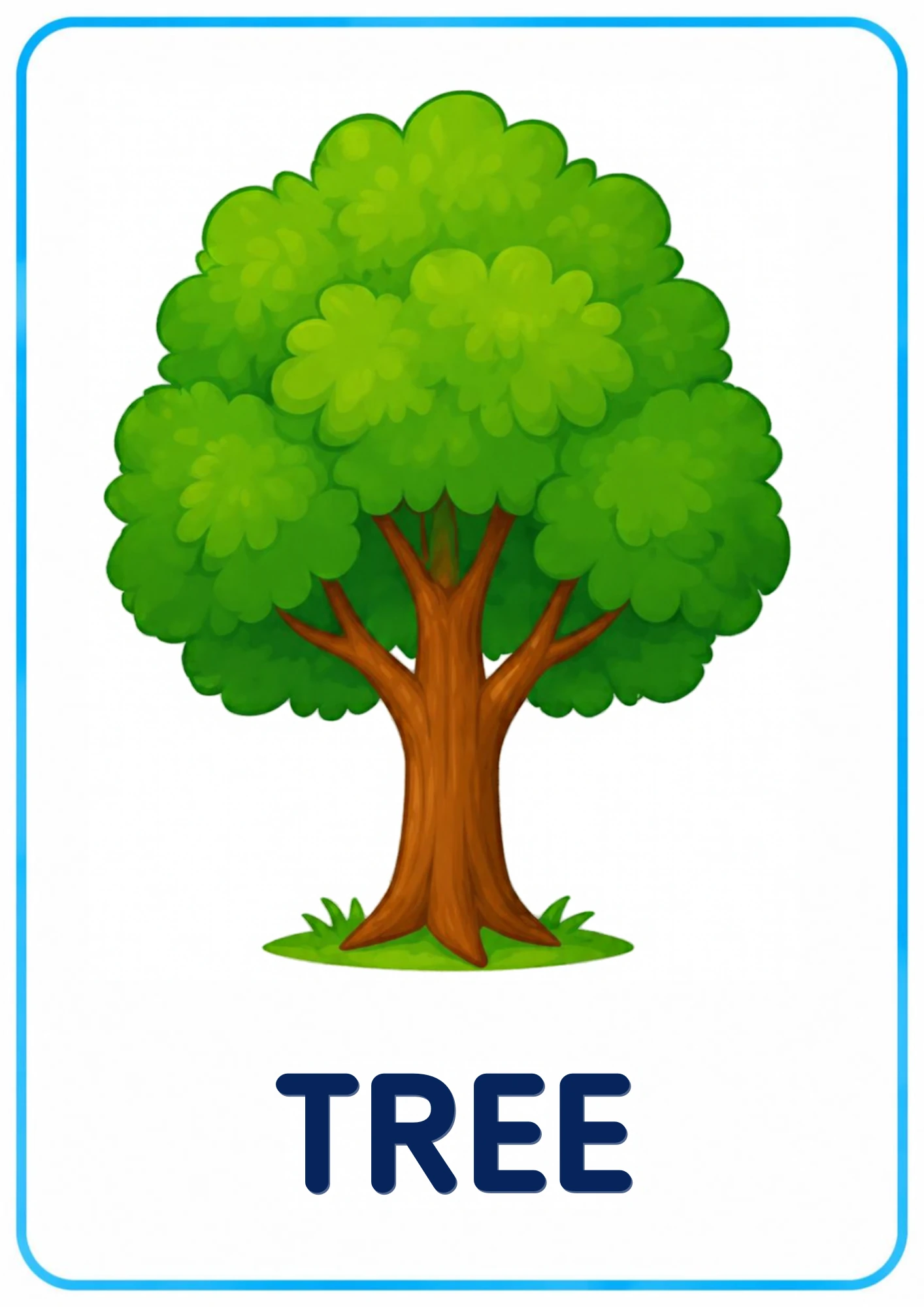
What is this?
A tree is a tall plant with a woody trunk, branches and leaves. Trees live for years and years, and they change with the seasons — blossom, shade, falling leaves, bare branches, then round again.
What does it mean?
The tree is the set’s touch-me card: bark is safe, rough, wonderful under small palms. It is also the set’s clock — a tree your toddler meets every month is quietly teaching the year.
What does the child need to know?
Trees have a trunk you can touch, branches up high and leaves that come and go with the seasons. We may touch trunks and hug trees as much as we like; mushrooms and berries that grow near them stay look-only.
Why this matters
Touching a real tree wires the word in like no card can — rough, smooth, tickly, huge. And a tree your toddler owns as "their" tree becomes a measuring stick for the whole year: buds, shade, leaf-kicking, bare branches.
What it teaches
Sensory touch vocabulary (rough, smooth, bumpy), big-body awareness (how small am I next to it?), seasonal change tracking, hugging as gentle strength, and upward looking — a neck skill with a payoff.
Words to learn
treetrunkbarkleavestallseasons
Say this to your child
“"A tree! Big and tall with a woody trunk. Can you touch it? Bumpy, rough — trees love a gentle hand. Can you hug it? Can you look up, up, up to find the top? Trees give us shade and leaves and homes for birds — and we can touch this one as much as we like."”
Step by step
- Show the card, say tree, and hold your arms out wide — trees are the biggest growing things your toddler will touch all week.
- Ask where the trunk is and where the leaves are on the card — bottom and top, one find each.
- Take the card outside to the nearest tree: touch the trunk together and collect the words — bumpy? smooth? tickly? cold?
- Hug the trunk with both arms — squeeze as much as your reach allows — then tip your head back and hunt for where the tree ends.
- Close with the year promise: come back to this tree in every season and it will look different each time — that is the tree’s own story, told slowly.
Look closer at the picture
Hold your arms out like branches and say tree. Ask your toddler to find the trunk on the card — the strong bit at the bottom — then take the pointing outside to a real trunk you can actually touch.
Ask your child
"Where is the trunk?" "Is the bark bumpy or smooth?" "Can you hug the tree?" "Where does the tree stop, if you look up?" — answered with touch, a squeeze and a very long neck-craning point.
What your child can say or do
"Tree! Big one!" Expect bark-rubbing at every trunk, trees hugged on every walk, and demands to find "the top". Your toddler may appoint a favourite tree and greet it daily — keep the greeting going.
Out in the real world
Trees line every street, park and garden; a trunk is never more than a few minutes away. Each meeting is a rerun — touch, hug, look up — and each season gives the same tree a brand-new look.
Try it together
Tree meeting: visit one tree weekly and ask what has changed — leaves more, leaves fewer, blossom out, leaves gone. Take the same pose photo each time and let your toddler spot the differences first.
Understanding check
At the next trunk, watch the hands: they reach for the bark before you ask means the touch rule has bloomed into touch-joy. The arms-out wide on the word tree seals the lesson.
Parent tips
Let your toddler pick "their" tree and name it — ownership turns a plant into a friend. Keep the hug gentle and the looking-up long; the scale feeling is the part that lasts for years.
Staying safe
Tree hugging is safe; tree climbing is for later years and steadier legs. Watch what grows at the base — mushrooms and berries are look-only — and keep tiny hands away from anything furry or buzzing resting on the bark.
This lesson pairs with the Tree flashcard in the library — print it, show it, keep it on the fridge. Back to Garden Things (School Garden).