
Tractor — a step-by-step lesson for grown-up and child
This lesson takes the farm’s slowest machine at its own pace: the put-put, the giant back wheels, the mud — with a country walk as the field trip that needs no planning.
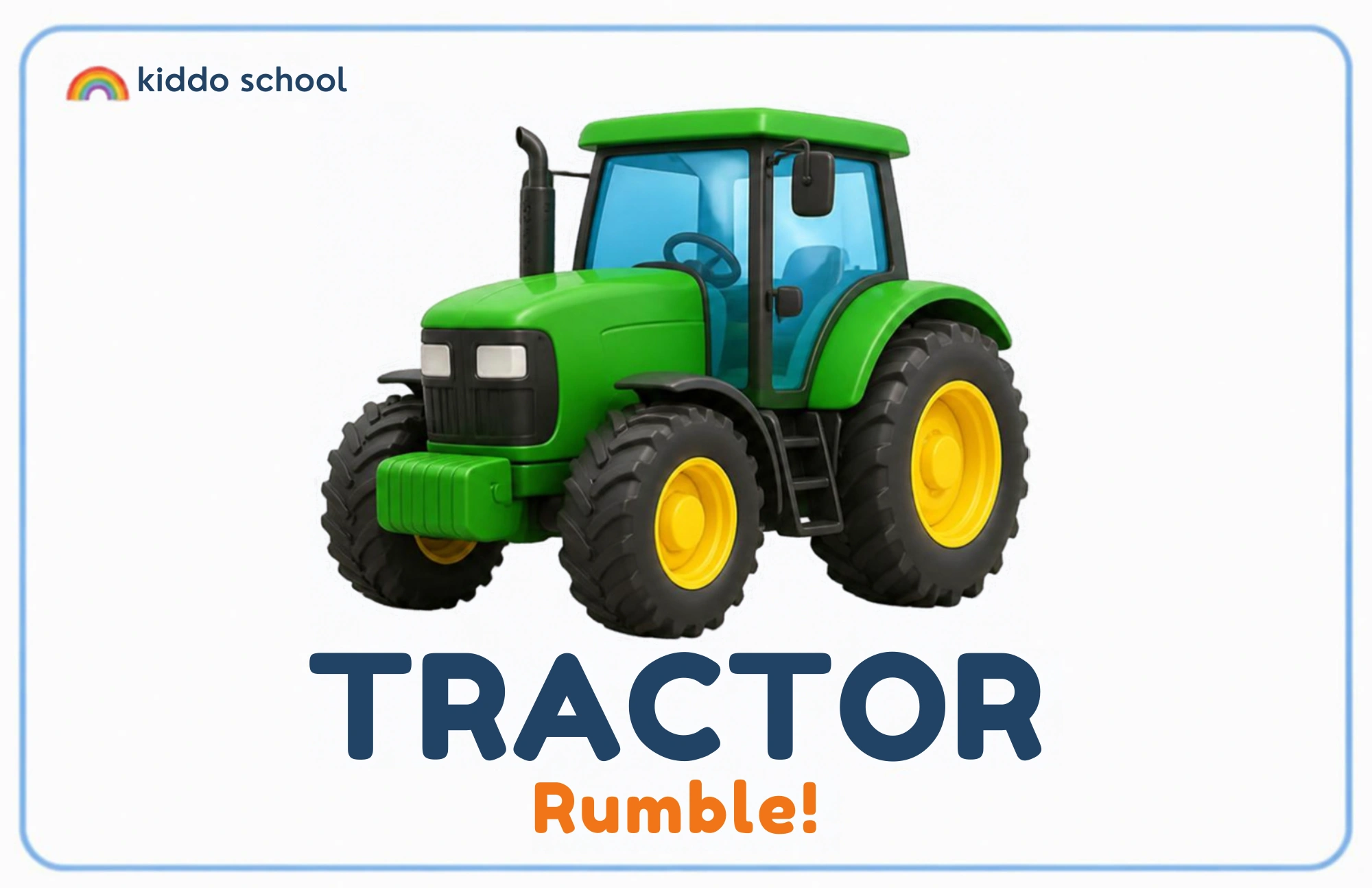
What is this?
A tractor is a slow farm machine with huge back wheels that goes put-put — built for pulling, ploughing and generally being enormous.
What does it mean?
Put-put is a repeated beat rather than a word: your toddler is keeping rhythm, which is a different sound skill from the sliding sirens and long vrooms.
What does the child need to know?
Tractors work in fields and pull heavy things. Out on a country lane, or spotted through the windscreen, a real one working a field is the sighting this card exists for.
Why this matters
Slow is the novelty here — every other vehicle in the set is fast. The tractor teaches that machines have paces, and slow is funny when you perform it.
What it teaches
Rhythm-making with a repeated sound, size contrast (giant wheels, little cab), and farm-machine vocabulary that pays out at every country mile.
Words to learn
tractorput-putslowwheelsfieldpull
Say this to your child
“"A tractor! Put-put, put-put. Can you keep the beat? Slow and bumpy. Look at those giant back wheels — bigger than you! The tractor pulls heavy things in the field, slow and strong."”
Step by step
- Show the card and say tractor, then put-put — slow, bumpy and content, like an engine idling.
- Drive the rug at tractor speed: hands on a toy tractor, put-putting, taking the longest possible route to the shortest possible distance.
- Hunt tractors in books and from windows; find the giant back wheels — bigger than the whole front of the machine.
- When the put-put arrives as a pop or a slow brmm, accept it and keep the beat going; rhythm is caught, not corrected.
- Keep the speed joke alive all week — tractor-slow tidying, tractor-slow stairs — and say the sound at any real sighting.
Look closer at the picture
Find the word Tractor on the label and Rumble beneath it. The giant back wheels are the detail — ask which wheels are the biggest on the card.
Ask your child
"Where is the tractor?" "What does the tractor say?" "Which wheels are the biggest?" "Is the tractor fast or slow?"
What your child can say or do
A steady "put-put-put" or a slow-motion march with sound effects. Some toddlers will adopt tractor pace for the whole walk home — the joke is the pace, and the pace is the point.
Out in the real world
Country walks, farm shops and harvest time are tractor season. A real one crossing the road in front of the car is the parade this card promised — count the wheels from your seat.
Try it together
Hauling yard: your toddler is the tractor, a rope or scarf is the hitch, and the trailer is a basket of toys pulled slowly across the rug. Put-put per step, unload at the barn (the sofa).
Understanding check
Ask what the tractor says and whether it is fast or slow. A put-put plus slow passes. Real-field sighting test: a pointed finger and a slow brmm from the car seat is full marks.
Parent tips
Exaggerate the slowness until it becomes the joke — toddlers learn pace by contrast with your speed. A farm trip turns this card into a whole day, but a field behind a fence does the same job.
Staying safe
Real tractors are working machines with moving parts and blind spots — watch from the car, the gate or the footpath, and never climb on parked ones, however perfect the seat looks.
This lesson pairs with the Tractor flashcard in the library — print it, show it, keep it on the fridge. Back to Vehicles & Sounds (Toddler 6).