
Bells — a step-by-step lesson for grown-up and child
This lesson teaches bells as the pitch ladder: a row of shiny metal notes standing in order, so the child can SEE low-to-high while their ears climb it.
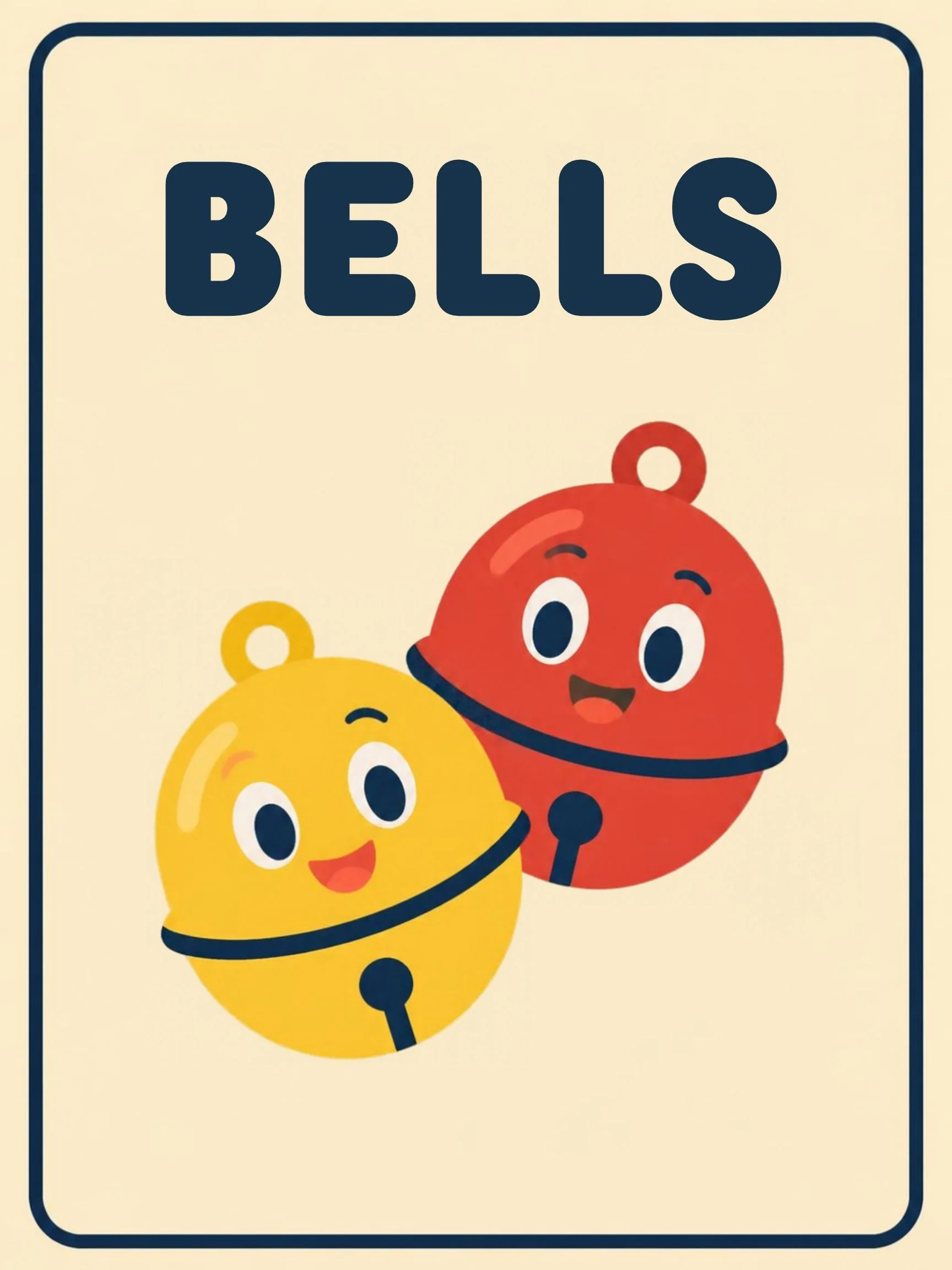
What is this?
Bells (orchestral or glockenspiel style) are a row of metal bars or bells, laid out low to high: strike each one with a mallet and it rings one clear note. Together they are a ladder of pitch you can walk up and down.
What does it mean?
The bells make pitch VISIBLE: the small bar on the right really is the high note, the big bar on the left really is the low one. Size-pitch, seen in a row, struck one by one — the scale stops being abstract forever.
What does the child need to know?
Your child needs three bells ideas: each bell is one note — one strike, one ding; the row is in ORDER — left is low, right is high; and the scale is the ladder — step up note by note, and the song "do-re-mi" is just the ladder climbed.
Why this matters
Pitch order is the doorway to every melody. The bells hand it over physically: step, step, step up the row — and every later instrument (piano keys, guitar frets) is just another ladder.
What it teaches
Size-pitch mapping, ordered sequencing (the scale is a sequence), mallet striking accuracy, and high-low listening discrimination.
Words to learn
bellspitchlowhighladderscaleding
Say this to your child
“"Bells are notes you can climb! Each bell rings one ding. And they stand in order like a ladder: the big bells on the left ring LOW, the small bells on the right ring HIGH. Ding your way up the row — step, step, step — and that climb is the scale, the staircase hiding inside every song."”
Step by step
- Show the card: "These are bells — a row of notes standing in order."
- The ladder law: point left — "small strike? no — big bell, LOW ding." Point right — "small bell, HIGH ding." Big-low, small-high: say it twice.
- Climb the ladder: ding each bell left to right, one step up each time — that climb is the scale, the staircase every song walks.
- Build the water bells: five glass jars, water at different levels — tap with a spoon. More water = lower ding. Line them up low to high, your own bell row.
- Play the stair game below and close: "big is low, small is high."
Look closer at the picture
On this card the word "Bells" stands in big navy capitals inside the rounded frame, with a friendly illustration of the row of bells below — exactly as the pitch ladder looks.
Ask your child
"Which side rings low — the big bells or the small ones?" "What do we call the climb up the row?" "How many notes does one bell ring?"
What your child can say or do
Your child might say: "Big bell — low ding!" "I climbed the whole ladder!" or the jar builder’s pride: "More water sings lower!"
Out in the real world
Bells ring everywhere: doorbells, bicycle bells, school chimes, the ice-cream truck’s five-note call. And the water-jar set is a kitchen classic — five jars, one spoon, the whole scale on the table.
Try it together
Bell Stairs: lay five cards on the floor as bell-steps, low to high. Tap each "bell" (a jar, a pot, a clap-pitch) and step up as you ding — body and ears climb together. Then ring a melody: the ice-cream call, "hot cross buns" (three notes!), happy birthday’s first five steps. Every melody is the ladder climbed in a pattern.
Understanding check
Ask: "Big bell or small bell — which rings high? What is the row called? What is a melody made of?" Small, a ladder, the ladder climbed — three answers and the bells are ringing.
Parent tips
Let the child REORDER mixed-up jars by ear — fixing the ladder is better training than climbing a pre-fixed one. And whisper "do-re-mi" up the rungs: the syllables stick to the steps like glue.
This lesson pairs with the Bells flashcard in the library — print it, show it, keep it on the fridge. Back to Music Room (Class 23).