
Castanets — a step-by-step lesson for grown-up and child
This lesson teaches the castanets — two little clappers that live on your fingers and click like talking beetles: the smallest instruments on the shelf with the quickest sound they make.
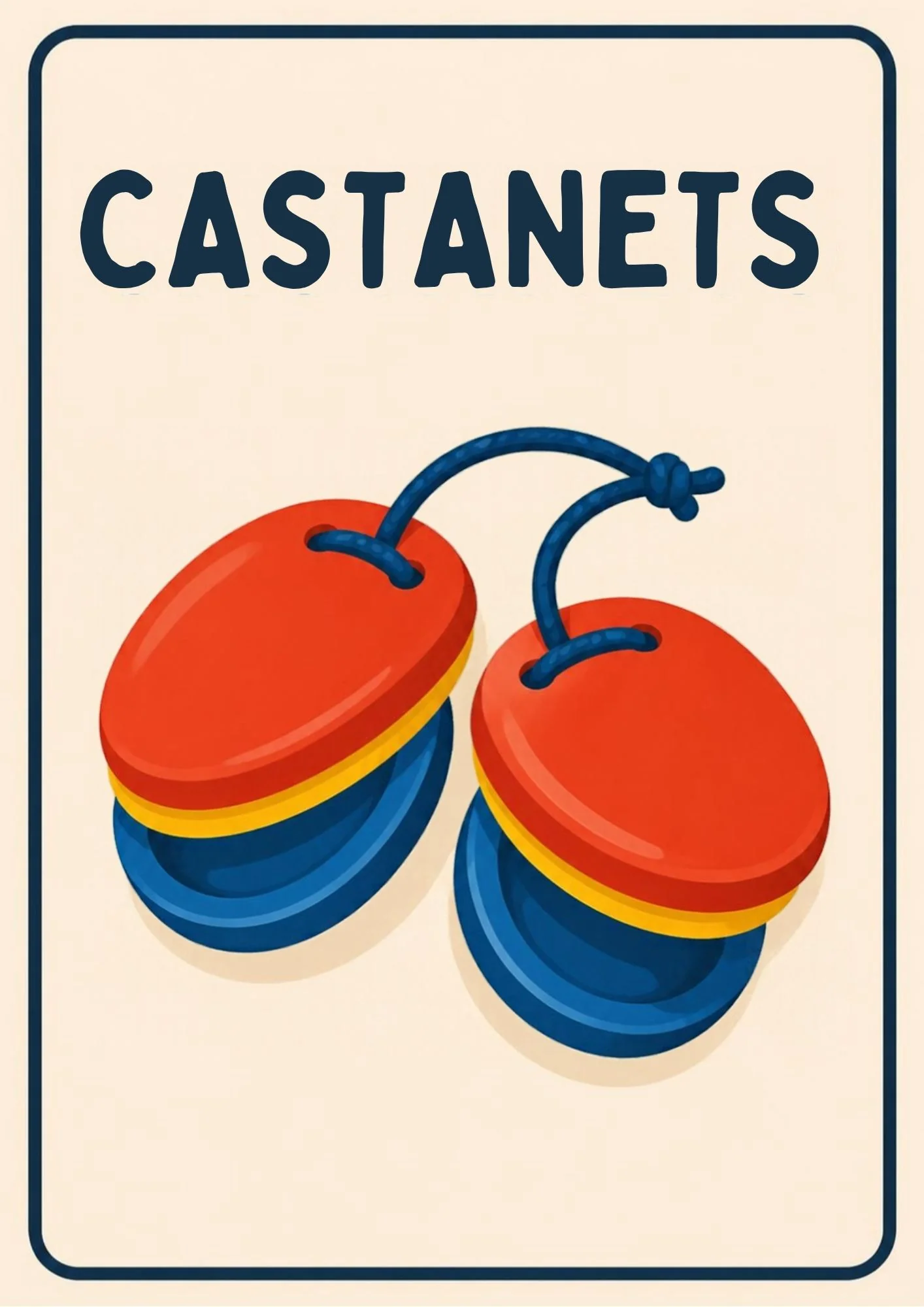
What is this?
Castanets are two shell-shaped pieces of wood joined by a cord: hold them in the palm and click the shells together with the fingers. Flamenco dancers wear them; whole orchestras borrow their chatter.
What does it mean?
Castanets train the fastest fine-motor music there is: the click is a finger squeeze, not an arm swing. Fast patterns — click-click-rest, clickety-click — live in fingers alone, which makes these two shells a fine-motor gym disguised as flamenco.
What does the child need to know?
Your child needs three castanet ideas: the click is a SQUEEZE — fingers press the shells together, not a bang; the cord loops over the finger so one hand holds both shells; and fast patterns are the game — click-click-rest is the first sentence the shells speak.
Why this matters
Of every instrument here, the castanets live closest to the hand: no stick, no mallet, no breath — just fingers. They grow the exact finger strength that pencils and scissors will ask for.
What it teaches
Finger isolation and squeeze control, fast alternating patterns, palm-steadiness while fingers work, and rhythm sentences — the click as a syllable.
Words to learn
castanetsclickshellsfingerssqueezepatternfast
Say this to your child
“"Castanets are two little shells that click in your palm! The secret is the SQUEEZE — fingers press the shells together, click! Not a bang, a click. Start talking: click-click-rest… click-click-rest… then the fast one: clickety-click! Your fingers are the fastest musicians in the whole Music Room."”
Step by step
- Show the card: "These are castanets — two little shells that click."
- The squeeze: clap your OWN fingers and thumb together — that snap is the castanet’s whole secret: a finger click, not a hand clap.
- Card castanets: two bottle caps glued (or taped) inside-card-out on folded card squares — hold both, click them together. Or two big buttons on fingers.
- The first sentence: click-click-REST. Say it, play it, three times. Then clickety-click (four fast) — the shells are talking!
- Play the click-pattern game below and close: "squeeze to speak."
Look closer at the picture
On this card the word "Castanets" sits in big navy capitals inside the rounded frame, with a friendly illustration of the pair below — the two shells and their cord exactly as they look.
Ask your child
"What makes the click — a bang or a finger squeeze?" "What holds the two shells together?" "What is the shells’ first sentence?"
What your child can say or do
Your child might say: "Click is a squeeze, not a bang!" "Clickety-click — the fast one!" or the flamenco shout: "Olé!"
Out in the real world
Castanets click in Spanish flamenco, in orchestras’ sneaky moments — and their cousins live on every kitchen bench: two spoons back-to-back, two bottle caps, a snap of fingers and thumb. Clicks are free.
Try it together
Click-Talk: the shells speak sentences and the other player copies — "click-click-rest", "clickety-click-click-rest", "click… clickety-click!" Then the flamenco finale: one player clicks a steady pattern, the other dances four big steps and shouts olé. Fingers fast, feet loud, pride enormous.
Understanding check
Ask: "What makes the sound? What is the first pattern? Where do flamenco dancers wear them?" The squeeze, click-click-rest, on their hands — three answers and the shells are talking.
Parent tips
If finger clicks frustrate, play on the knee first — knee-clicks build the pattern, palm-clicks arrive by themselves. And keep shells small and cord short: castanets are whisper-instruments with giant personalities.
This lesson pairs with the Castanets flashcard in the library — print it, show it, keep it on the fridge. Back to Music Room (Class 23).