
Conductor — a step-by-step lesson for grown-up and child
This lesson teaches the conductor — the musician who plays the BAND instead of an instrument: two hands, a small stick, and a hundred players watching every move.
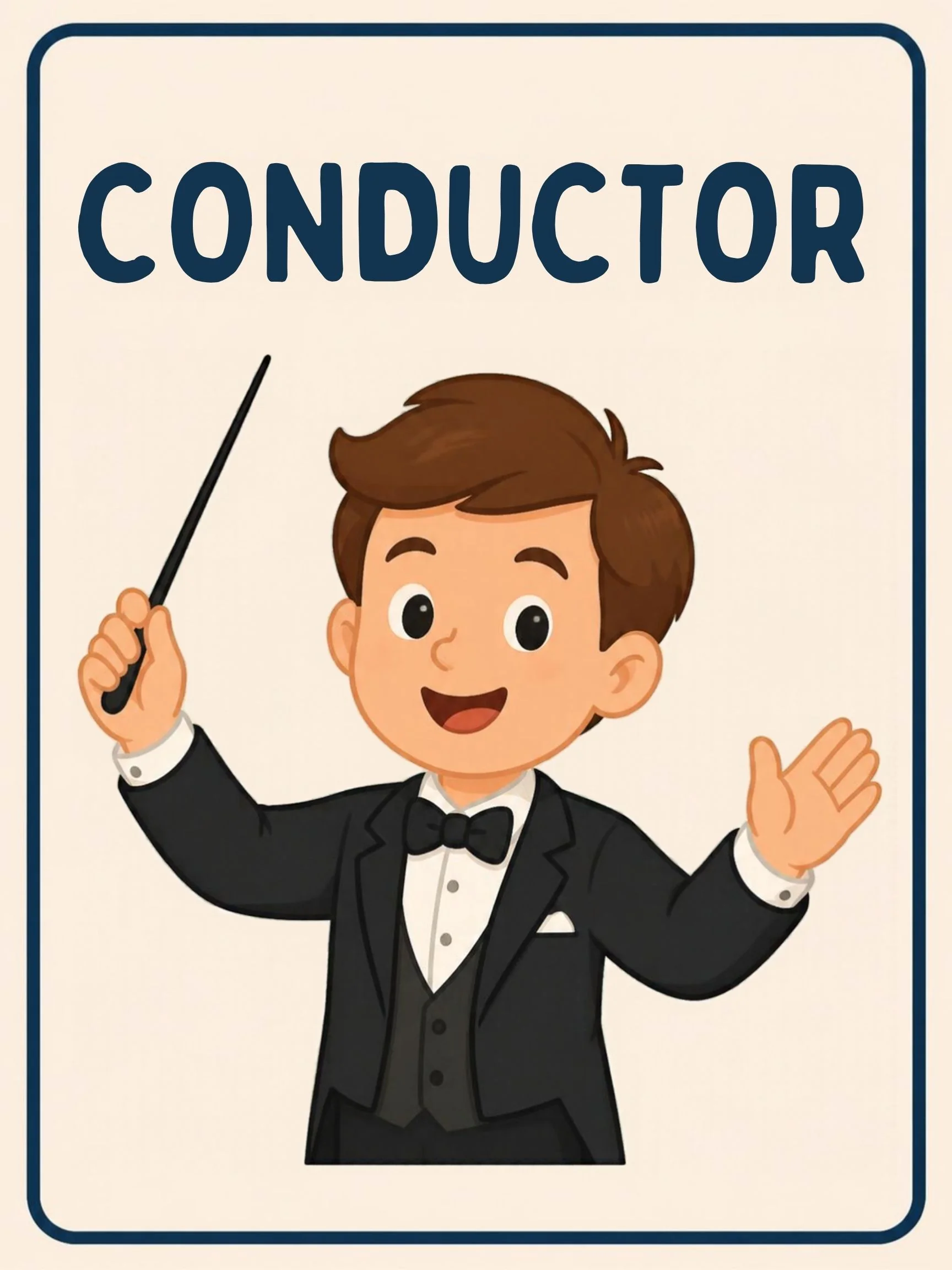
What is this?
A conductor leads an orchestra without speaking: the raised hands set the tempo, the stick draws the beat in the air, and pointing brings players in or quiets them down. The conductor’s instrument is everybody else.
What does it mean?
The conductor is leadership made visible: no sound of their own, total responsibility for everyone else’s. Watching hands, staying together, starting and stopping as one — the skills are ensemble’s deepest, taught here in their purest form.
What does the child need to know?
Your child needs three conductor ideas: the conductor plays the BAND, not an instrument; big movements mean big sounds, small movements mean soft — the hands are the volume and speed dial; and the eyes never stop — conductors watch players, players watch hands: a circle of attention.
Why this matters
Leading-and-following without words is the quietest, most transferable game on the shelf — it rehearses attention, timing and the social magic of moving together.
What it teaches
Silent leadership, watching-hands attention, gesture-to-sound mapping (big-small, fast-slow), and the start-stop-together discipline.
Words to learn
conductorleadbatongesturefollowsilenttogether
Say this to your child
“"The conductor plays the whole BAND — with no instrument but two hands and a little stick! Big arms: the band plays big. Tiny waves: the band whispers. The stick draws the beat in the air — down-up, down-up — and a hundred players watch it like a clock. The conductor never says a word… and the whole orchestra listens."”
Step by step
- Show the card: "This is the conductor — the musician who plays the whole band."
- The silent job: conductors never shout "faster!" — the HANDS say it. Big sweeping arms: big, bold sounds. Tiny fingertip waves: soft, gentle ones.
- The beat in the air: down-up, down-up — the stick draws the beat where everyone can see it. The air becomes the clock.
- The watching circle: players watch the hands, the conductor watches the players — nobody looks away. That circle IS the orchestra.
- Play the conductor games below and close: "watch the hands, play together."
Look closer at the picture
On this card the word "Conductor" stands in big navy capitals inside the rounded frame, with a friendly conducting illustration below — the raised hands exactly as the silent leader looks.
Ask your child
"What does a conductor play? How do the hands ask for soft? What do the players watch?"
What your child can say or do
Your child might say: "The conductor plays the BAND!" "Big arms — big sound!" or the leader: "My stick drew the beat in the air!"
Out in the real world
Conductors stand before every orchestra and choir on Earth — and the follow-the-hands game lives in every music classroom: one leader, silent hands, everyone watching. Lead your family song tonight with hands alone.
Try it together
Follow the Conductor: one conductor, everyone else humming (or tapping) a steady sound. The conductor’s hands are the dial: high sweep — grow big! Low fingers — shrink soft! Fast beating — speed up! Fist closes — STOP, frozen. Then swap conductors: every child leads once, and the room obeys their silent hands. No words the whole game — the circle of attention does the talking.
Understanding check
Ask: "What is the conductor’s instrument? What do big arms ask for? What do players and conductor watch?" The band, big sounds, each other — three answers and the orchestra follows.
Parent tips
The conductor says NOTHING — the silence is the game’s engine; keep it even when the band wobbles. And big-vs-small gestures before fast-vs-slow: volume first, tempo second.
This lesson pairs with the Conductor flashcard in the library — print it, show it, keep it on the fridge. Back to Music Room (Class 23).