
Drum Kit — a step-by-step lesson for grown-up and child
This lesson teaches the drum kit’s astonishing trick: ONE person plays MANY drums — hands on different drums, feet on others — four body parts telling four rhythm stories at the same time.
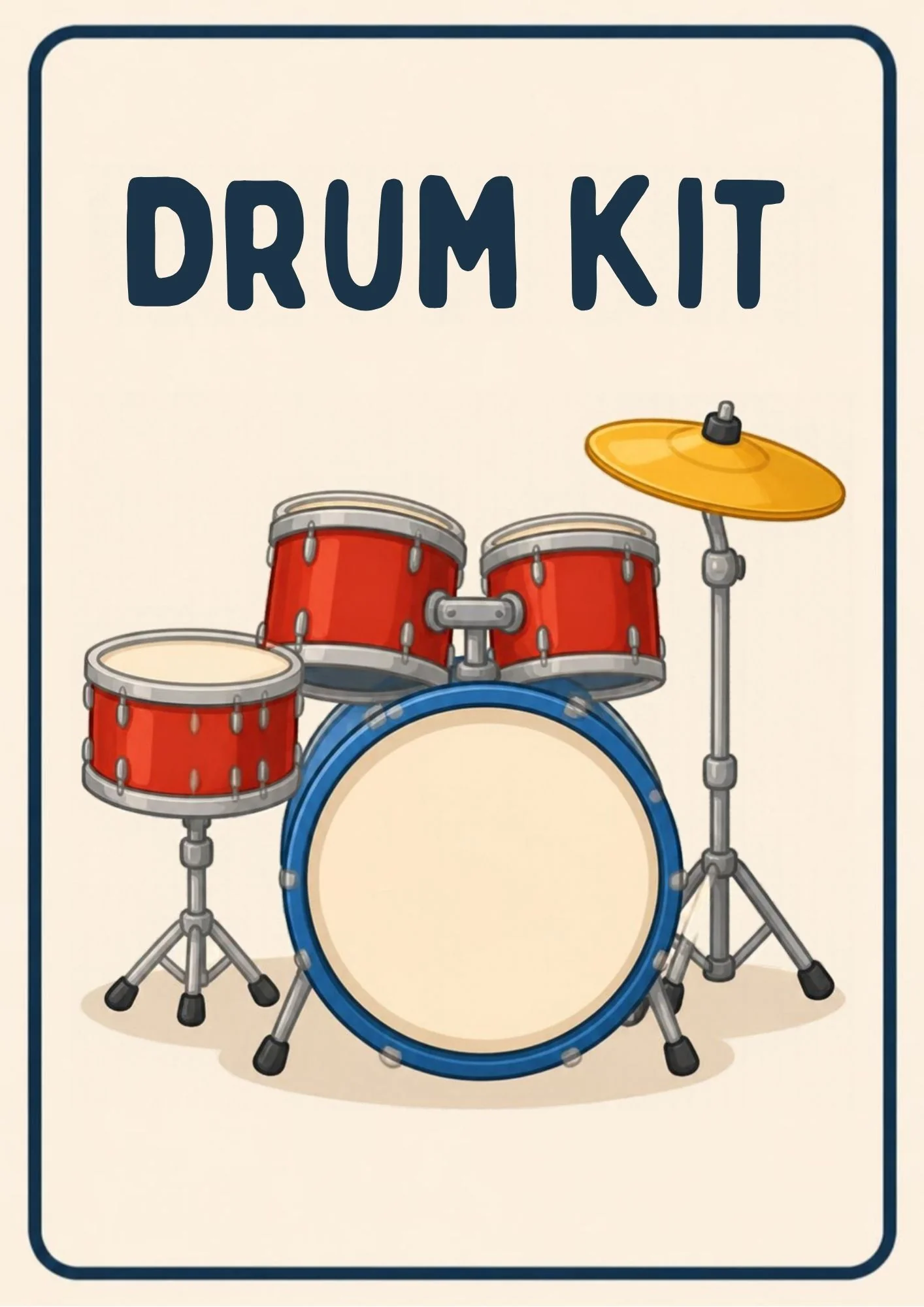
What is this?
A drum kit is a whole drum section arranged around one throne: snare between the knees, bass drum under the right foot, toms above, cymbals around — and the drummer plays them all at once.
What does it mean?
The kit is the brain’s greatest rhythm workout: each limb keeps its own pattern while the others keep theirs. Even the beginner version — clap one pattern, tap another — builds the body-splitting that drummers, pianists and typists all share.
What does the child need to know?
Your child needs three kit ideas: the seat is the centre — everything within arm’s reach and foot’s reach; each limb owns one job — right hand, left hand, right foot, left foot; and the patterns start simple: boom (foot) on one, tap-tap (hands) on four.
Why this matters
Air-drumming a split pattern is the single best pre-instrument exercise there is: the child who can boom-foot while tap-tapping hands has built the coordination every piano and drum lesson will ask for.
What it teaches
Limb independence (the foundation of all kit and keyboard playing), pattern layering, seat-side spatial mapping, and steady beat under physical complexity.
Words to learn
drum kitdrummerthronesnarebass drumpatternlimbs
Say this to your child
“"The drum kit is a whole drum section with ONE player! Sit on the throne — snare between your knees, boom-drum under your foot, cymbals all around. And here is the magic: your hands go tap-tap while your foot goes BOOM — at the same time! Four body parts, four patterns, one drummer. You are the whole band."”
Step by step
- Show the card: "This is a drum kit — many drums, ONE drummer."
- The map: name the neighbours — snare between the knees, boom-drum under the foot, cymbals around. Everything close, nothing far.
- The split: pat your knees (tap-tap) while stomping one foot (BOOM) — that is already drum-kitting! Hands do tap-tap, foot does BOOM.
- Build the home kit: a chair as the throne, a pot (snare), a big box (boom), two lids (cymbals) — the whole section in one corner.
- Play the four-limb game below and close: "one drummer, many drums."
Look closer at the picture
On this card the words "Drum Kit" are printed in big navy capitals inside the rounded frame, with a friendly illustration of the full kit below — drums and cymbals exactly as the set looks.
Ask your child
"How many drummers play a kit? What does the foot play? What do your hands play while the foot booms?"
What your child can say or do
Your child might say: "I’m the whole band!" "Tap-tap with my hands, BOOM with my foot!" or the kit-owner’s pride: "My throne is a chair!"
Out in the real world
Drum kits live in every band room and garage — and their four-limb game lives in every car seat: knees patted while feet tap-tap the floor mats. The kit’s brain trick is free to rehearse anywhere.
Try it together
Four-Limb Kit: chair throne, pot snare, box boom, lid cymbals. Level one: hands alternate pot-lid (tap-tap) while the right foot booms the box — thirty seconds, steady. Level two: cymbal crash on your call — "big moment!" — without losing the tap-tap-boom. Level three: swap the boom to the LEFT foot. Every level is the drummer’s real brain-splitter, played at kitchen scale.
Understanding check
Ask: "How many players? Which limbs play what? What do we call the seat?" One, hands-taps and foot-boom, the throne — three answers and the kit is yours.
Parent tips
Start the split with just TWO limbs and add the third only when the first two go steady. And air-drumming counts: steering-wheel kits build exactly this coordination, and nobody has to hear it.
This lesson pairs with the Drum Kit flashcard in the library — print it, show it, keep it on the fridge. Back to Music Room (Class 23).