
Cymbals — a step-by-step lesson for grown-up and child
This lesson teaches the cymbals — two golden plates you crash together for the biggest sparkle in music, plus the gentle shimmer that follows every crash like a glitter cloud.
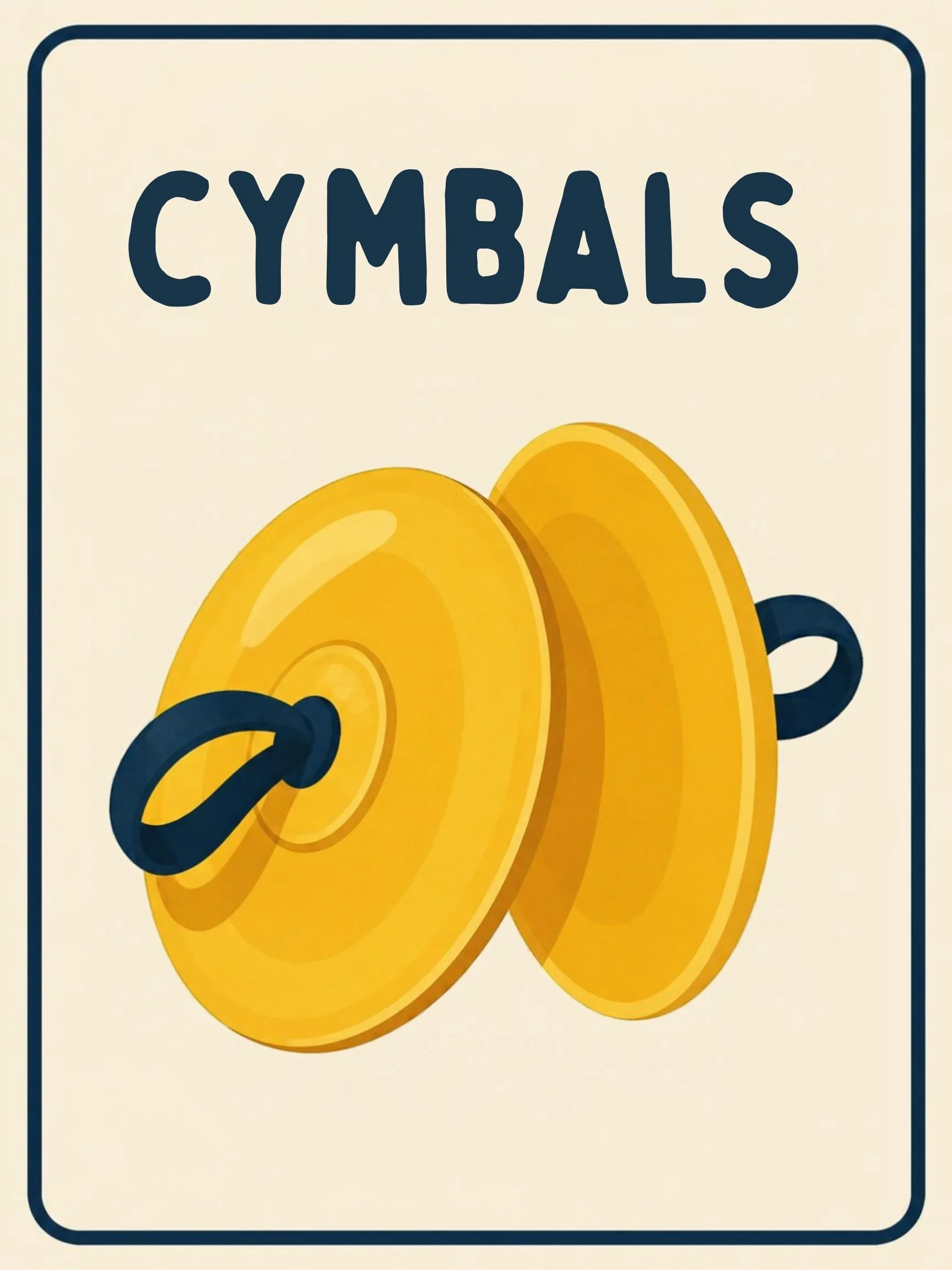
What is this?
Cymbals are two round metal plates: crash them together for a mighty CLANG that rings on and on, or tap and sway one for a shhhimmer. Every drum kit hangs them, every parade carries them.
What does it mean?
The crash is the lesson in big moments: cymbals do not play OFTEN — they play at THE moment, the boom of the story. Choosing WHEN to crash is a whole musical idea: power is about timing, not volume alone.
What does the child need to know?
Your child needs three cymbal ideas: the crash is edge-to-edge, plates kissing sideways — not face-slam, or the sound chokes; the ring goes on and on after the hands stop — metal remembers; and the shimmer is the gentle version — sway and tremble one cymbal for the soft sparkle.
Why this matters
Cymbals teach restraint-with-power: the child who can HOLD a crash until the big moment has learned musical patience, the rarest skill in any pre-school band.
What it teaches
Edge-alignment striking (a real coordination trick), decay listening (the ring that fades), big-movement control, and the when-to-play decision.
Words to learn
cymbalscrashclangshimmerringmomentsparkle
Say this to your child
“"Cymbals are two golden plates! Bring them together edge to edge — like a crocodile clap — CRASH! And listen: the metal keeps sparkling long after your hands stop. Cymbals do not play all the time — they WAIT for the big moment, the loudest part of the story, and then: CLANG! Waiting well is the cymbal player’s superpower."”
Step by step
- Show the card: "These are cymbals — two golden plates that crash."
- The crash secret: plates meet EDGE to edge, like a crocodile clap — sidelong, never face-on. Practise the crocodile clap in the air.
- The long ring: crash… and LISTEN — the metal rings after your hands have stopped. Count how long the glitter lasts.
- The shimmer: one cymbal, held up, trembling quickly — shhhhhh. The soft sister of the crash.
- Play the big-moment game below and close: "wait for the moment, then crash."
Look closer at the picture
On this card the word "Cymbals" stands in big navy capitals inside the rounded frame, with a friendly illustration of the two plates below — exactly as the golden pair looks.
Ask your child
"How do the plates meet — flat or edge to edge?" "What happens after our hands stop?" "When does a cymbal crash — all the time or at the big moment?"
What your child can say or do
Your child might say: "Crocodile clap — CRASH!" "The ring kept going by itself!" or the patient one: "I waited for the big moment!"
Out in the real world
Cymbals crash at every parade, orchestra crescendo and drum-kit fill — and their household cousins hang in every cupboard: two pot lids, edge to edge. The kitchen orchestra’s grand finale, free.
Try it together
Big-Moment Story: tell a tiny story — "and THEN the giant stomped…" — and the cymbalist’s one job is to crash exactly at THEN, not before, not after. Three stories, three crashes, each judged by the room. Then the shimmer: the same cymbalist whispers shhhh under the whole next story. Loud at the moment, soft under the tale — the whole percussion section in one game.
Understanding check
Ask: "How do the plates meet? What keeps sparkling after the crash? What is the soft version?" Edge to edge, the ring, the shimmer — three answers and the moment is ready.
Parent tips
Crocodile clap first, always — face-slams hurt wrists and kill the ring. And honour the wait: a cymbalist who crashes three times in a story gets gently reminded that gold is rare.
This lesson pairs with the Cymbals flashcard in the library — print it, show it, keep it on the fridge. Back to Music Room (Class 23).