
French Horn — a step-by-step lesson for grown-up and child
This lesson teaches the French horn — brass wound into a great coil, played with a hand tucked inside the bell, making the roundest, mellowest hoot in the whole brass family.
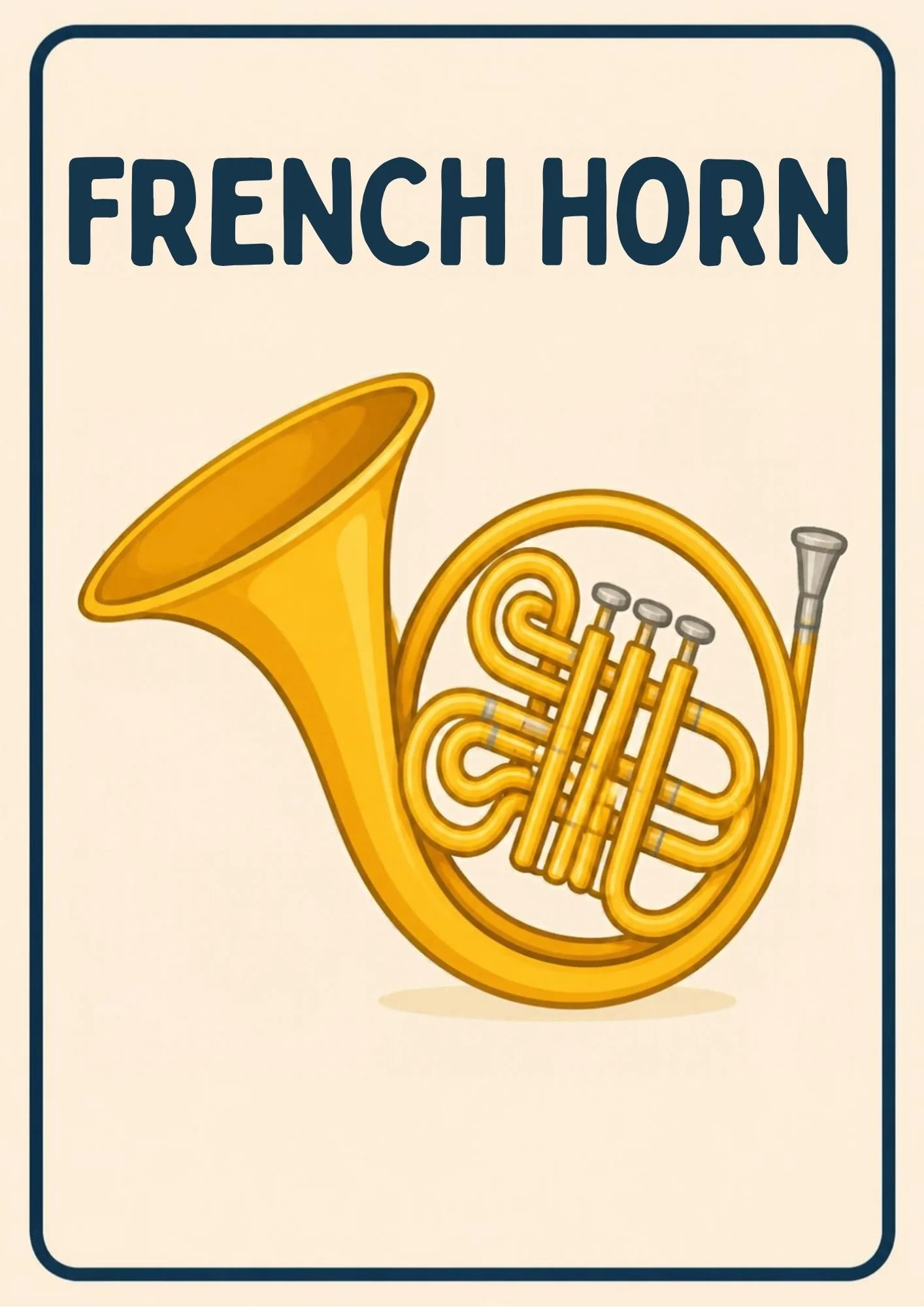
What is this?
A French horn is brass tubing coiled into a big circle, ending in a wide flaring bell: buzz the mouthpiece, and the long coiled tube hums a noble, mellow note — with the right hand tucked inside the bell to shape it.
What does it mean?
The coil is the lesson: the horn’s tube is SO long (unrolled, over four metres) that it must spiral to stay playable — and long tube means low, warm, rich. Length is tone: the horn’s snail-shell is its sound.
What does the child need to know?
Your child needs three horn ideas: the tube is coiled because it is ENORMOUS — unrolled, longer than a car; the hand rests inside the bell like a mute pillow, softening the sound; and the horn’s voice is the mellow one — round where the trumpet is bright.
Why this matters
The horn teaches tube-length thinking — the law behind every brass and woodwind instrument — and its tucked hand is the friendliest reminder that players shape sound with their whole body.
What it teaches
Length-pitch mapping, buzz control (lip buzzing is the brass engine), mellow-versus-bright listening, and the gentle-hand shaping idea.
Words to learn
French horncoilbellhandmellowbrasstube
Say this to your child
“"The French horn is a snail-shell of brass! Its tube is so long it has to coil — unrolled, longer than a car! — and long tubes hum deep and warm. The player buzzes their lips into the mouthpiece — brrr! — and tucks one hand inside the big bell, like a soft pillow, to make the hoot round and mellow. The gentlest giant in the brass family."”
Step by step
- Show the card: "This is the French horn — a very long tube, coiled like a snail shell."
- The coil: trace the spiral on the card with a finger — round and round. Unrolled, this tube is longer than a car! Long tube = deep, warm hoot.
- The bell hand: the right hand tucks INSIDE the wide bell — a soft pillow that rounds the sound. Tuck a hand over a cup’s mouth and hum: warmer, rounder. That is the horn hand.
- Buzz the engine: lips together, blow a raspberry — brrr. That lip buzz is what every brass instrument plays. The horn just makes it noble.
- Play the mellow game below and close: "long coil, warm hoot."
Look closer at the picture
On this card the words "French Horn" stand in big navy capitals inside the rounded frame, with a friendly illustration below — the coiled brass and its wide bell exactly as the horn looks.
Ask your child
"Why does the horn coil? Where does the hand go? Which is mellow — the horn or the bright trumpet?"
What your child can say or do
Your child might say: "The tube is longer than a car!" "My hand is the sound pillow!" or the buzz report: "Brrr — my lips are the engine!"
Out in the real world
Horns call across every orchestra’s back row — hunting calls, film fanfares — and the coil law lives at home: a garden hose coiled on its hook is a French horn’s twin. Unroll the hose, drop the pitch: length is tone.
Try it together
Mellow-or-Bright: two players hum the same note — one through a cup (bright, forward), one with a hand-pillow over the cup’s mouth (mellow, round). The room votes on which is the horn and which the trumpet. Then the coil law: hum through a rolled poster (long tube) — deep! Hum through a short straw — high! The horn’s snail-shell, understood by lunchtime.
Understanding check
Ask: "Why coil the tube? What does the hand in the bell do? What kind of voice does the horn have?" It is very long, softens and rounds it, mellow — three answers and the horn hoots.
Parent tips
Buzzing lips IS brass — practise the raspberry proudly; it is the engine, not a joke. And the cup-and-hand demo is the horn’s whole personality: try it before explaining it.
This lesson pairs with the French Horn flashcard in the library — print it, show it, keep it on the fridge. Back to Music Room (Class 23).