
Orchestra — a step-by-step lesson for grown-up and child
This lesson teaches the orchestra — the biggest team music ever built: a hundred players arranged in families, strings in front, brass at the back, all breathing as one.
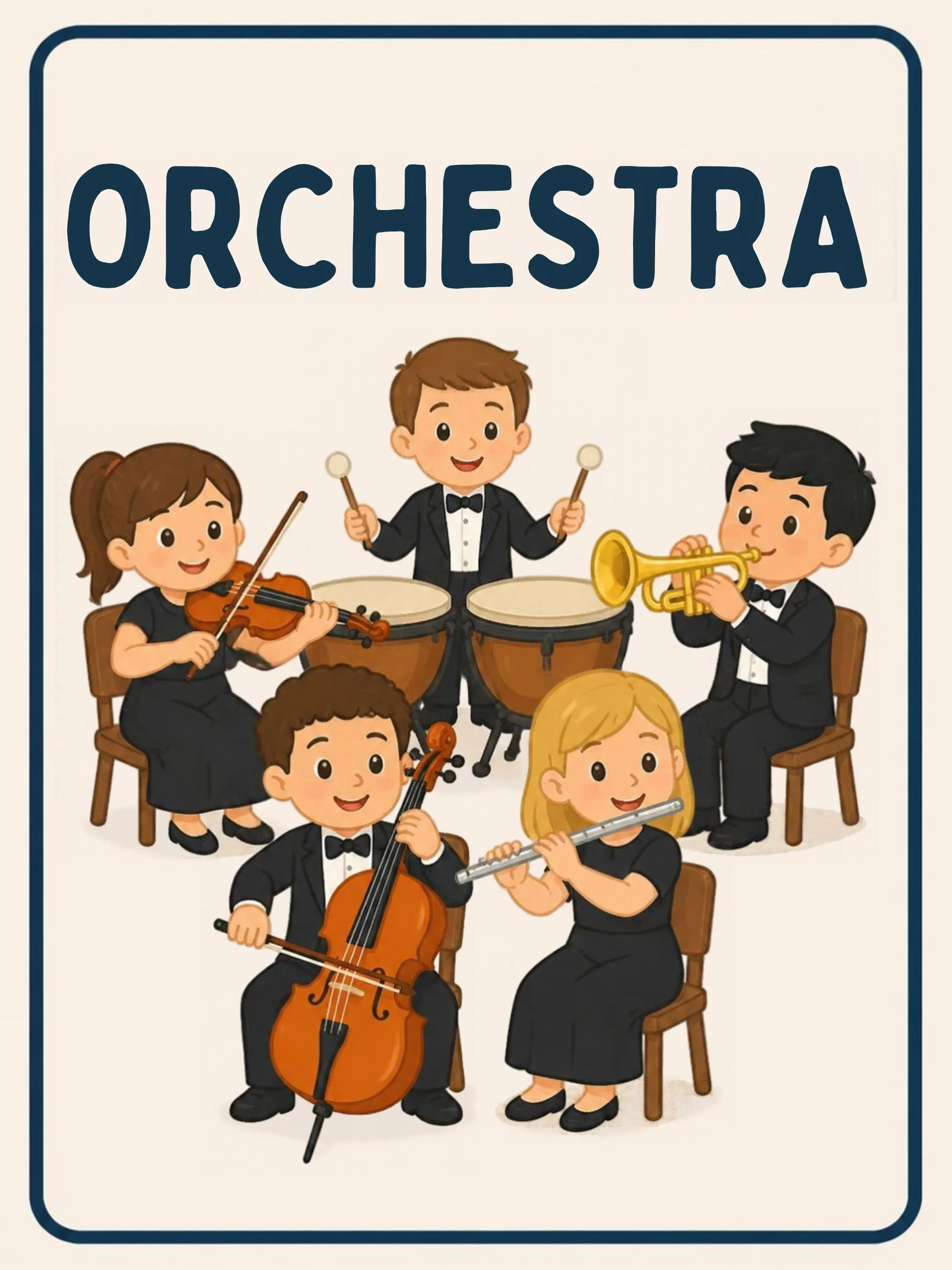
What is this?
An orchestra is a huge group of musicians: strings (violins, cellos) in front, woodwinds (flutes, clarinets) behind them, brass (trumpets, tuba) behind those, and percussion (drums, cymbals) at the back and sides — often a hundred players, one conductor, one sound.
What does it mean?
The orchestra is the room’s whole map in one place: every family on this shelf takes its seat, and the seating chart is the sound chart — quiet strings near the conductor, mighty brass at the back where their power needs room.
What does the child need to know?
Your child needs three orchestra ideas: the orchestra is the biggest music team — around a hundred players; the four families sit in order — strings, woodwinds, brass, percussion — quiet at the front, mighty at the back; and ONE conductor holds the hundred together — the team of teams.
Why this matters
The orchestra gathers every card on this wall into one picture — and its seating logic (soft near, loud far) is a spatial idea children grasp instantly and remember forever.
What it teaches
Family categorisation across the whole instrument wall, spatial-sound logic (seating = volume), big-team cooperation, and conductor-team structure.
Words to learn
orchestrafamiliesstringswoodwindsbrasspercussionhundred
Say this to your child
“"The orchestra is the biggest team in music — a HUNDRED players! Four families sit in order: the singing strings at the front, the breathing woodwinds behind them, the mighty brass at the back, the heartbeat percussion at the sides. And one conductor holds them all together with two hands and a stick. Every instrument we know lives here — all breathing as ONE sound."”
Step by step
- Show the card: "This is an orchestra — the biggest team in music."
- The four families: strings (the singing crowd), woodwinds (the breath players), brass (the mighty), percussion (the heartbeat). Name each family’s cards from our own wall.
- The seating logic: soft strings sit CLOSEST to the conductor, mighty brass at the BACK — loud instruments need room, quiet ones need to be heard.
- One conductor, hundred players: a hundred people, one pair of hands — and it works, because everyone watches.
- Play the family-orchestra game below and close: "four families, one sound."
Look closer at the picture
On this card the word "Orchestra" stands in big navy capitals inside the rounded frame, with a friendly orchestra illustration below — exactly as the big team looks.
Ask your child
"How many players in an orchestra? Name the four families. Which family sits at the back — and why?"
What your child can say or do
Your child might say: "A hundred players!" "Strings, woodwinds, brass, percussion!" or the seating expert: "Brass at the back — they need room!"
Out in the real world
Orchestras fill every concert hall on Earth — and the seating chart is visible from any seat: find the strings’ fan around the conductor, the brass’s back row. Every children’s concert introduces the families — now yours already knows them.
Try it together
Family Orchestra: assign the room’s four families — hummers (strings, front), straw-reeds and bottles (woodwinds, middle), paper-tube raspberry brass (back), pot-and-shaker percussion (sides). The conductor raises the stick: one family plays at a time — strings… woodwinds… brass… drums! Then ALL families together for eight beats — the hundred-player sound at living-room scale. Bow, and the hall (sofa) goes wild.
Understanding check
Ask: "How many players? Name the four families in seating order. What holds a hundred players together?" A hundred, strings-woodwinds-brass-percussion, one conductor — three answers and the orchestra plays.
Parent tips
Play families SOLO first, then together — the layering IS the orchestral effect. And the paper-tube brass stays at the back even in the living room: the seating logic holds at every size.
This lesson pairs with the Orchestra flashcard in the library — print it, show it, keep it on the fridge. Back to Music Room (Class 23).