
Xylophone — a step-by-step lesson for grown-up and child
This lesson teaches the xylophone — the wooden note ladder: bars from long-low to short-high, two mallets, and the cheeriest way to climb a scale with your own two hands.
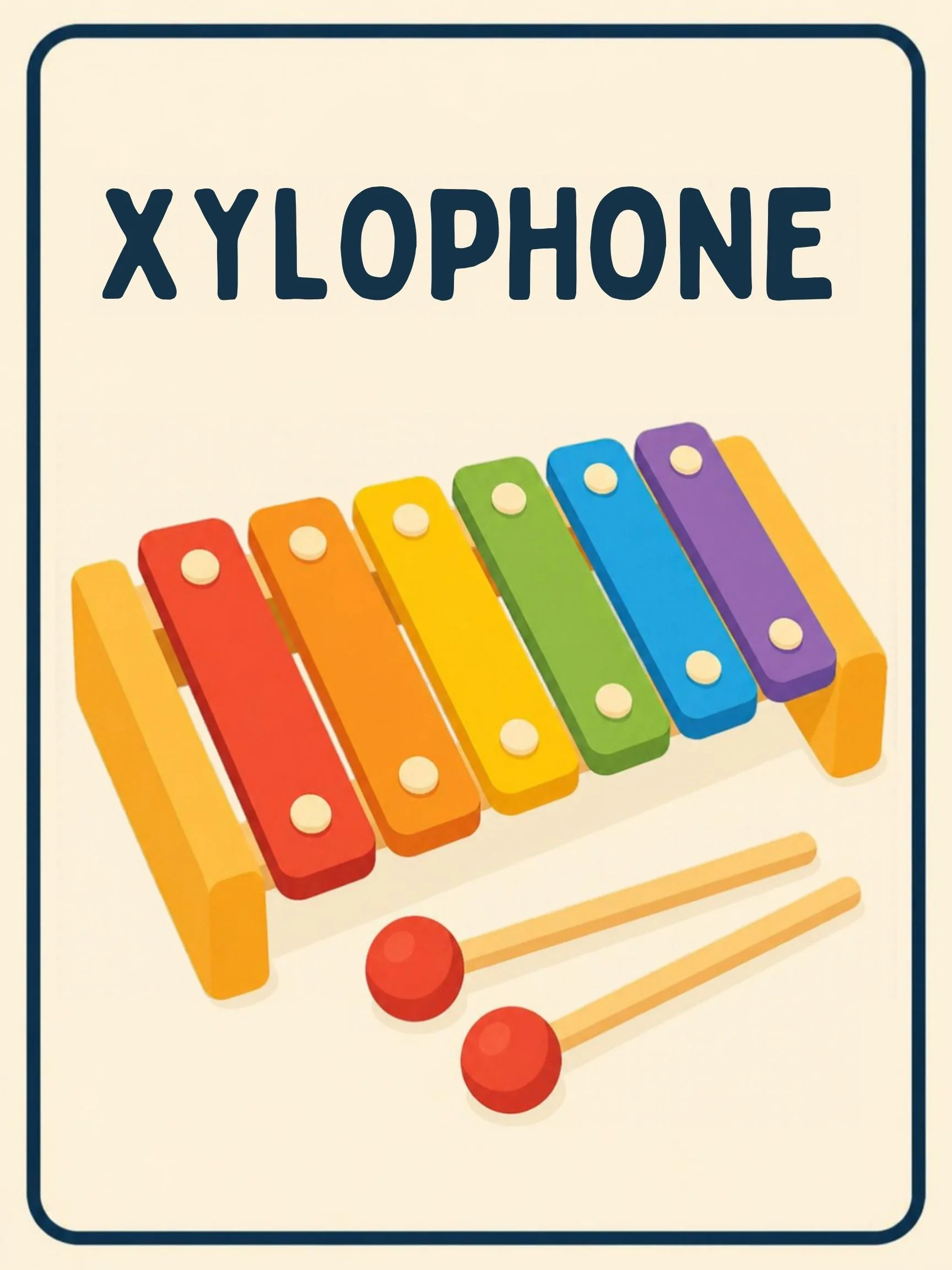
What is this?
A xylophone is a row of wooden bars in pitch order — long bars low, short bars high — struck with mallets. Each bar speaks one bright, woody note, and the row is a ladder a child can walk by ear.
What does it mean?
The xylophone is the bells’ wooden cousin and the piano’s outdoor ancestor: the same ladder, but visible, touchable and impossibly cheerful. Two mallets make it a two-finger piano — patterns, jumps and runs within one small reach.
What does the child need to know?
Your child needs three xylophone ideas: long bar = low note, short bar = high note — the wooden ladder; two mallets, one in each hand — the friendly claw grip; and the bar’s centre rings true — strike the middle, not the edge.
Why this matters
The wooden ladder is the friendliest scale practice there is — bright enough to make errors delightful — and the two-mallet hold quietly rehearses two-hand keyboard playing.
What it teaches
Ladder walking by ear, two-mallet coordination, centre-striking accuracy, and pattern memory — runs, jumps and the famous downward slide.
Words to learn
xylophonebarsmalletsladdertapcentrewooden
Say this to your child
“"The xylophone is a ladder of wooden notes! Long bars on the left ring LOW, short bars on the right ring HIGH — and you climb it with two little mallets, one in each hand like holding two birds. Tap the MIDDLE of each bar for the true voice — tink! — and walk the ladder up, run it back down, then jump the rungs: the cheeriest scale in the world."”
Step by step
- Show the card: "This is a xylophone — a ladder of wooden notes."
- The ladder: long bars left are LOW, short bars right are HIGH — the bells’ law, in wood.
- The claw: one mallet in each hand, held like holding little birds — loose, ready, two-handed from the start.
- The centre rule: strike the MIDDLE of the bar — the true voice lives there; edges go thumpy.
- Play the ladder games below and close: "long-low, short-high, tap the middle."
Look closer at the picture
On this card the word "Xylophone" stands in big navy capitals inside the rounded frame, with a friendly illustration of the wooden bars and mallets below — exactly as the ladder looks.
Ask your child
"Which bars ring low — long or short? How many mallets? Where is the bar’s true voice?"
What your child can say or do
Your child might say: "Long is low, short is high!" "Two mallets — two birds!" or the ladder runner: "I ran the whole ladder down!"
Out in the real world
Xylophones plink through orchestras, school rooms and toy boxes — and the wooden ladder lives on every toy glockenspiel, water-jar row and fence-post line. Tap the middles; climb the rungs.
Try it together
Ladder Runs: xylophone (or jars, or taped paper bars). Walk the ladder UP — one bar, one tap, one hummed step. Run it back DOWN — the famous xylophone slide, woo-o-o! Then jumps: bottom bar to top bar, skips in between. Finish with the echo game: leader taps a three-bar pattern, player answers. Two mallets, one ladder, endless songs.
Understanding check
Ask: "Long or short for low? What do the two mallets hold like? Where do we strike?" Long-low, two birds, the middle — three answers and the ladder plinks.
Parent tips
Centre-striking is the sound rule — a week of "tap the tummy of the bar" beats months of edge-thumps. And alternate hands naturally: right-left-right-left up the ladder builds the two-hand habit for free.
This lesson pairs with the Xylophone flashcard in the library — print it, show it, keep it on the fridge. Back to Music Room (Class 23).