
Violin — a step-by-step lesson for grown-up and child
This lesson teaches the violin — the smallest, highest member of the string family, balanced on the shoulder like it grew there, speaking in the voice closest to a human singing.
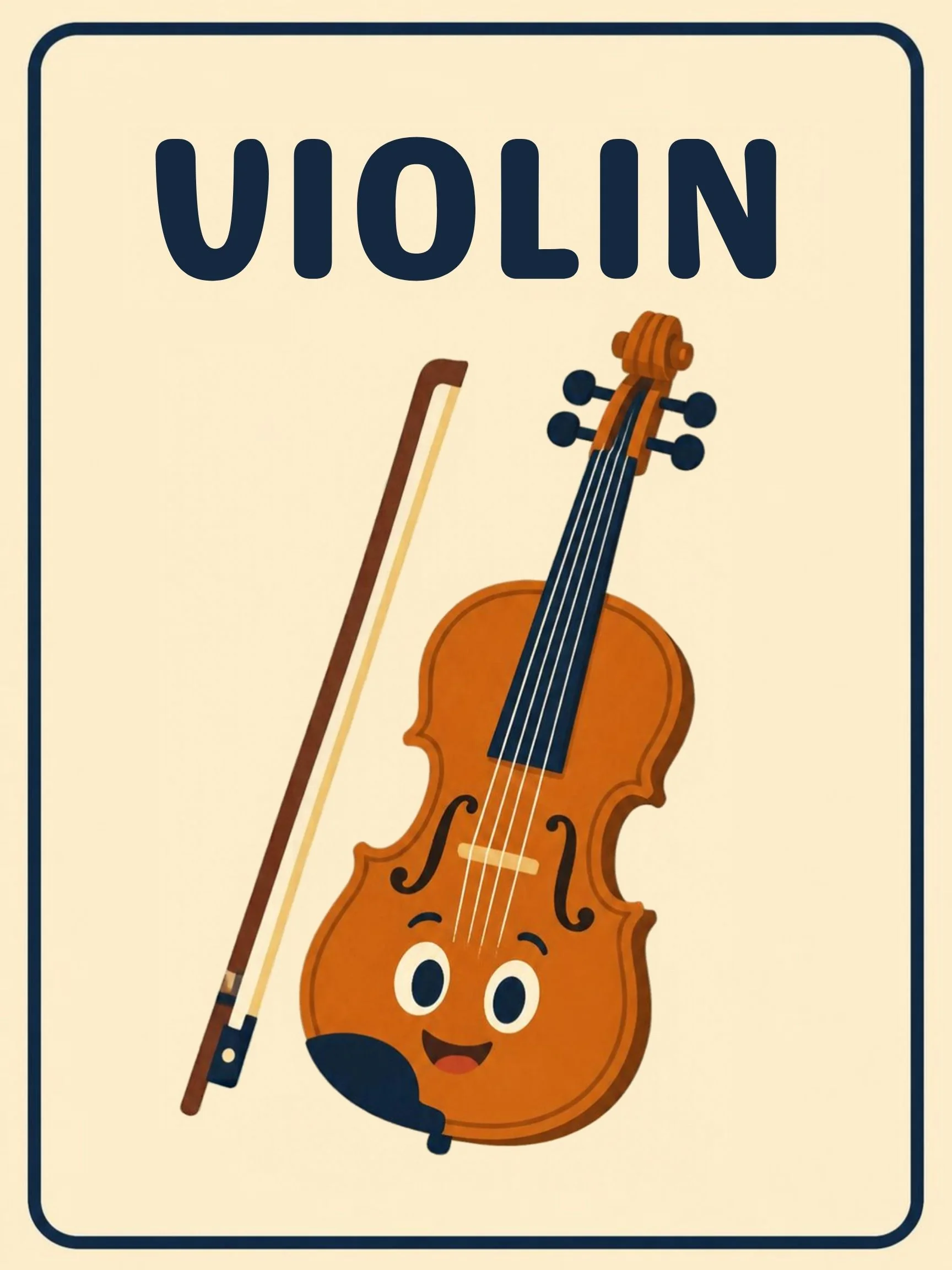
What is this?
A violin is the highest-voiced string instrument: held against the shoulder with the chin, fingers pressing the fingerboard strings, and a bow of horsehair drawn across them. Plucked it is pizzicato; bowed it sings and sings.
What does it mean?
The violin leads the orchestra for a reason: its range and its voice sit closest to the human singing voice — it can sob, laugh and soar. And its posture is a genuine skill: the instrument balances WITHOUT hands, leaving both free to play.
What does the child need to know?
Your child needs three violin ideas: it balances on the SHOULDER, held by the chin — no hands needed to hold it; the bow is the singing breath — slow and straight across the strings; and the size ladder: violin smallest and highest, viola bigger, cello bigger still, double bass the giant.
Why this matters
The shoulder-hold frees both hands for music — a postural marvel children find hilarious and then brilliant — and the string-family size ladder completes the map the cello started.
What it teaches
No-hands balance (posture as skill), slow straight bow strokes, the string-family size-pitch ladder completed, and expressive playing — the voice that can laugh.
Words to learn
violinshoulderchinbowstringspizzicatohighest
Say this to your child
“"The violin lives on your SHOULDER, held by your chin — no hands! — so both hands are free: one fingers the strings, one flies the bow. Draw the bow slow and straight, and the violin SINGS — the closest thing in the orchestra to a person’s voice: it can laugh, it can cry, it can soar. The smallest string, the highest song."”
Step by step
- Show the card: "This is a violin — the singing string that lives on your shoulder."
- The balance: rest a cushion-box "violin" on the shoulder, chin holding it — hands OFF! It balances. That is the violin’s famous trick: both hands stay free to play.
- The bow breath: the bow is the violin’s breath — draw it SLOW and STRAIGHT across the strings and the instrument sings like a person.
- The family ladder: violin (small, highest) → viola → cello → double bass (giant, lowest). Same family, four sizes.
- Play the shoulder game below and close: "shoulder, chin, sing."
Look closer at the picture
On this card the word "Violin" stands in big navy capitals inside the rounded frame, with a friendly illustration of the violin and its bow below — exactly as the singing string looks.
Ask your child
"Where does the violin rest — and what holds it there? What is the bow’s job? Which string family member is highest?"
What your child can say or do
Your child might say: "Shoulder and chin — no hands!" "The bow is its breath!" or the ladder-builder: "Violin, viola, cello, bass!"
Out in the real world
Violins lead every orchestra, soar over every film score and fiddle through every folk dance — and the no-hands balance lives in every toy-on-shoulder game. The singing bow needs only a rubber band and a slow finger.
Try it together
Shoulder Balance School: box violin on the shoulder, chin clamp, walk three steps without hands — giggling allowed, balance earned. Then the singing bow: rubber-band string, finger-bow drawn SLOW — a long singing note. Feelings round: "bow me a happy note… a sleepy one… a surprised one!" The same string sings them all — the bow decides. That is why the violin leads the orchestra.
Understanding check
Ask: "What holds the violin — hands or shoulder and chin? What does the bow draw? Name the family ladder." Shoulder and chin, the singing, violin-viola-cello-bass — three answers and the string sings.
Parent tips
Balance before bowing — the no-hands hold is the violin’s rite of passage and its funniest party trick. And slow bow strokes only: speed is noise; slowness is song.
This lesson pairs with the Violin flashcard in the library — print it, show it, keep it on the fridge. Back to Music Room (Class 23).