

Zigzag — a step-by-step lesson for grown-up and child
After the smooth waves, this card changes the rules: every corner is a small event. This lesson turns those events into a game of tick and tock.
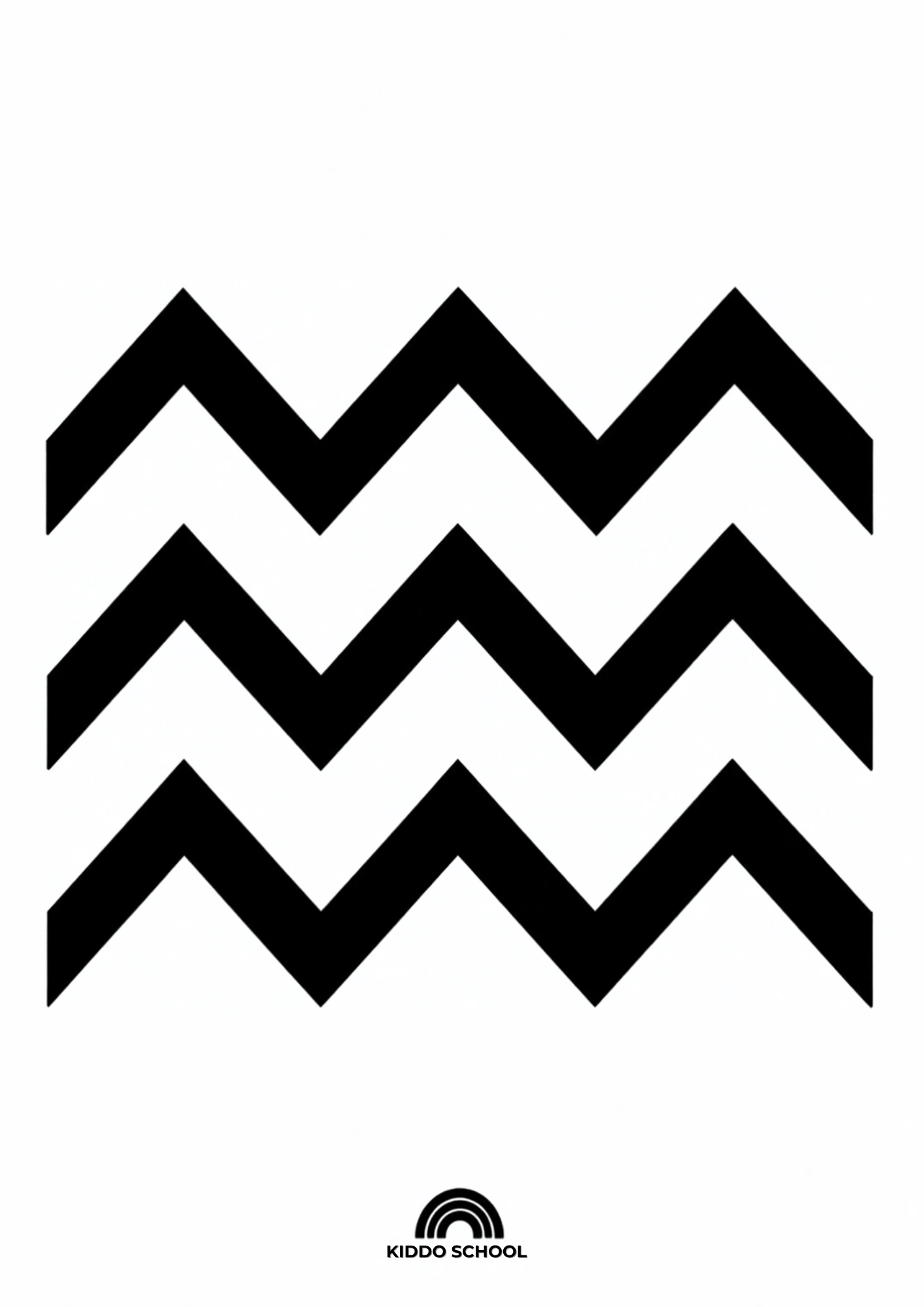
What is this?
A zigzag is a line that turns sharply back and forth — corners instead of curves. Where the waves let the eye rest while it moved, the zigzag asks it to notice: the direction just changed, right there, at the point.
What does it mean?
Direction change is visual news. An eye that has learned curves now meets events, and each corner is a miniature surprise — expected once traced twice, exciting every time. Surprise, in small safe doses, is what keeps attention growing.
What does the child need to know?
Zigzags are busier than waves, and busy burns attention faster. Expect a shorter visit and treat that as normal. The tick-tock trick — a tiny voice turn at every corner — marks the changes so the eyes learn to predict them.
Why this matters
The world does not move in curves only: hands reach and withdraw, siblings dart, pets turn on a sixpence. An eye that has practised corners catches sudden movers sooner, and a baby who predicts the next turn is learning that the world has rules.
What it teaches
Visual scanning across direction changes, anticipation (what happens at the corner?), auditory-visual pairing through the tick-tock voice, and tolerance for gentle surprise.
Words to learn
zigzagcornerturnticktockpointy
Say this to your child
“"Zigzag — up to the corner, turn! Down to the corner, turn! Tick, tock, tick, tock. The line cannot decide which way to go, so it goes both ways. What a busy, pointy line."”
Step by step
- Show the card briefly and name it with a playful voice: "Zigzag! Pointy corners everywhere."
- Trace the line slowly and let your voice tick at one corner and tock at the next — sound marks the surprise so it stops being a jolt.
- Pause at a corner, finger parked, and wait; some babies stare hardest exactly at the turn.
- Run the trace a second time at the same speed so the corners become predictable — prediction is the skill hiding in this card.
- Stop while curiosity is still alive; a shorter session on a busy card leaves the door open for tomorrow.
Look closer at the picture
The artwork is a thick zigzag line full of hard angles and about-turns — say that and no more. The real show to notice: does your baby’s gaze hesitate a beat at each corner? That hesitation is the surprise landing.
Ask your child
Watch the corners: do the eyes pause at the turns or sail across them? Does the tick-tock voice collect the gaze back after a slip? Wonder aloud: "I wonder if you knew the corner was coming by the third lap."
What your child can say or do
A stare pinned to one corner, a startle at the first turn that settles by the third, rapid eye-darting that mirrors the line, or a quick loss of interest — all normal; the last one just means this card stays short in your rotation.
Out in the real world
Corners are everywhere once you look: the edge of a picture frame, the zigzag of a knitted blanket, the chevron on a wet-floor sign at the shop. Name real corners casually and the card keeps echoing.
Try it together
Corner peek: trace to a corner, hide the card behind your palm for one second, then reveal it turned the other way. Tiny, safe, repeatable — the same surprise, packaged as peek-a-boo.
Understanding check
Self-check: did you mark the corners with your voice, and did the session end earlier than the wave session did? Both answers being yes means you read the card right — busy cards trade length for brightness.
Parent tips
If the zigzag floods your baby — darting eyes, stiff body, fussing — park it for a fortnight and stay with waves; there is no order to enforce. When it lands, it lands, and corners become the fun half of the set.
Staying safe
Busy cards can tip an alert baby into overload fast; watch for a pink face, flailing or gaze-darting and end at the first sign. Keep sound effects gentle — the tick-tock marks corners, it does not perform a concert.
This lesson pairs with the Zigzag flashcard in the library — print it, show it, keep it on the fridge. Back to Faces & Visual Tracking (Newborn 2).