
Balance — a step-by-step lesson for grown-up and child
This lesson teaches balance as a quiet body conversation: arms out, eyes on the end of the line, feet talking to the ears — one slow chalk-line walk at a time.
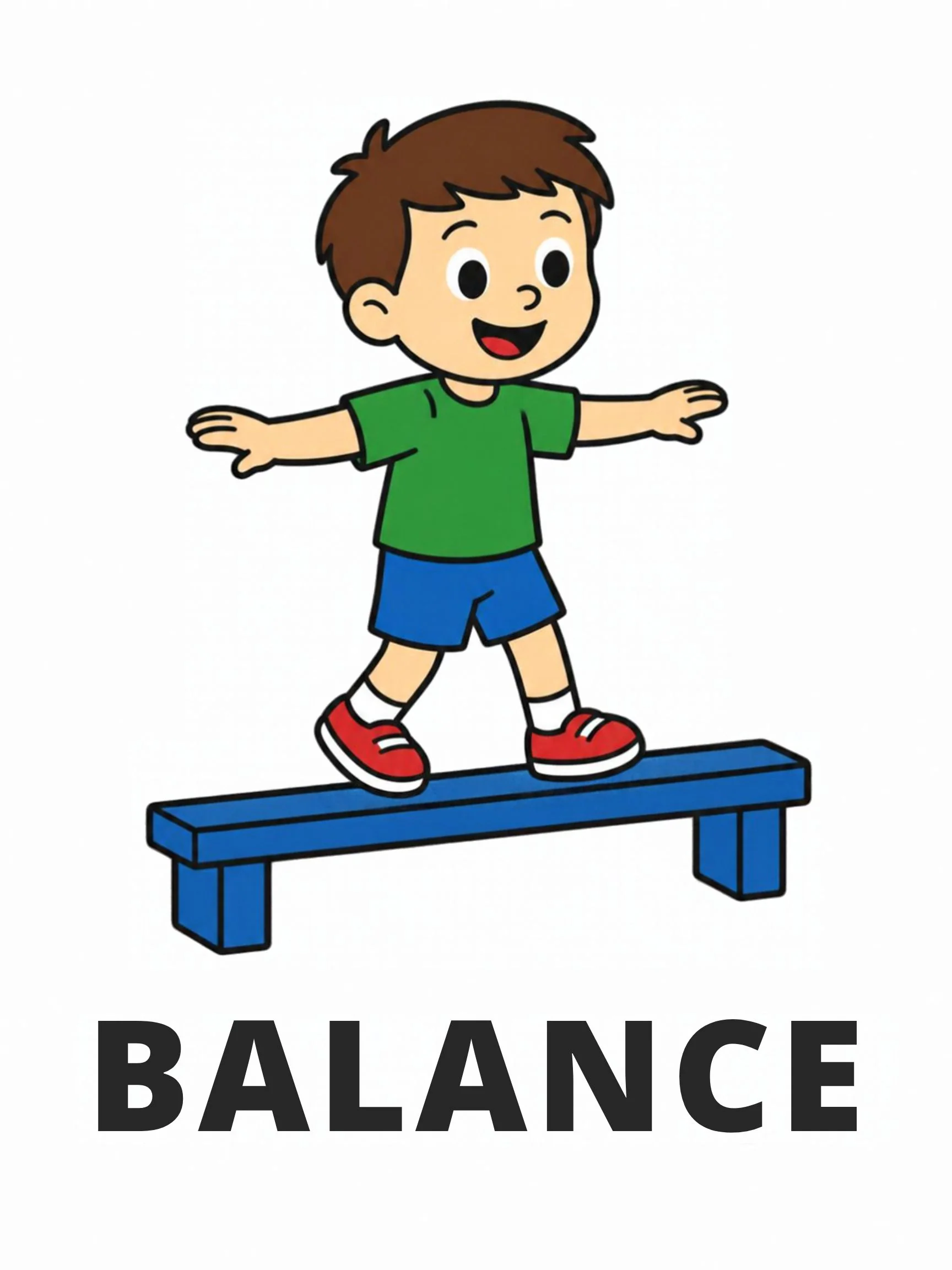
What is this?
Balance is staying steady when the ground narrows or the body wobbles: the ears read the tilt, the eyes pick a target, the legs correct. Three helpers, one steady walk.
What does it mean?
Balance is the base under every other playground skill — the swing mount, the ladder climb, the hop all start with a moment of steadiness. It is also the quietest skill here: the body goes still to get better.
What does the child need to know?
Your child needs three balance ideas: arms out are the wings — wide arms widen the wobble-margin; eyes pick a FIXED point ahead — looking down at the feet tips the body; slow beats fast — the slower the step, the longer the ears have to correct.
Why this matters
Of the fifteen action words, balance is the one that quietly trains the others: the steadier the base, the braver the jump, the swing and the climb.
What it teaches
Static and dynamic balance, ear-eye-leg coordination, focus (fixed-point gazing), and self-calming — a balance walk is deep-breathing in disguise.
Words to learn
balancesteadywobblearms outslowkerbtightrope
Say this to your child
“"Balance is steady feet on a narrow line! Arms out like airplane wings, eyes on the tree at the end — not your feet — and step… so… slowly. The slower you go, the more your body can catch you. Wobbles are allowed — every wobble is your body practising its comeback!"”
Step by step
- Show the card: "This is balance — steady feet on a narrow line."
- Wings first: arms out wide — "airplane wings keep you up." Demonstrate the difference: arms in (wobbly), arms out (steady).
- Eyes ahead: pick a target at the end of the line — "your eyes steer your feet." Practise looking ahead, not down.
- The slow walk: chalk line, kerb or bench edge — step… step… step. Slow is the skill; speed comes on its own.
- Play the tightrope games below and close: "wings out, eyes ahead, slow steps."
Look closer at the picture
On this card the word "Balance" stands in big navy capitals inside the rounded frame, with a friendly balancing illustration below — exactly as the steady pose looks.
Ask your child
"Where do the arms go? Where do the eyes look — feet or ahead? What happens when we go slower?"
What your child can say or do
Your child might say: "Airplane wings out!" "My eyes steer my feet!" or the wobble report: "I wobbled three times and caught myself!"
Out in the real world
Balance lines are everywhere: kerbs, garden edges, painted lines, the shadow of a fence. Any walk becomes a tightrope when a line appears — the skill travels home free.
Try it together
Tightrope Progression: chalk line forwards, then backwards, then sideways — three walks, each slower than the last. Then the beanbag ride: walk the line with a beanbag on the head — the bag only stays when the steps are truly steady. Count the wobbles together across the week and watch them shrink. Wings out, eyes ahead — the tightrope is anywhere.
Understanding check
Ask: "What do the arms do? Where do the eyes look? Does slow or fast win?" Wings out, ahead, slow — three answers and the line is walked.
Parent tips
Chalk before kerbs, kerbs before benches: raise the line’s height only when the floor version looks easy. And count wobbles as wins — the counting makes practice into a game, not a test.
This lesson pairs with the Balance flashcard in the library — print it, show it, keep it on the fridge. Back to Playground.