
Catch — a step-by-step lesson for grown-up and child
This lesson teaches catching in its right order: the EYES catch the ball first, the hands just finish the job — a watching skill wearing gloves.
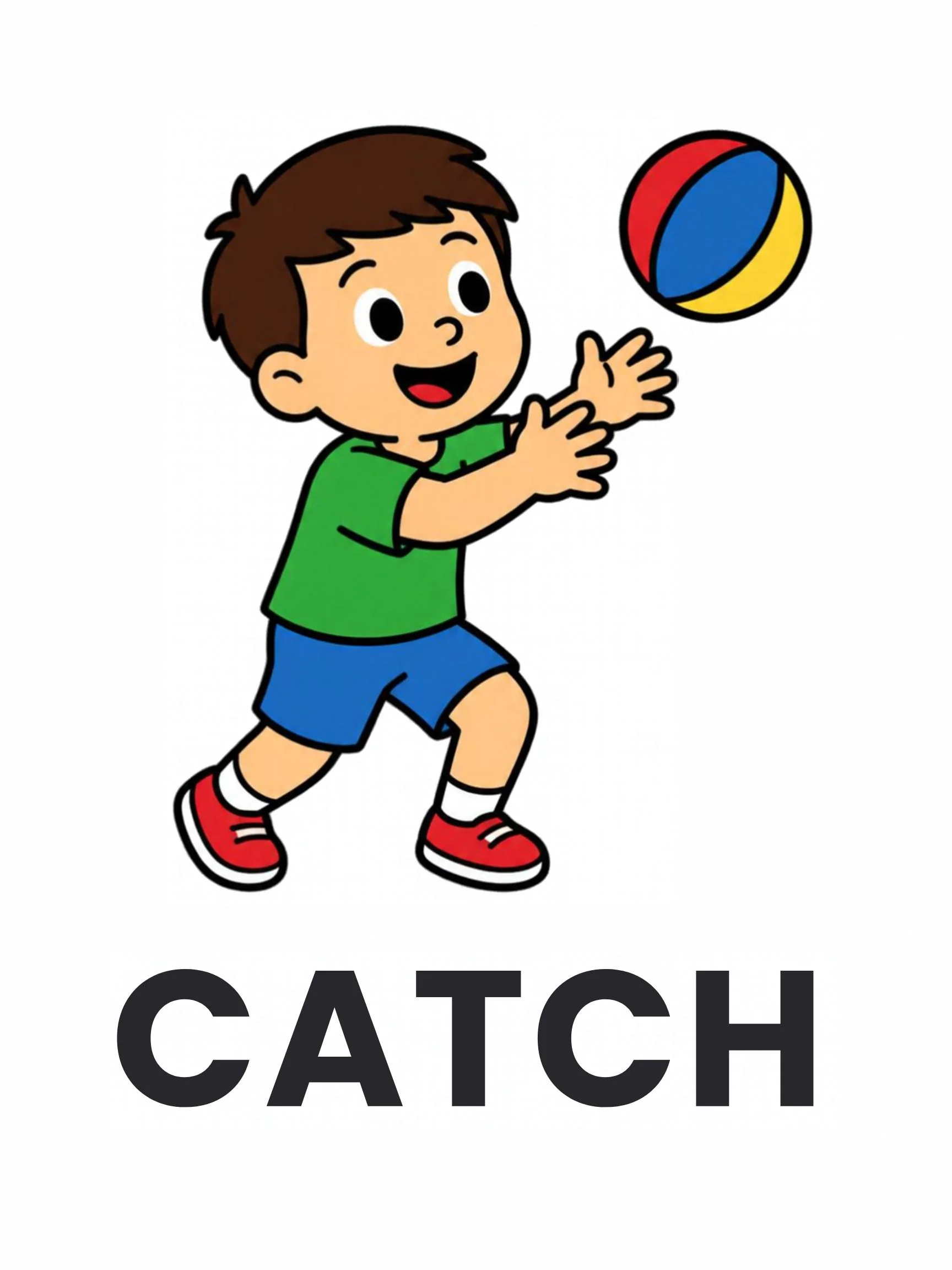
What is this?
Catch is stopping a flying thing with the hands: eyes track the ball, hands move to the spot, fingers close around it — a soft cage, not a hard slap.
What does it mean?
Every failed beginner catch is a watching failure: the hands close where the ball WAS. Teaching eyes-first reframes catching from a grab into a tracking game, and tracking is trainable with balloons.
What does the child need to know?
Your child needs three catch ideas: the eyes catch the ball — hands just close where the eyes say; the catch is a soft cage — big hands, bent elbows, ball pulled IN as it arrives; and starting big — balloons and slow rolls — beats starting small and hard.
Why this matters
Catching is the confidence keystone of ball play: children who catch relax into every throwing, batting and team game that follows.
What it teaches
Eye tracking, hand-eye timing, soft-hands catching (the pull-in), and gentle bravery — a ball coming AT you asks for calm, not flinch.
Words to learn
catchwatchtracksoft handscageballoonready
Say this to your child
“"Catch is a watching game! Your eyes grab the ball first — follow it, follow it — and your hands just close where your eyes say: a big soft cage, fingers wide, and pull it IN gently. Balloons first, balls later: whatever flies, you catch it with your eyes first!"”
Step by step
- Show the card: "This is catch — two hands close around a flying ball."
- Eyes first: roll a ball slowly and let your child WATCH it all the way into still hands — the roll cannot miss. "Your eyes caught it before your hands did!"
- The cage: arms out, elbows bent, fingers spread — a big bird cage. Ball arrives; fingers close, hands pull gently IN — hugging the ball, not slapping it.
- Balloon rounds: balloons hang long enough for tracking to win — ten catches, no flinches.
- Play the catch games below and close: "watch it all the way in."
Look closer at the picture
On this card the words "Catch" stand in big navy capitals inside the rounded frame, with a friendly catching illustration below — exactly as the two-hand cage looks.
Ask your child
"What catches the ball first? What shape do the hands make? Do we slap the ball or pull it in?"
What your child can say or do
Your child might say: "My eyes caught it!" "A soft bird cage!" or the proud count: "Ten balloon catches — no drops!"
Out in the real world
Catch practice lives in every garden and hallway — and the tracking game lives everywhere: follow a soap bubble, a falling leaf, a soap bubble of a balloon. Eyes first, hands second — for life.
Try it together
Roll-and-Catch Ladder: level one, sitting, rolling a ball back and forth — pure tracking. Level two, standing, gentle underarm tosses at chest height — cage closes. Level three, balloons — slower, higher, funnier. Level four, small soft ball with a bounce in between. Each level is one game day; the ladder climbs on confidence, not age.
Understanding check
Ask: "What catches first? What shape are the hands? Slap or pull?" The eyes, a soft cage, pull — three answers and the ball is yours.
Parent tips
Keep tosses at CHEST height — rising balls vanish over the head and scare beginners. And say "watch it all the way in" every round: the phrase does the coaching.
This lesson pairs with the Catch flashcard in the library — print it, show it, keep it on the fridge. Back to Playground.