
Take Turns — a step-by-step lesson for grown-up and child
This lesson teaches taking turns — the fair machine: my go, your go, a queue everyone can see, and waiting that turns into watching.
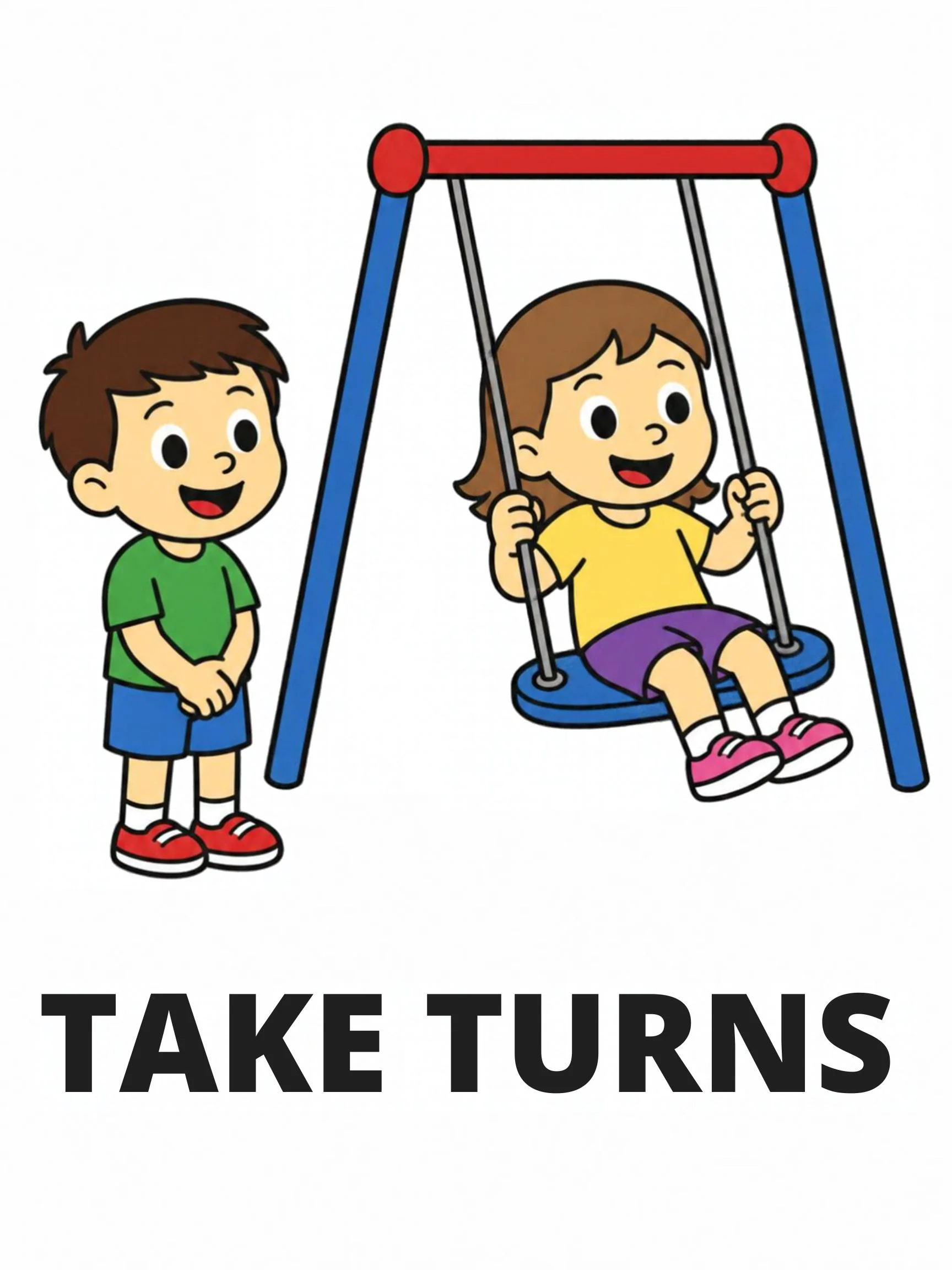
What is this?
Take turns is trading goes: my turn, then your turn, in an order everyone can see — the queue, the count, the next-up — so every game with one swing, one spade or one spotlight stays fair.
What does it mean?
Turn-taking is fairness made visible: the queue shows the order, the count shows the length, and next-up shows the hope. Children wait bravely when the system is SEEABLE — which is why queues, timers and turn-tokens work.
What does the child need to know?
Your child needs three turn ideas: turns are an ORDER everyone can see — the queue or the count; my go ends and YOURS begins — the handover is part of the turn; and waiting is easier when watching — the next turner learns the game while they wait.
Why this matters
Turn-taking runs every classroom, every family and every queue on Earth — taught here at the slide and the swing, where the fairness is felt in the body.
What it teaches
Queue patience, handover rituals (my go ends cleanly), watching-to-learn while waiting, and fairness perception — the seen order soothes.
Words to learn
take turnsmy goyour goqueuenext uphandoverfair
Say this to your child
“"Taking turns is the fair machine! Turns work when everyone can SEE them: the queue, the count, the next-up name. My go ends with a handover — ‘YOUR go!’ — clean and loud. And waiting is easier when it is watching: the waiter learns the whole game before their turn. My go, your go, next up — fair, seen, fun!"”
Step by step
- Show the card: "This is take turns — the fair machine!"
- The seen order: turns work when everyone can SEE them — a queue, a count, a next-up name. Hidden turns feel unfair; seen turns feel fair.
- The handover: my go ends with a handover — "your go!" — clean and loud. A tidy handover is half the fairness.
- Waiting watches: the waiter watches the rider — learning the game, spotting the tricks. Waiting is practising.
- Play the turn games below and close: "my go, your go, next up!"
Look closer at the picture
On this card the words "Take Turns" stand in big navy capitals inside the rounded frame, with a friendly turn-taking illustration below — exactly as the fair queue looks.
Ask your child
"What makes turns FEEL fair — seen or hidden? What ends my go? What does the waiter do while waiting?"
What your child can say or do
Your child might say: "Seen turns are fair turns!" "YOUR go! — I handed over clean!" or the watcher: "I learned the trick while I waited!"
Out in the real world
Turns run every classroom turn-and-talk, every board game, every family bathroom queue — and the handover ritual works everywhere. Waiting-while-watching even makes waiting useful.
Try it together
Turn-Token Queue: one swing, three players — each holds a token (a leaf, a cap); the swing belongs to the token-holder, and the handover is the token pass: "YOUR go!" Countable goes (ten pushes) keep the length fair. The waiters watch-and-learn one trick per wait. Rotate until every token has flown twice. Seen order, clean handovers, useful waiting: the fair machine, fully running.
Understanding check
Ask: "What makes turns fair? What ends my go? What does waiting become?" Seen order, the handover, watching — three answers and the queue hums along.
Parent tips
Make the handover a CELEBRATION — "your go!" with a grin turns the end of my fun into the start of ours. And countable goes beat vague ones: certain length teaches certain waiting.
This lesson pairs with the Take Turns flashcard in the library — print it, show it, keep it on the fridge. Back to Playground.