
Orange — a step-by-step lesson for grown-up and child
This lesson peels: your child rounds their mouth into a little o for the sound, traces circles on the fruit before it opens, and counts segments while the room fills with the smell.
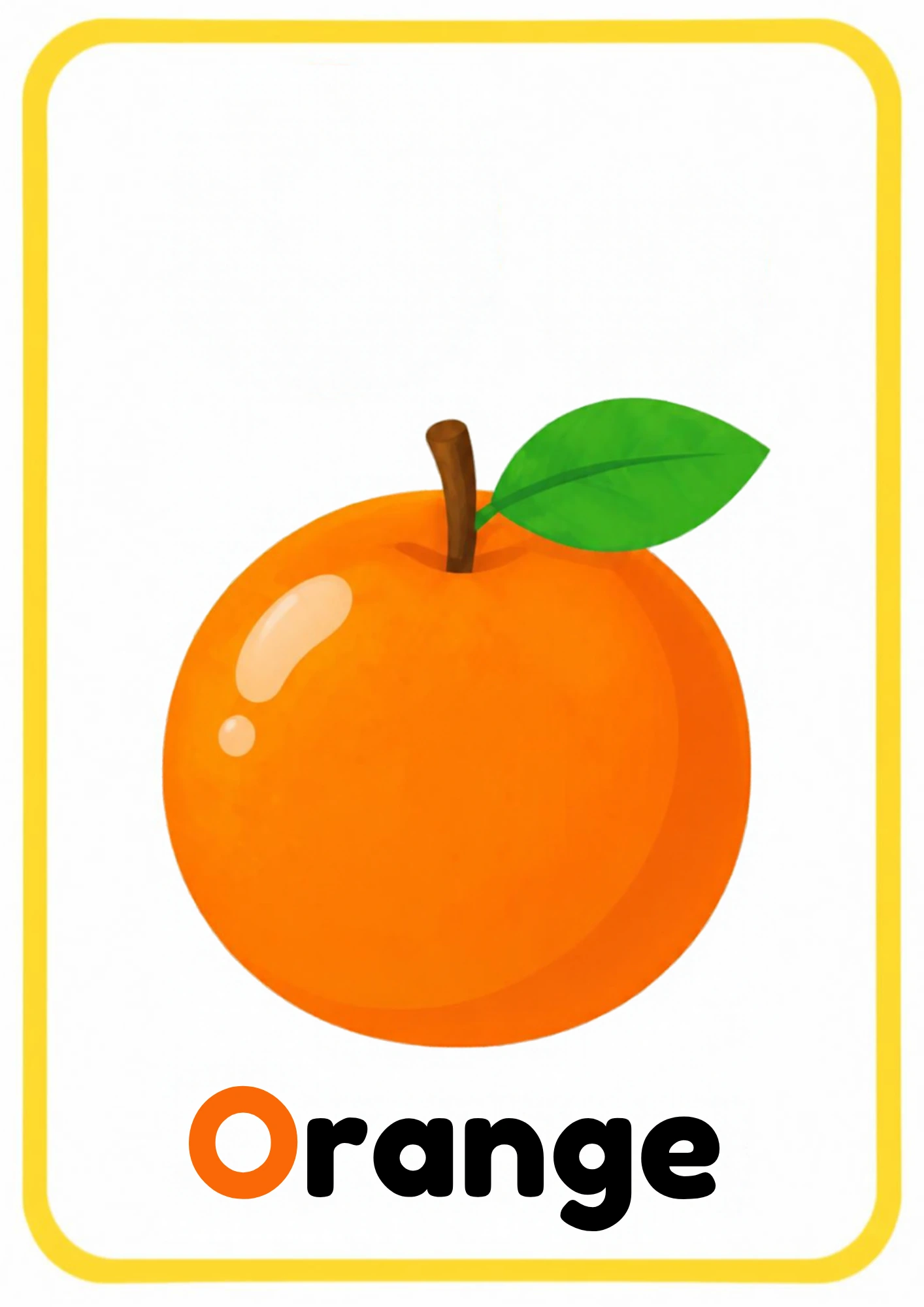
What is this?
O is the fifteenth letter of the alphabet. In orange, it makes its short round sound: oh — the sound at the start of on and octopus. Your mouth makes a little O shape to say it.
What does it mean?
O is the letter that draws itself: round the lips, round the fruit, round the letter. A shape repeated three ways in one lesson feels like discovery every single time.
What does the child need to know?
The letter is called O; in orange it says oh — short and round, mouth open in a small circle. O has other sounds in other words, but today the orange keeps things simple and peelable.
Why this matters
Smell is the strongest memory hook there is, and this card arrives with one built in. Peeling, counting and sharing segments turns the letter into snack time, which is where practice sticks best.
What it teaches
Round-lip sound production, circle tracing in air and on surfaces, letter recognition in two cases, pincer-grip peeling and segment-pulling, and one-to-one counting that ends in sharing.
Words to learn
Oorangeohroundpeelshare
Say this to your child
“"This is the letter O — hello, O! O says oh — make your mouth a little circle, like this: oh. Look, your lips just drew the letter! Now smell the orange... peel it with me... count the pieces: oh, oh, oh! Round and sweet, just like the letter."”
Step by step
- Show the card and pass the fruit if you have one: this is the letter O, and this is an orange — round, like the letter itself.
- Make the sound with a small round mouth: oh. Watch your lips draw a little O in the mirror. Try oh three times, then oh-orange.
- Trace big O — one round loop, all the way around — and little o: the same circle, smaller. Draw both in the air, then on the orange’s skin.
- Peel together: pull the skin away in pieces, break the fruit into segments and count them out — one oh, two oh, three oh.
- End with an oh-hunt: find three round things or oh-words — a ball, a bowl, an octopus toy if one lives here — and trace a circle above each.
Look closer at the picture
Find the big uppercase O and the little lowercase o on the card, then the orange and the word Orange. Ask what shape both letters make — one closed loop, big and small, the easiest circle in the alphabet.
Ask your child
"What is this letter called?" "What does O say in orange?" "Can your mouth make the letter’s shape?" "How many segments shall we count this time?" — answered with a name, a round oh, a circle-mouth and a number.
What your child can say or do
"Oh! Oh-orange!" Expect circle-mouths in mirrors, oh-sounds offered to onions and octopuses, and segment-counting at every orange until further notice. The smell will summon the lesson from another room. That is the plan working.
Out in the real world
O rolls through the day: orange at snack time, on and open and over in speech, circles everywhere your child looks. Every round thing is a tracing prompt and every peeled fruit is the card, refreshed.
Try it together
Segment shop: peel an orange, lay the segments in a row and count them aloud with an oh per piece. Then share them out — one for you, one for me — trading every handover with an oh. Maths, phonics and manners in one fruit.
Understanding check
Ask what O says in orange: a short round oh with circle lips means the sound landed. A little o traced in the air — one smooth loop, no corners — completes the fruit bowl.
Parent tips
Let the circle do the teaching: lips, fruit, letter, loop drawn in the air — the shape repeats itself without any drilling. If other O sounds come up in books, smile and save them; the orange owns this week.
Staying safe
Peeling starts with grown-up hands for the first cut, then small fingers pull the loosened skin. Segments are cut to suit your child’s chewing stage, and sticky hands get washed before anything else is touched.
This lesson pairs with the Orange flashcard in the library — print it, show it, keep it on the fridge. Back to Alphabet A–Z (Preschool).