
Chin — a step-by-step lesson for grown-up and child
This lesson finds the smallest body part on the card — and the trickiest one to point at. The chin hides below the mouth, stars in every thinking pose, and the card settles the where-is-it question with an arrow aimed exactly at the right spot.
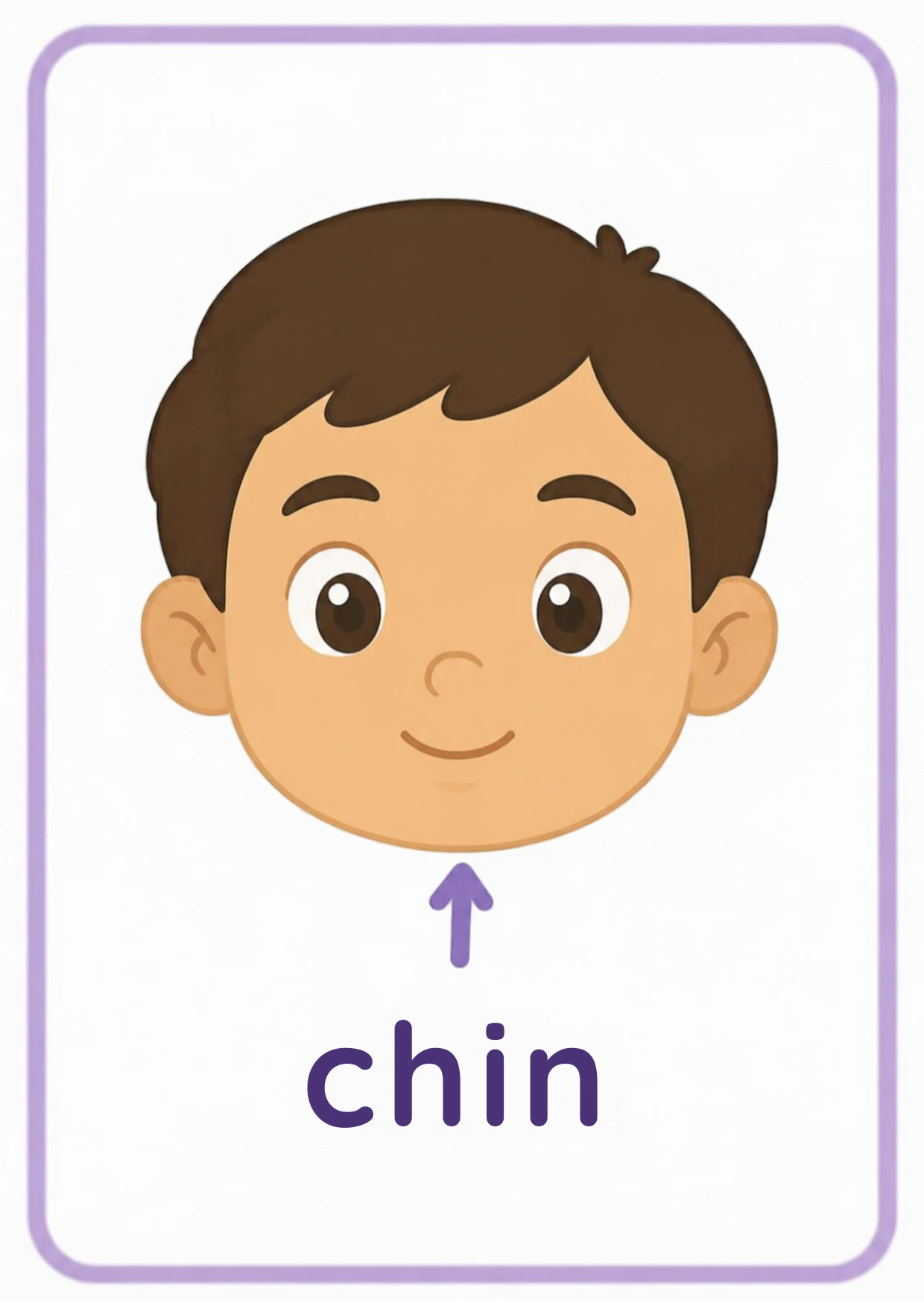
What is this?
The chin is the little bony ledge at the very bottom of the face, just under the mouth and the lips. It is what rests on a hand in a thinking pose, what tucks down when a jumper is pulled over a head, and what juts out when someone decides to be brave.
What does it mean?
The chin is a landmark more than a worker: the face has a map, and the chin is its bottom edge. Knowing it completes the map — forehead, eyes, nose, mouth, chin — and gives your child words for the way feelings show: chin up for brave, chin tucked for shy, chin on a hand for thinking hard.
What does the child need to know?
Your child needs to know: the chin is the bony bit at the bottom of the face, just under the lips, found by tucking a finger under it — not the neck, not the cheek — and it moves with feelings: up for brave, down for thinking. Most children point at the neck first, which is what the arrow on the card is for.
Why this matters
The chin is usually the last face part to be named, and naming it finishes the face map. It also carries real language — chin up, chin rest, chin strap — and the finder’s pride is real, because a part this small, found this precisely, is a genuine achievement for a three-year-old finger.
What it teaches
Face-map completion (forehead to chin), spatial language (under, below, bottom edge), precision pointing as fine-motor practice, feeling-words linked to chin poses, and the mirror work that builds self-recognition.
Words to learn
chinfacearrowthinktuckunder
Say this to your child
“"This is your chin — the very bottom of your face, just under your lips! Tuck a finger under it: there! It is where big thoughts happen — finger on chin, hmmmm — and where brave happens too: chin up! Forehead, eyes, nose, mouth, chin: your whole face, mapped from top to bottom!"”
Step by step
- Show the card and follow the arrow with one finger: where does it land? At the very bottom of the face — the chin. Name it, then hunt it down in a mirror.
- Play the finder: tuck a finger under your child’s chin — there it is! Watch out for the neck trick: the chin sits above that, just under the lip.
- Strike the thinker pose: finger on chin, eyebrows down, hmmmmm. Big thoughts need a chin, and the sillier the pose the better it sticks.
- Do the chin feelings: chin up — brave! Chin tucked — sneaky! Chin resting on both hands — bored, or thinking about snacks. Your child guesses each one.
- Complete the face map together: forehead, eyes, nose, mouth, chin — bottom of the map reached. Tap each one in order, faster and faster.
Look closer at the picture
Look at the picture together: where is the arrow pointing — at the chin? Whose face is it? Is the chin at the top of the face or the bottom? Can you find your own chin without a mirror?
Ask your child
"Where is your chin — show me with one finger!" "What does the chin rest on in a thinking pose?" "Which face part sits just above the chin?" "How does a brave chin stand?"
What your child can say or do
Your child may answer every question from here on in the thinker pose, correct a sibling who points at the neck — no, the chin, the arrow says so — or march the face map at top speed: forehead, eyes, nose, mouth, chin!
Out in the real world
Chins come up at the dentist — lift the chin for me — in the jumper tug when a head gets stuck halfway, and in every chins-up at the doctor’s. The face map ends at the chin, and now your child knows the last stop.
Try it together
Chin-and-balance races: walk a line on the floor with a soft toy balanced on the chin — wobbling allowed, giggling guaranteed. Or pass a balloon chin-to-chin with a partner: no hands, chins only. It is chin awareness, posture control and comedy in one game.
Understanding check
Ask: "Where is the chin? What sits just above it? Show me the thinker pose." The bottom-of-the-face answer, the lips and a thoughtful hmm — that is the lesson landed.
Parent tips
If the finger keeps landing on the neck, go back to the mirror and trace the jaw together — bottom of the face, under the lips, a small bony ledge. And let the thinker pose become a family joke: a child who strikes it mid-conversation is a child who owns the word.
Staying safe
Chins take the fall in trips — they land first when feet race wheels — so every chin bump gets a grown-up’s look, a cold cloth and a cuddle. Helmet chin straps get buckled before wheels roll: the strap lives under the chin, and so does the rule — helmet on, strap clicked, then ride.
This lesson pairs with the Chin flashcard in the library — print it, show it, keep it on the fridge. Back to Body Parts & Five Senses Flashcards.