
Hair — a step-by-step lesson for grown-up and child
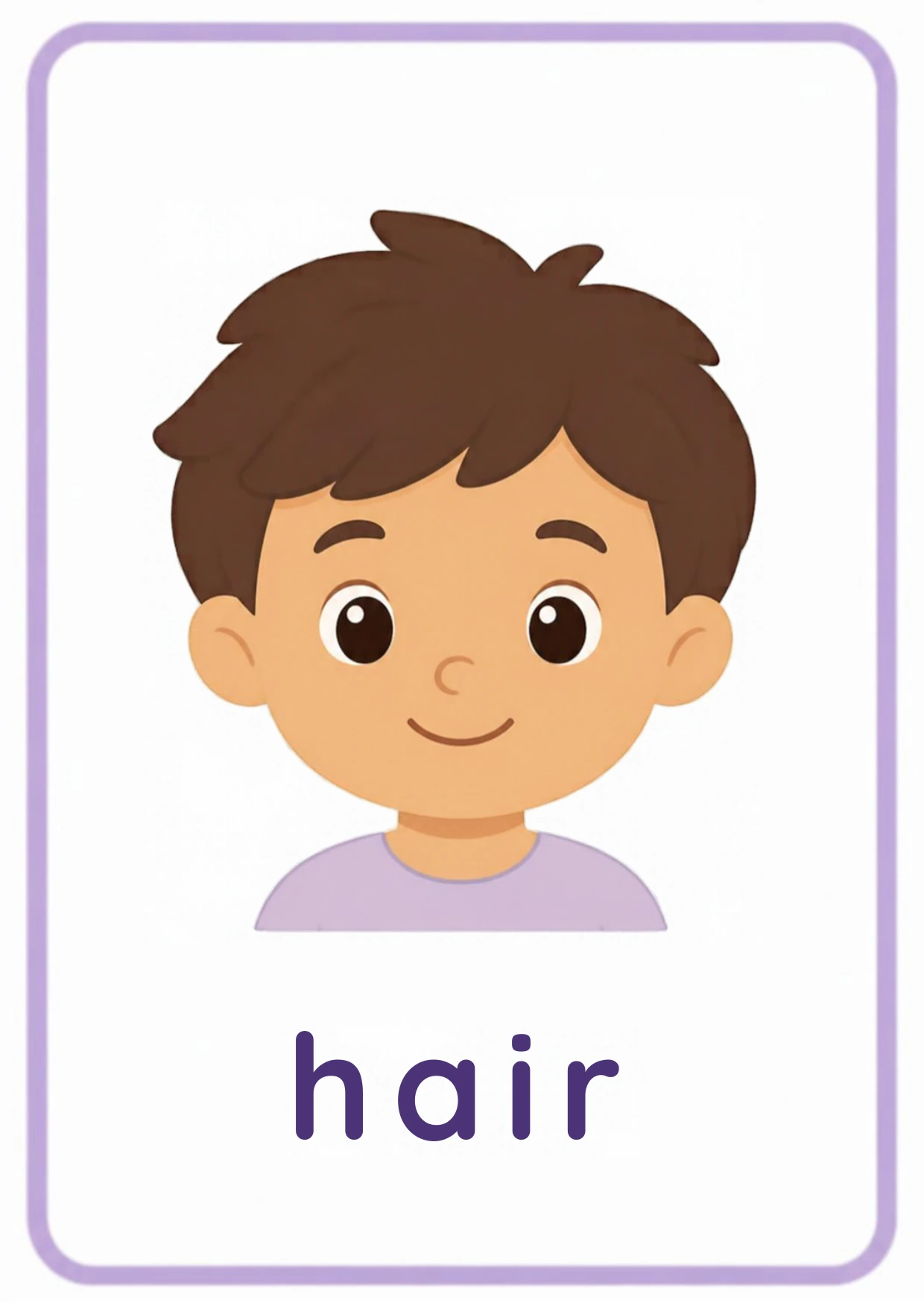
This lesson climbs to the top of the head. Hair is the body part your child meets most often without naming it — brushed, washed, trimmed and ruffled daily — and the card gives it a face: a boy with a dark crop, ready for the pat test.
What is this?
Hair is the stuff that grows from the skin on top of the head — and only there, which is what gives it an address. It can be dark or light, curly or straight, long or short, thick or fine. It keeps warm the head it lives on, and it is one of the first things people notice about each other.
What does it mean?
Hair is the body part that is never hidden and never the same: every child in the classroom owns a different version. That makes it the gentlest possible first conversation about differences — my hair, your hair, her curls, his crop — and the easiest place to practise the big idea that different is normal.
What does the child need to know?
Your child needs to know: hair grows on top of the head, out of the skin, and it comes in every colour and curl — straight, curly, dark, fair, long, short. It needs a little care: brush and wash, and a grown-up for trims. Everyone’s hair is different, and everyone’s is good.
Why this matters
Naming hair gives your child the word for a daily routine — the brush, the wash, the hat — and for the noticing they already do. Hair is also where children first meet difference and sameness side by side: comparing hair kindly is a small daily rehearsal for a much bigger skill.
What it teaches
Body-part naming above the face line, descriptive vocabulary (colour, curl, length, texture), comparing and contrasting as early thinking, gentle hands in hair-care routines, and the first friendly chat about how people differ.
Words to learn
hairbrushcurlsstraighttrimdark
Say this to your child
“"This is hair — it grows on top of your head! Yours is yours, and everyone’s is different: curly, straight, dark, fair, long, short. Hair gets brushed in the morning, washed at bath time, and trimmed by a grown-up when it gets long. Give yours a pat — is it soft? Whose hair in this family curls?"”
Step by step
- Show the card and spot the hair: dark, drawn neatly over the boy’s head. Then find your child’s hair — same address, different style.
- Pat test: pat your own hair, pat your child’s — soft? fuzzy? smooth? Hair answers differently on every head, and the patting is the point.
- Play the mirror game: brush it smooth, ruffle it wild, spike it up, sweep it over one eye and giggle. Hair does both — tidy and wild — and so does the day.
- Compare kindly: whose hair in the family is curly? Whose is straight? Who has dark and who has fair? Every answer is right, and every difference is interesting.
- Finish with care: the brush visits every morning, the wash happens at bath time, and trims are a grown-up’s job — scissors and heads only ever meet at the barber’s.
Look closer at the picture
Look at the picture together: whose head is this — a boy’s? What color is his hair? Is it dark or light? What word sits with the picture? How is your own hair the same and different?
Ask your child
"Where does hair grow?" "What does your hair feel like — soft? curly? spiky?" "Who in our family has the curliest hair? The darkest?" "Who cuts hair when it gets long?"
What your child can say or do
Your child may compare hair at every opportunity — the postman’s, the dog’s, the teddy’s — report the brush results each morning, or announce that everyone’s hair is different and everyone’s is good, both parts word for word.
Out in the real world
Hair comes up all day: hats on and off, wind at the park, bath-night washes, the haircut chair with its cape and scissors. Name the routine — brush, wash, trim — and the morning hair battle gets a body-part reason attached.
Try it together
The hair salon: set up a chair, a towel cape, a soft brush and a mirror, and let your child style every teddy and doll in the house — brush, pat, announce, repeat. Then swap: your child is the barber, you are the customer, and the gentle-hands practice goes both ways.
Understanding check
Ask: "What grows on top of your head? What does the brush do? Who does the trims?" The place, the routine and the grown-up answer — that is the lesson landed.
Parent tips
Keep comparisons kind and specific — curly like grandpa, red like the neighbour — because hair is where children rehearse their first difference-talk. And let your child hold the brush even if the result is wild: a hand that brushes its own hair is a hand learning self-care.
Staying safe
Hair care has sharp edges: scissors and clippers are grown-up tools, and trims happen at the barber’s or with a still, sitting child and steady hands. Small clips and bobbles stay away from babies, and brushing starts at the ends and works up — gentle, not tugging.
This lesson pairs with the Hair flashcard in the library — print it, show it, keep it on the fridge. Back to Body Parts & Five Senses Flashcards.