
Hands — a step-by-step lesson for grown-up and child
This lesson gives names to the busiest workers on the body. Hands grab, clap, wave, build, draw and help — they are how your child touches the whole world — and they come with their own care routine your child already half knows.
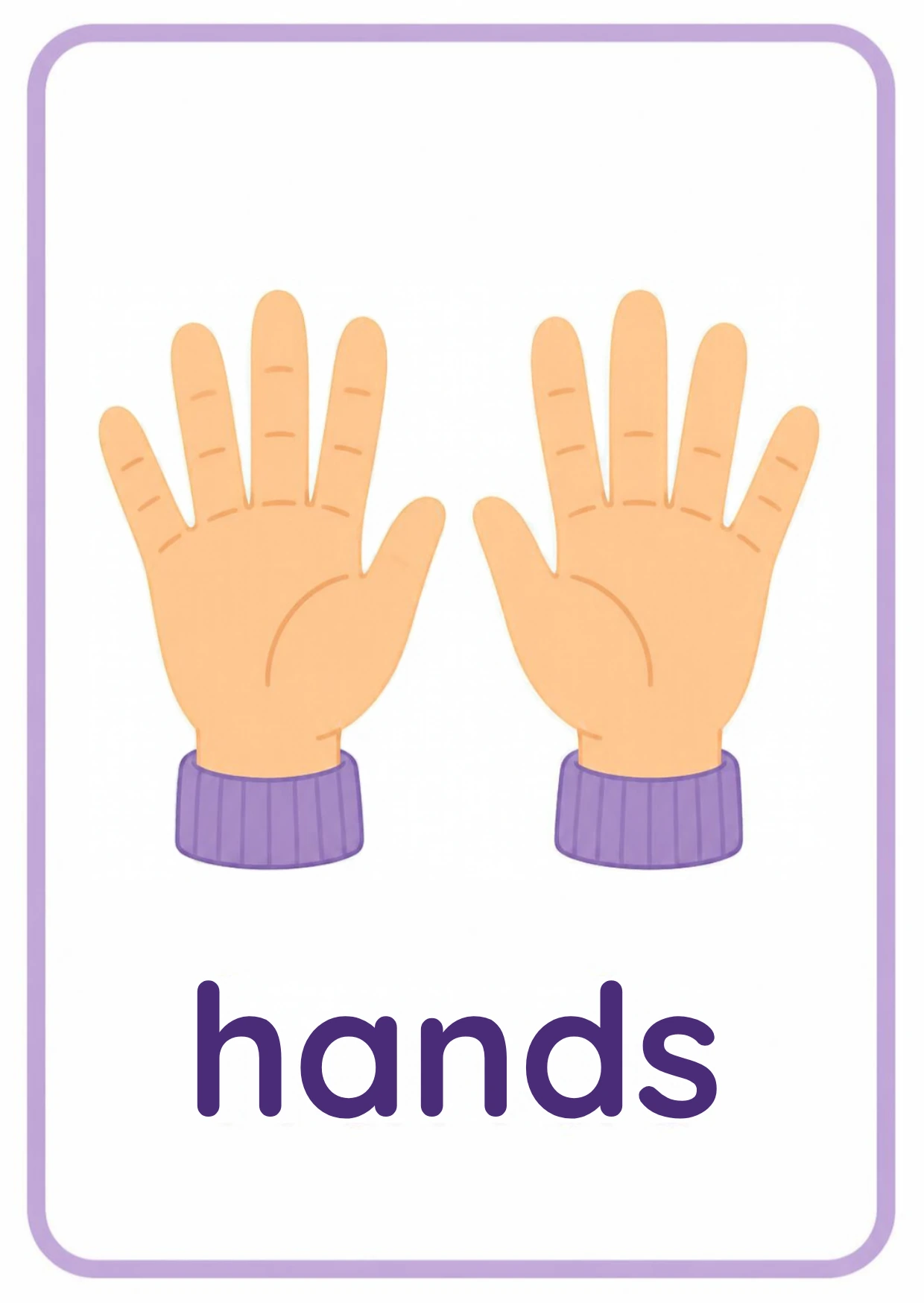
What is this?
Hands are the two grabbing parts at the ends of the arms, each with a palm and five fingers. They hold spoons and crayons, clap and wave, build towers, turn pages, stroke pets and help carry — nearly everything your child does with the world goes through the hands.
What does it mean?
Hands are the body’s main tool users — and its main touchers. Through the hands, your child learns what things feel like: smooth, bumpy, warm, soft. And hands are social too: they clap for friends, wave hello, point at wonders and reach out for comfort before any words get there.
What does the child need to know?
Your child needs to know: hands hold, clap, wave and help, each hand has five fingers, they come as a left and a right, and they need care — washed before eating and after the toilet, dried, and kept gentle with friends and pets.
Why this matters
Hand skills are the school-readiness skills: holding crayons, turning pages, managing zips and buttons. Naming the hands and celebrating their work builds both vocabulary and pride — and the washing link turns a body-part lesson into a hygiene habit with a reason attached.
What it teaches
Fine-motor vocabulary and pride, hand preference as it emerges (left or right), touch learning through the palms, hygiene habits with meaning, and the social language of clapping, waving, pointing and helping.
Words to learn
handsfingersclapwaveholdwash
Say this to your child
“"These are your hands — two busy workers! They clap, they wave, they hold your spoon and build your towers. Five fingers each, a left and a right. And hands have rules: washed before we eat, gentle with our friends, and always helping. Show me your helping hands!"”
Step by step
- Show the card: two open hands in striped sleeves, fingers spread. Count the fingers on the card, then on your child’s real hand — five each.
- Name the jobs: clap, wave, hold, point, help. Do each one together — a clap, a wave, a spoon held up, a point at the window, a toy handed over.
- Play clap-fast-clap-slow: speed the claps up, slow them down, clap high, clap low, then hide both hands behind your back — where did they go?
- Introduce left and right: hold a hand up, thumb out — the L-shape is the left. Try both ways and see which one makes the letter.
- Finish with hand care: pretend to wash — palms, backs, between the fingers — and name the moments: before eating, after the toilet, after playing outside.
Look closer at the picture
Look at the picture together: how many hands are in the picture? Are the fingers open or closed? What do the sleeves look like — stripes? What word sits between the hands?
Ask your child
"What can your hands do — name five jobs!" "How many fingers does each hand have?" "Which hand is your left one?" "When do hands need washing?"
What your child can say or do
Your child may count all ten fingers twice a day, announce which hand is the drawing hand, or offer a helping hand at every chore with the phrase attached — the workers, named and proud.
Out in the real world
Hands are named all day: wash your hands, hold my hand at the road, clap for the birthday child, gentle hands with the cat. Each daily phrase is a repetition — and each one lands better on a child who knows exactly what a hand is.
Try it together
Helping-hands mission: give your child three real jobs that only hands can do — carry the spoons to the table, fold the tea towel, post the letter in the drawer. Narrate each as hand-work: your hands carried it, your hands folded it, your hands posted it. Pride follows the naming.
Understanding check
Ask: "What do hands do? How many fingers? When do we wash them?" The job list, the five and the before-eating answer — that is the lesson landed.
Parent tips
Follow your child’s lead on left versus right — preference settles by itself around this age, and forcing it slows it down. The L-trick is enough. And let helping hands be a real job title in the family: children work brilliantly for a title they hold.
Staying safe
Hands are for gentle: hitting, grabbing and throwing-at-friends are outside their job description, and the rule is easiest to teach as what hands are for, not just what they are not. Wash before eating and after the toilet — the palm-and-back-and-between-fingers way.
This lesson pairs with the Hands flashcard in the library — print it, show it, keep it on the fridge. Back to Body Parts & Five Senses Flashcards.